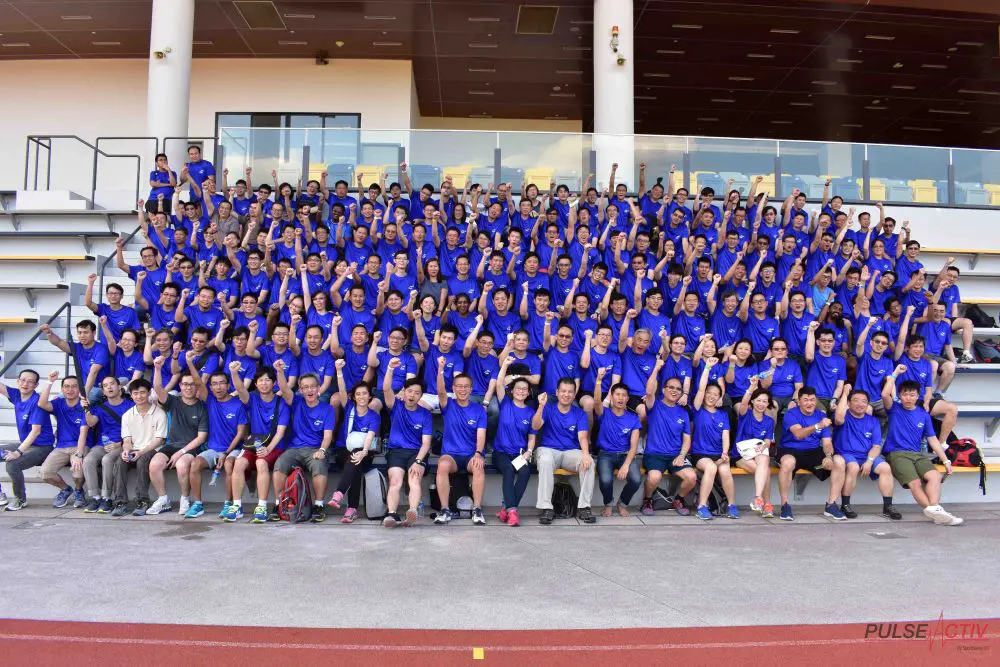
For large corporate team building events in Singapore, the formats that scale most reliably are race and station-based programmes, Olympics and Sports Day formats, indoor cluster events, and collaborative build activities. But at scale, the activity choice matters less than how the programme is designed. Sub-group structure, facilitation team size, game briefing logistics, and venue space requirements all change significantly above 100 participants, and getting any one of them wrong affects the entire group.
Having run large-scale corporate events across Singapore for over a decade, including events for groups of 500, 1,000, and upwards of 3,000 participants, we know that most issues at large-group events are not about the activity. They are about execution. This guide covers what works, how these events are structured differently from smaller gatherings, and what consistently catches even experienced event organisers off guard when they scale up.
One principle runs through all of it: at large group scale, every minute counts. One minute of unnecessary waiting for 200 participants is 200 minutes of dead time. The way a programme is designed, briefed, and run either compounds or eliminates that waste across every transition in the event.
Running a team building event for 30 people and running one for 200 people are fundamentally different undertakings. The activity may be the same. The design, logistics, facilitation resourcing, and timing structure are not.
At small group scale, informal facilitation and flexible pacing work. At large group scale, every variable needs to be planned for in advance because the cost of a single point of failure is multiplied across the whole group.
The threshold where this shift becomes significant is around 80 to 100 participants. Above that number, registration logistics, crowd briefing, game explanation, sub-group management, and venue space requirements all behave differently. Vendors who run events at this scale regularly plan for these variables as a matter of course. Vendors who mainly work with smaller groups almost always underestimate them, and it shows immediately on the day.
Pulse Amazing Race is a station-based format where teams move through a series of challenges across locations, with each station designed as a distinct team task. The structure naturally distributes participants and keeps energy high throughout.
Property Typhoon, which blends strategic decision-making with team movement across stations, also performs well at scale. We have delivered this format for groups of over 2,000 participants, and for one semiconductor client, it has been commissioned multiple times, which is the clearest indicator that the experience delivers at that scale.
For organisations wanting a technology-integrated format, Click Snap Move incorporates real-time scoring, location-based challenges, and digital coordination across large areas. The platform is web-based rather than app-based: at large group scale, onboarding participants onto a platform needs to happen in under one to two minutes. A web-based approach requires no download and no account creation, the only realistic way to onboard 200 or more participants without losing the first 20 minutes of the programme.
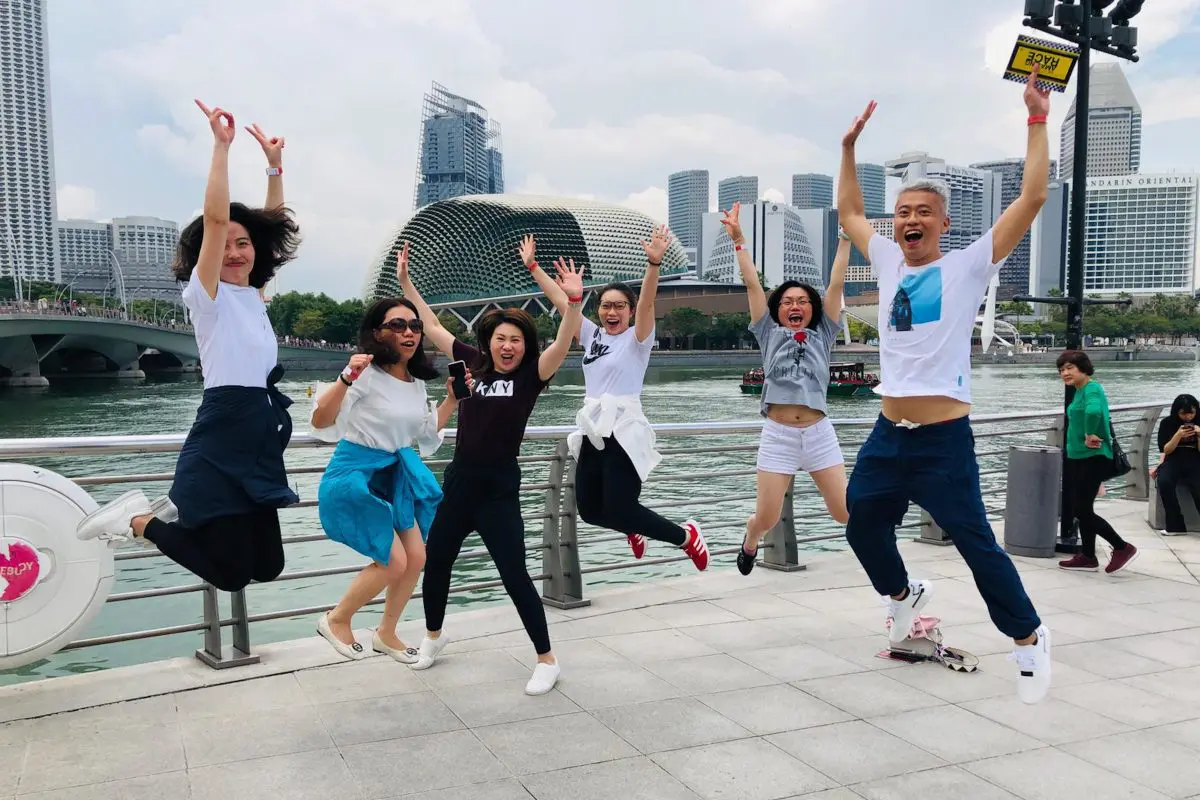
Mini Olympics and Sports Day formats are among the most popular choices for large corporate groups in Singapore. The station-based structure means participants are always active, waiting time is minimised, and energy is sustained across the full event. These formats scale effectively from 100 participants up to several hundred and accommodate mixed fitness levels because stations can be designed around team strategy rather than individual physical performance.
For very large groups, scaling up the number of stations running simultaneously is the primary lever for eliminating bottlenecks. We have delivered sports day formats for groups of 500 and above using this approach, and it consistently produces one of the highest energy-to-effort ratios of any large-group format.
Running Man is not a race format. It is a series of team-based games where everyone plays together, building collective energy through shared challenges. It works well up to around 300 participants: beyond that, the intimacy of the format starts to erode as settling teams down and transitioning between games takes progressively longer at higher headcounts.
For groups above 300, a cluster approach works better, combining collaborative elements, team-versus-team competition, and structured cross-group interaction. Wacky Wars follows a similar pattern and is likewise best adapted into cluster rotations for large groups.
Build A Dream Team scales well at large group sizes because it is inherently table-based and does not require significant floor movement. Teams work in parallel without the coordination overhead of race or station formats.
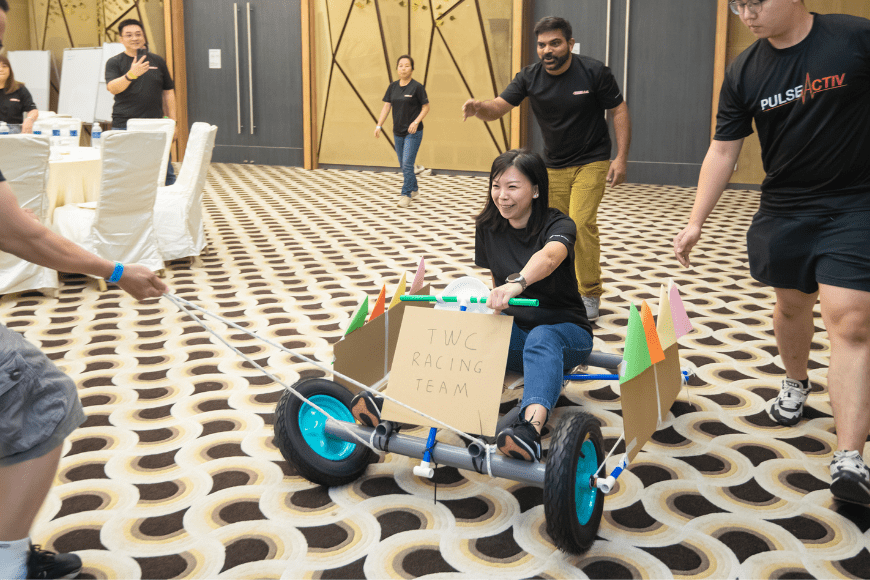
For build-based programmes such as Build A Car and DIY Coaster Adventure, the consideration at large scale is participation quality: as groups grow very large, the risk of passive participation within teams increases. These formats benefit from stronger team segmentation and clear individual role assignments when run for groups above 150 to 200 participants.
Telematch is a naturally more intense format. It is designed around community spirit rather than structured competition, with segments that pay homage to the traditional sports day format before opening into activity breakouts. Unlike conventional team building where participants play every game throughout the event, Telematch intensity means participants rotate through a selection of games rather than the full set. This is by design: asking a group to sustain high physical intensity across every station is not realistic or enjoyable.
The programme is balanced deliberately, pairing intense physical stations with lighter, less demanding ones to ensure everyone finds something that suits their participation level. Traditional team building, by contrast, is designed so that everyone plays every game. The energy arc is different: it builds gradually and is sustained through programme flow rather than physical intensity. Both formats have their place, and the choice depends on the group profile, the occasion, and what the event needs to achieve.
Large-group team building events are structured in one of three ways, and the choice between them shapes everything: participant experience, facilitation requirements, and the type of engagement the event creates.
All-together formats run the entire group through the same activity simultaneously. This works well when games are not overly intense and the collective energy of everyone participating at once is part of the experience. The limitation is timing: the gap between the first team to finish a segment and the last grows with group size, and managing that gap without killing energy requires careful programme design.
Cluster formats divide participants into sub-groups that rotate through stations in parallel. The key benefit is structured cross-team interaction: groups that would not otherwise meet during the event are brought together deliberately through the rotation. This structure also eliminates the waiting time problem, keeps everyone active, and gives facilitators manageable units to work with. It requires more coordination but consistently delivers a tighter event experience for groups above 150.
Free for All (Power of Choice) gives participants autonomy over which stations they visit and in what order. This format is particularly effective for very large groups or events where participants have different interests and fitness levels. Rather than forcing every participant through the same sequence, Power of Choice allows the event to cater to a genuinely diverse group. The facilitation challenge is ensuring that stations remain populated evenly and that the energy of the event does not fragment into isolated pockets.
For large corporate events, the facilitation team is sized and structured based on the programme, not a simple headcount ratio. The team type matters as much as the number: logistics support roles, active facilitation roles, and game-specific coordinators each serve a different function and cannot be substituted for one another.
For a 200-person event, we typically deploy 15 to 20 people. For groups of 300 and above, that number scales to 25 to 30 or more. This team includes a lead emcee managing the full group, station and cluster facilitators running the activity, a dedicated registration and logistics crew managing arrivals and flow, and a coordination lead overseeing timing and transitions.
The nature of the game also shapes how the team is deployed. Race formats require logistics coordinators tracking teams across locations. Station-based formats need a facilitator at every station simultaneously. All-together formats demand stronger emcee presence and more support facilitators managing crowd energy. There is no single formula: the facilitation team needs to be built around the programme.
At large group scale, a single point of failure in facilitation affects every participant in that cluster. Vendors who deploy teams sized for smaller events are a common source of disappointing outcomes, and one of the most frequent things we hear from clients who have had a bad experience elsewhere.
For large groups, a predictable pattern plays out at almost every event: participants are given a start time, and a significant proportion arrive in the last 10 minutes. For 200 people, this creates a concentrated registration bottleneck that delays the programme start if the check-in process has not been designed for volume. Build enough registration lanes, assign dedicated registration crew, and treat the registration window as a logistics problem, not an administrative one.
In smaller events, it is obvious when someone is missing. In a group of 200, participants know they are less visible, and some will use that. Work commitments, phone calls, and quiet exits are more common at large group scale than clients anticipate. This is worth accounting for in your confirmed headcount and in how sub-groups are structured, so that a few absences do not unbalance a team or leave a station short. For groups crossing the 100-pax mark, the operational design changes, full breakdown in our team building activities for 100 employees guide.
Briefing 200 people on game rules requires multiple communication channels working together: clear slides, a strong emcee, physical demonstrations by facilitators, and time built in for questions. Different people process information differently, and at scale there is no way to check understanding individually. The briefing that works for 30 people, where the facilitator can read the room and clarify, does not work for 200. This is one of the most underestimated time costs in large-event planning and one of the most common causes of a slow start.
Large-group team building requires substantially more floor area than a venue’s stated seating capacity suggests. Active programmes, station-based formats, and movement-heavy activities need space for participation, for facilitators to move around teams, and for transitions between segments. Clients who book based on maximum seating capacity frequently discover on the day that the venue is too tight for the programme. For large groups, always confirm the usable activity footprint against the programme requirements before booking.
Over the years, we have delivered large-group events across a wide range of formats and industries in Singapore. A few examples of what this looks like in practice:
For a semiconductor technology company, Property Typhoon was run for over 2,000 participants using a Free and Easy structure where teams moved through a self-directed choice of stations, with the number of stations scaled up to ensure no waiting. The same company has commissioned this format multiple times, the clearest indicator that the experience delivers at that scale.
For a healthcare technology organisation, engagement and facilitation programmes have been run for groups of up to 3,000 participants. At this scale, game design and facilitator deployment become the critical variables: the programme needs to be simple enough to brief at full scale and robust enough to run without breakdown across dozens of simultaneous stations.
For a major financial institution, team building programmes have been delivered for over 1,000 participants. For a leading Singapore educational institution, annual programmes have been run consistently for groups of 500 across multiple years. Repeat delivery at the same organisation is, practically speaking, the best proof of a programme that works.
We have also run nationwide race formats across multiple locations simultaneously for government bodies, covering both student and non-student groups. These events require coordination infrastructure that goes beyond a single venue: real-time scoring, logistics across dispersed teams, and facilitation teams deployed at each site.
Factor | Small Group (under 50) | Large Group (100+) |
Facilitation team | Smaller team, flexible structure | 15 to 20 for 200 pax; 25 to 30 for 300+; structured across logistics, facilitation, and game-specific roles |
Registration | Informal check-in | Dedicated crew, multiple lanes, timed window |
Game briefing | Verbal, flexible, easy to clarify | Slides, emcee, physical demo, built-in Q&A time |
Programme structure | All together, flexible pacing | Cluster rotations recommended above 150 pax |
Venue space | Standard event space | Significantly more floor area than seating capacity suggests |
Drop-out risk | Low: absences are visible | Higher: participants feel anonymous in large groups |
Cost structure | Simpler: activity + basic logistics | More components: larger facilitation team, AV, scaled equipment |
Having run events from 80 to over 3,000 participants, the gaps we see most consistently are not about the activity. They are about execution.
The most common failure point. A team sized and structured for 50 people will not hold a 200-person event together. Stations stall, transitions drag, energy drops, and there is nobody available to adapt when something does not go to plan. For 200 participants, you need 15 to 20 people in the facilitation team. For 300 and above, 25 to 30 or more. That team needs to be structured across logistics, active facilitation, and programme-specific coordination roles, not just bodies on the ground.
A programme that works well for 40 people does not automatically work for 200. The rules, rotation structure, scoring system, and briefing approach all need to be redesigned for the headcount. An activity that takes 5 minutes to explain to a small group can easily take 20 minutes to brief properly at scale. Vendors who simply run their standard programme at a higher participant count without rethinking the design will produce an event that feels slow, unpolished, and out of control.
Getting 200 people to understand the same rules at the same time is a logistics challenge, not just a communication one. It requires clear slides, a confident emcee, physical demonstrations, and enough time built in for the message to land across different learning styles. The briefing at scale is not a shorter version of the small-group explanation. It is a different problem entirely, and vendors who have not solved it produce events where a significant portion of participants spend the first activity figuring out what they are supposed to be doing.
At large group scale, the transitions between programme segments are where events lose their energy. Moving 200 people from registration to briefing, from briefing to activity, from one station to the next: each of these moments needs to be planned, not assumed. A two-minute delay at each of five transitions is ten minutes of unnecessary downtime across 200 participants. That is 2,000 minutes of wasted experience. The vendors who consistently deliver strong large-group events are the ones who have designed every handover, not just the activities themselves.
Whether you are coordinating 100 or 1,000 participants, the structure behind your event matters as much as the activity itself. Fill in our enquiry form and we will help you work through format, facilitation requirements, and venue sizing, before you commit to anything.
If you want more details on planning, read our guides about How to Choose a Team Building Vendor, Corporate Team Building Budget Guide and Choosing the Right Venue.
Contact us here to enquiry more or discuss about your event. Click here to read more articles like this.
Race and exploration formats such as Pulse Amazing Race and Property Typhoon, Olympics and Sports Day structures, and high-energy indoor cluster formats including Wacky Wars and Running Man all scale reliably for groups of 100 or more. Build A Dream Team also works well at large scale. The key is that the programme is designed for the headcount: sub-group structure, facilitation team size, and station count need to be calibrated to the group, not simply copied from a smaller-event format.
Cluster rotation structures are the most effective way to maintain engagement at large group scale. They keep all participants active simultaneously, eliminate the waiting time that builds up in all-together formats, and give facilitators manageable sub-groups to work with. Beyond structure, engagement at scale depends on the quality of the game explanation briefing, the energy of the facilitation team, and a programme flow that builds momentum rather than plateaus or drags.
For a 200-person event, plan for a facilitation team of 15 to 20 people. For 300 and above, 25 to 30 or more. The number alone does not tell the full story: the team needs to be structured across logistics, active facilitation, and game-specific coordination roles, not simply headcount. The nature of the programme determines how the team is deployed. Underfacilitating at large group scale is one of the most common reasons events fall flat.
For groups of 100 to 300, hotel ballrooms, managed event spaces, and large community facilities are common options. Above 300 participants, the venue pool narrows: you need both the floor area for active programming and the infrastructure for AV, catering, and multiple registration points. For groups above 500, purpose-built event venues, convention spaces, and large outdoor areas with shelter become the more practical options. Always confirm usable activity space rather than seated capacity.
For large corporate groups, professionally facilitated team building in Singapore typically ranges from $80 to $120 per person for a well-run mid-tier event, with premium programmes above $120 per person. Costs increase with group size due to facilitation team requirements, equipment, and logistics. For a full breakdown of what each budget tier covers, see our guide: How Much Does Team Building Cost in Singapore.