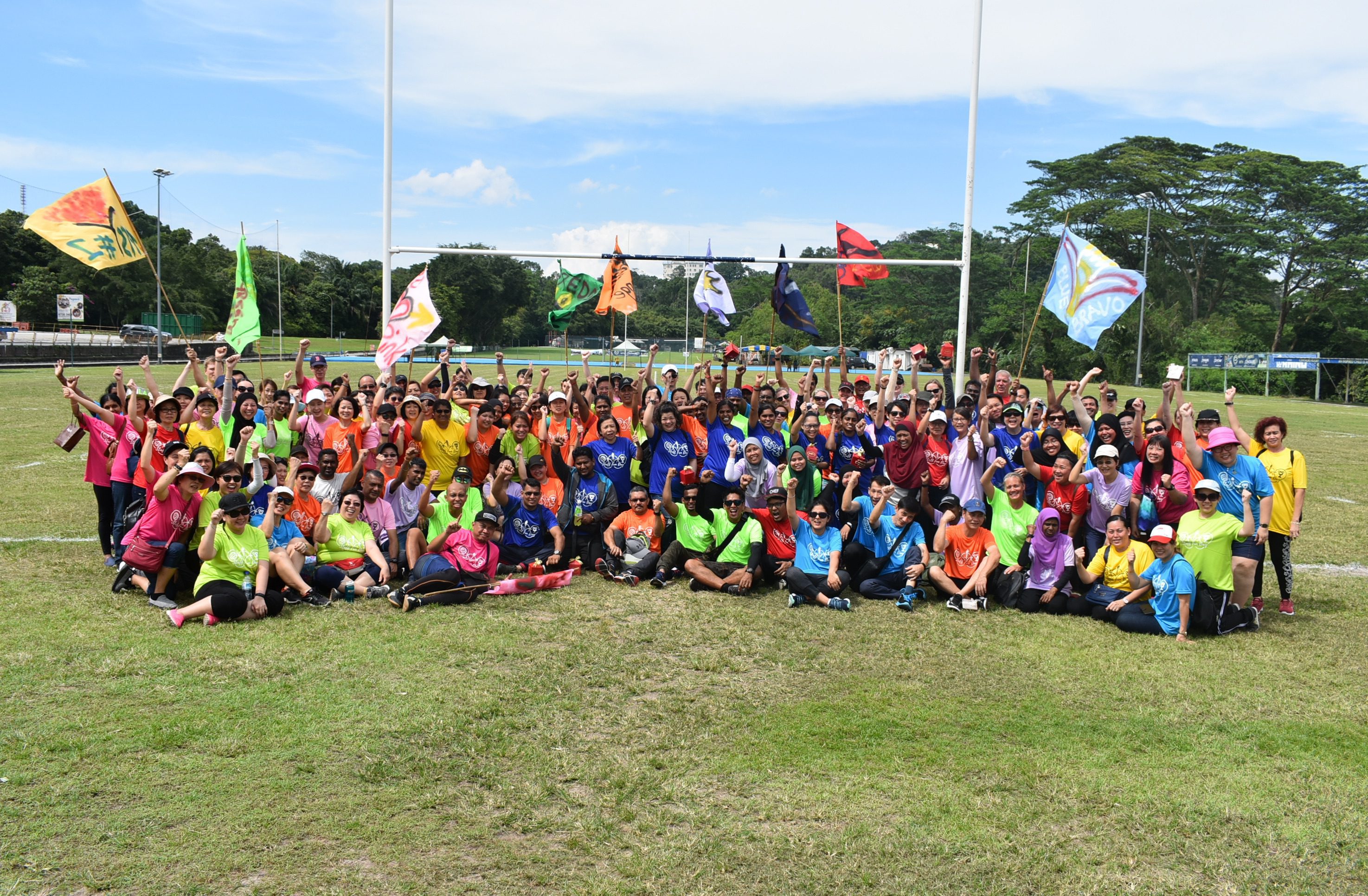
A corporate sports day in Singapore is one of the most effective formats for energising a large group, building cross-department connections, and creating a high-energy shared experience, especially for groups of 80 or more. Unlike generic team building programmes, a sports day is built around physical activity and competition, and the format you choose matters as much as the activities themselves. The right structure, competition system, and venue combination makes the difference between an event that people talk about for months and one that runs flat by round two.
We have been designing and facilitating corporate sports days in Singapore for over 10 years, including large-scale events for MNCs and multinationals at 500 participants and above. Some of our clients have made this an annual fixture. The programme structures and activity recommendations below come from what actually works at scale.
Corporate sports days in Singapore generally fall into two distinct categories: the Traditional Sports Day, where real sports and athletic challenges are the focus, and the Running Man-style approach, where the emphasis is on missions, chases, and game-show energy rather than straight athletic competition. Both can be run at large scale, but they attract different types of groups and deliver different energy.
Most organisations planning a corporate sports day are thinking of the traditional format, which itself has several structural variations depending on how competitive they want the event to be, how mixed their group is, and what they want people to walk away feeling.
Mini Olympics is one of the most popular large-group corporate sports day formats in Singapore, and a format we have refined significantly over years of delivery for groups of 100 to 500 participants. The programme runs across three clearly defined segments. Segment 1 is the Telematch opener, where all teams compete simultaneously in relay and cooperation challenges that get everyone moving from the first minute. Segment 2 is the Sports Breakout, where teams rotate through a range of sports stations competing for points across multiple disciplines. Segment 3 is the Finale, a high-energy closing segment, often anchored by a direct head-to-head challenge such as Tug of War, that brings cumulative scores together for a dramatic conclusion.
Safety is a priority in the Mini Olympics design. Activities are selected and structured to ensure that physical contact is controlled, rules are clearly briefed, and facilitation is active throughout. For large groups in particular, having a professional facilitation team managing station flow, timing, and participant safety is not optional.
For groups that want a more straightforward sports competition, the event can be structured as a pure sports day where teams play against each other directly across one or more sports. The competition structure you choose here significantly affects how the day feels.
Round Robin is the most commonly recommended competition structure for corporate groups. Every team plays against every other team, which means more game time for each team and a more inclusive experience where no one is eliminated early and sidelined. It rewards consistent performance rather than a single good run, which tends to suit mixed corporate groups better than straight elimination.
Elimination formats, where losing teams exit and winners progress, create sharper tension and a more dramatic finale but at the cost of participation time for teams that lose early. This works well for groups with a genuinely competitive culture that can handle being knocked out in good humour.
Double Elimination gives teams two losses before they exit, which increases game time before elimination but adds significant scheduling complexity. It is rarely recommended for corporate events because the logistics of managing brackets for large groups outweigh the benefit.
Whichever structure is used, the Finale should be a high-energy standalone moment for everyone in the room, not just the finalists. Tug of War is the most popular Finale choice because it is fast, visually dramatic, and everyone in the group can participate or spectate with equal investment.
When the direction from a client is fun participation rather than competition, the sports day can be run as a station rotation format. Teams move through a series of sports stations and get to try different activities without a competitive scoring system attached. The focus is on trying sports they may never have played before, enjoying the physical activity, and mixing with colleagues in a low-pressure environment.
This format works particularly well for groups with a wide range of physical abilities, groups where the demographics are mixed across age and seniority, or clients who specifically want an inclusive, relaxed event rather than a high-competition programme. It also gives more flexibility in activity selection since the pressure of competitive scoring is removed.
Here is a quick comparison of the three main competition structures used in corporate sports days.
Format | How It Works | What It Feels Like | Best For |
Round Robin | Each team plays every other team | More game time per team; more inclusive feel | Best for groups where participation and enjoyment matter more than a sharp competitive edge |
Elimination | Losers exit; winners progress | Creates strong tension as the day progresses | Works well when the group has a genuinely competitive culture |
Double Elimination | Two losses before elimination | More game time before exit | Rarely recommended; adds scheduling complexity for limited benefit |
The sports you include depend on the group, the venue, and how physically demanding you want the programme to be. These are the most frequently used options.
Sport | Contact Level | Venue Requirement | Notes |
Tug of War | Non-contact | Sports hall or outdoor | Classic finale activity; high energy, universal appeal |
Dodgeball | Contact | Sports hall required | Needs ceiling height and clear floor; high energy |
Captain’s Ball | Contact | Sports hall or outdoor | Team passing game; easier than dodgeball for mixed groups |
Archery | Non-contact | Indoor or outdoor | Inclusive, accessible for all fitness levels; traditional option |
Human Foosball | Non-contact | Large indoor space | Unique, high fun factor; works well as a standalone station |
Not every sports day needs to be contact-heavy. Traditional archery is one of the most consistently popular choices for groups with mixed physical abilities because it is accessible, requires skill and focus rather than athleticism, and is genuinely enjoyable for participants who would not normally engage well with high-contact sports.
Human Foosball is worth highlighting as a unique station option for groups that want something more playful. Participants are connected in lines on a large inflatable field and play foosball with a real ball, mimicking the table game at human scale. It generates a lot of energy and works well as a standalone highlight station.
For groups that want the energy of a sports day without the structure of a traditional athletics format, Running Man and Wacky Wars offer different approaches.
Running Man is a chase-based elimination game where teams compete across a series of missions and physical chases across a defined venue space. It combines the physical energy of a sports day with the narrative tension of a game show format, and works best for groups that enjoy something less conventional. It runs well for groups of 80 to 300.
Wacky Wars takes sports and approaches them differently. Rather than straightforward athletic competition, Wacky Wars introduces modified rules, unexpected formats, and head-to-head challenge structures that level the playing field between athletic and non-athletic participants. It is a genuinely competitive programme that maintains high energy throughout and accommodates groups of up to 300 participants.
Use this to help narrow down which direction is right for your group.
Format | Group Size | Duration | Energy Style | Best For |
Mini Olympics | 80 to 500 | 3 to 4 hrs | High, structured | Annual events, large flagship sports days |
Sports Competition | 50 to 300 | 2.5 to 4 hrs | High, competitive | Groups who want real sport competition |
Station Rotation | 50 to 300 | 2 to 3 hrs | Fun, relaxed | Fun-first events, mixed demographics |
Running Man | 80 to 300 | 2.5 to 4 hrs | High, chase and missions | Groups wanting something unconventional |
Wacky Wars | 80 to 300 | 2.5 to 3.5 hrs | High, head-to-head | Groups wanting genuine competitive rivalry |
The age range, fitness level, and cultural mix of your group should drive the format and activity selection. A group of 25-to-35-year-olds in a technology company will respond differently from a cross-generational group spanning new hires to senior management. Station Rotation and Mini Olympics tend to be the most inclusive across wide demographic spreads. High-contact sports work better for younger, more physically active groups.
Are you trying to build competitive energy, celebrate the year, break down silos between departments, or simply give people a day out? The answer shapes both the format and the competition structure. A year-end celebration calls for high energy and broad participation. A new team integration event calls for formats where mixing between departments is built into the programme mechanics.
The activities you choose determine the venue you need, and this decision also affects your F&B options. Ball-throwing sports such as Dodgeball require a proper sports hall with adequate ceiling height and clear floor area. Outdoor fields and resort lawns are suitable for lower-contact activities and telematch formats.
An important consideration that is often missed: some sports halls do not allow food and beverages on the floor. If your programme includes a meal or catering component, confirm with the venue before finalising both the activity list and the event flow. OCBC Arena and dedicated sports halls are excellent choices for high-energy large-group events, but the F&B policy differs between venues and must be checked early in the planning process.
As a general rule: if your sports day involves ball sports with throwing or physical contact, book a sports hall. If the activities are relay-based or station-based without ball play, a wider range of indoor spaces becomes available.
A facilitated corporate sports day in Singapore typically ranges from $80 to $130 per participant depending on group size, format, and scope. Larger groups of 300 or more tend to come in at the lower end of that range as fixed programme costs are spread across more participants. Groups of 80 to 150 sit closer to the upper end.
Venue hire, catering, and custom production elements such as team jerseys or printed equipment are typically scoped separately. When comparing quotations, check what is included in the per-pax rate. A professionally facilitated sports day with equipment, safety briefings, scoring systems, a competition structure, and a prize ceremony is not directly comparable to a DIY rental package. The facilitation team is what keeps the programme running on time, at the right energy level, and safely throughout.
A corporate sports day is one of the formats where experience in format design and on-the-ground facilitation makes the biggest difference. We have helped organisations across Singapore build their annual sports day from scratch, refine an existing format that was not landing, and scale up to events of 500 participants and above.
If you are planning a sports day and want guidance on format, venue, activity selection, or budget benchmarks, use the enquiry form to get in touch. We will respond within one business day.
If you want to know more about these activities from PulseActiv, click here.
Contact us here to learn more about these activities.
Click here to read more articles like this.
A corporate sports day can include relay challenges, direct sports competition (Dodgeball, Captain’s Ball, Tug of War, Archery, Human Foosball), cooperative team tasks, and a high-energy finale segment. The format, competition structure (Round Robin, Elimination, or station rotation), and specific sports depend on the group’s demographics, the venue, and how competitive the client wants the event to be.
Mini Olympics is a structured three-segment programme (Telematch, Sports Breakout, Finale) designed for large groups of 80 to 500. It combines multiple sports and challenge types within a single programme arc rather than focusing on one sport. A regular corporate sports day might be structured as a round robin or elimination competition in a specific sport such as Dodgeball or Captain’s Ball, or as a station rotation where teams try different sports without a competition structure. Mini Olympics typically delivers more sustained energy for larger groups because the three-part structure prevents the flat spots that occur in single-sport formats.
Activity selection and competition structure both matter. Round Robin keeps everyone playing more games rather than eliminating teams early. Station Rotation removes competitive pressure entirely. Non-contact sports such as Archery and Human Foosball reward focus and coordination rather than athleticism. Mini Olympics mixes physical and strategic elements across its three segments so that no single skill type dominates. Where employees have specific physical considerations, the facilitation team adjusts participation roles rather than sidelining individuals.
Venue choice depends on the sports involved. Ball sports with throwing, such as Dodgeball, require a proper sports hall with adequate ceiling height and clear floor space. OCBC Arena and dedicated sports halls are strong choices for high-energy large-group events. Note that some sports halls do not permit food and beverages on the floor, so if your event includes catering, confirm the F&B policy before booking. For relay-based or station-rotation formats without ball play, a wider range of indoor spaces including hotel ballrooms and convention floors is available.
Facilitated corporate sports days in Singapore typically range from $80 to $130 per person. Group size is the primary driver: groups of 300 or more tend to come in at $80 to $100 per person, while groups of 80 to 150 sit between $100 and $130. These figures cover facilitation, equipment, and programme management. Venue hire and catering are typically scoped separately.
A half-day format of three to four hours is the most practical choice for most corporate groups and delivers a complete competitive experience including briefing, multiple rounds, scoring, and a prize ceremony. Full-day formats of six to eight hours work best when the sports day is the entire event rather than a component within a larger programme. The most common mistake is trying to run a full sports competition in under three hours: the result is rushed rounds, incomplete scoring, and a flat finale.