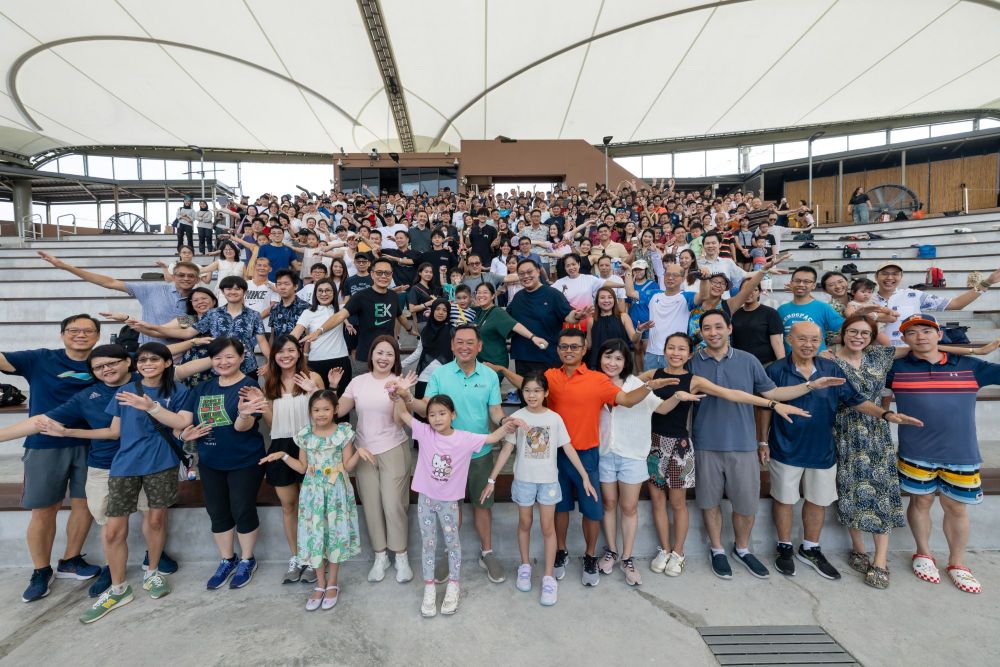
Corporate team building in Singapore for large groups (events of 80 to 300 or more participants) typically costs between $80 and $200 per person. For organisations planning at this scale, understanding where that budget goes, and how to allocate it effectively, matters far more than simply finding the lowest per-pax rate.
This guide is written for HR managers, event organisers, and department heads planning large-scale corporate team building events. The cost dynamics, logistics, and trade-offs at 80 or more participants are fundamentally different from smaller informal gatherings, and budget decisions made early have a disproportionate impact on the final experience.
Before getting into tiers, it helps to understand what you are actually budgeting for. At scale, the cost covers a professional facilitation team, a fully designed programme, venue, catering, prizes, door gifts, and all the logistics that hold a large-group event together. When any of these is underbudgeted, participants feel it, even if they cannot name exactly what was missing.
Most large corporate team building events in Singapore sit within three ranges:
Under $60 per pax is possible, but it comes with real trade-offs. At this budget you are typically looking at a venue that is further from the city, has fewer facilities, or is a bare space without furniture and AV included. Food usually gets reduced to a tea break, or removed entirely. The programme stays, but the surrounding experience carries the compromise throughout.
$80 to $120 per pax is where most professionally run large corporate events in Singapore land. At this range, there is enough to invest meaningfully across all components: a good venue, proper catering, a professional facilitation team, prizes that create genuine energy, and door gifts that land well. This is also the range where optimisation becomes possible without having to sacrifice one element for another.
Above $120 per pax, the experience can be elevated significantly: premium venues, live food stations, higher facilitator ratios, full programme customisation, and branded elements. This tier suits organisations where the event needs to clearly reflect the company’s brand and culture, or where the group’s profile demands higher-end execution.
One of the most common misconceptions in team building budgeting is the assumption that a higher budget unlocks better or more sophisticated activities. At PulseActiv, that is not how it works.
Our pricing is based on programme duration, not on which activity is chosen. This means the full range of programmes is accessible regardless of budget level:
What your budget determines is not which activity you can afford: the quality of the execution surrounding it. Venue, catering, prize structure, production quality, and facilitator experience are what change across budget tiers. The activity itself remains the engine of the experience at every level.
One practical note: some programmes, such as Wacky Wars, require a larger venue footprint than standard because of the scale of the games involved. If this is a consideration, your venue budget needs to account for it.
Running team building for 100 to 300 people is operationally complex. A professional facilitation team for a group of 80 to 100 typically comprises 8 to 10 people: a lead emcee, support facilitators, station managers, registration crew, and logistics support. Props, scoring systems, PA setups, and contingency materials all scale with group size.
Events that cut corners on facilitator numbers or equipment at scale almost always show it on the day, and at 100 participants, a single point of failure affects everyone.
For large groups, venue selection is one of the highest-stakes planning decisions, and the most common source of budget surprises. A space that looks affordable can become considerably more expensive once the provisions are read carefully.
Key things to confirm before signing:
A venue that includes everything (furniture, AV, open catering, central location) sits at the higher end of the rental range. A bare space requires each item to be sourced and budgeted for separately. Both can work. What matters is knowing which you have before the budget is set.
At scale, food is one of the most visible elements of the event. Participants notice it, and they will talk about it. Basic catering works for tight budgets. As the budget allows, the experience can be meaningfully upgraded:
Prizes have an outsized effect on energy and motivation throughout a large-group event. A practical rule of thumb: allocate prizes for approximately 30 to 40 percent of participants. This creates sufficient competitive motivation without leaving the majority feeling they had no chance.
How prizes are presented matters as much as what they are. Public recognition during a proper finale, in front of the whole group, lands far more effectively than items handed out quietly at the end. Do not scrimp here. Participants notice, and it directly affects how the event is remembered.
Door gifts are a finishing touch that is easy to overlook in a large-event budget. A well-chosen gift (practical, branded, or tied to the event theme) gives every participant something tangible from the day.
Budget for door gifts separately from prizes. When they share the same line, one tends to get cut when costs tighten, usually the wrong one.
The most common large-event budgeting mistake is putting too much into a single line item, usually venue or catering, and leaving too little for everything else.
Beyond a certain spend level, the returns on any individual component diminish quickly. For a group of 100 or more, not everyone will appreciate or even notice a significant catering upgrade. What the entire group will notice is a poorly facilitated programme, weak prizes, or an AV system that fails during the finale.
The goal is not to maximise any single element. The goal is optimisation: allocating budget in a way that maximises both perceived and actual value across the whole event. A $100 per pax event where every dollar is working outperforms a $150 one where $40 was misallocated.
Budget conversations that happen after a venue is booked and an activity is shortlisted leave very little room to manoeuvre. At large-group scale, small per-pax differences become significant sums: $10 per person across 200 participants is $2,000. Teams that set the total budget first and allocate deliberately across components have far more control over the outcome.
Plan the budget before the programme. Not the other way around.
Large-event budgets are easier to approve when they:
When evaluating team building vendors, the price in a quote tells you very little on its own. Two quotes at the same per-pax rate can represent very different levels of experience, manpower, and execution quality. Two quotes at different rates can deliver the same outcome.
Before deciding based on price, ask:
The conclusion is not that cheaper is worse or that more expensive is better. Price without context tells you very little. What matters is whether the vendor understands large-group events, has the right team size and equipment, and is transparent about what is included. A lower rate from a vendor who delivers all of that is good value. A higher rate without substance is not. Ultimately, it comes down to what you value and whether the activity they offer is the right fit for your group.
For large-group events, a detailed brief produces far more accurate and comparable quotes:
What is the typical cost of team building for large groups in Singapore?
For large-scale corporate team building events of 80 or more participants, costs typically range from $80 to $120 per person for a professionally facilitated mid-tier event, and $120 or above for premium, fully customised experiences. Events under $60 per person at this scale require trade-offs across venue quality, food, and prizes.
Does the activity type affect the price?
At PulseActiv, pricing is based on programme duration rather than which activity is chosen. This means the full range of programmes, from Amazing Race and Mini Olympics to CSI Mystery, Wacky Wars, and Build A Dream Team, is available across budget levels. What changes with budget is the quality of the surrounding execution: venue, catering, prizes, and production value.
What hidden costs should I watch out for?
The most common hidden costs are venue-related: setup and teardown charges, tables and chairs not included in the rental, AV and PA top-ups, restricted catering arrangements, and transport for non-central venues. For outdoor events, permits may also be required. Read every contract carefully and ask vendors to confirm exactly what is included.
Is a cheaper vendor always worse?
Not necessarily. Price alone tells you very little. What matters is what is behind the number: the facilitator team size, equipment quality, experience with large groups, and what is actually included in the package. Evaluate vendors on these criteria, not on price alone.
How should a large-event team building budget be allocated?
Avoid spending more than 50 percent of the total budget on venue alone. Distribute meaningfully across programme and facilitation, food, prizes for approximately 30 to 40 percent of participants, and door gifts. The goal is optimisation, maximising both perceived and actual value across the whole event, not maximising any single component.
How do I justify a large team building budget to management?
Present cost per person rather than a lump sum, connect the event to a specific business objective, show that multiple vendors were compared, and include a simple plan to measure outcomes. Stakeholders respond better when team building is framed as a purposeful investment.
Does spending more always produce a better event?
Not beyond a certain point per component. For groups of 100 or more, returns on individual items diminish. What the whole group notices is facilitation quality, programme flow, and prizes, not whether the catering was premium. Optimise across all components rather than maximising any single one.
If you want to know more about these activities from PulseActiv, click here.
Contact us here to learn more about these activities.
Click here to read more articles like this.