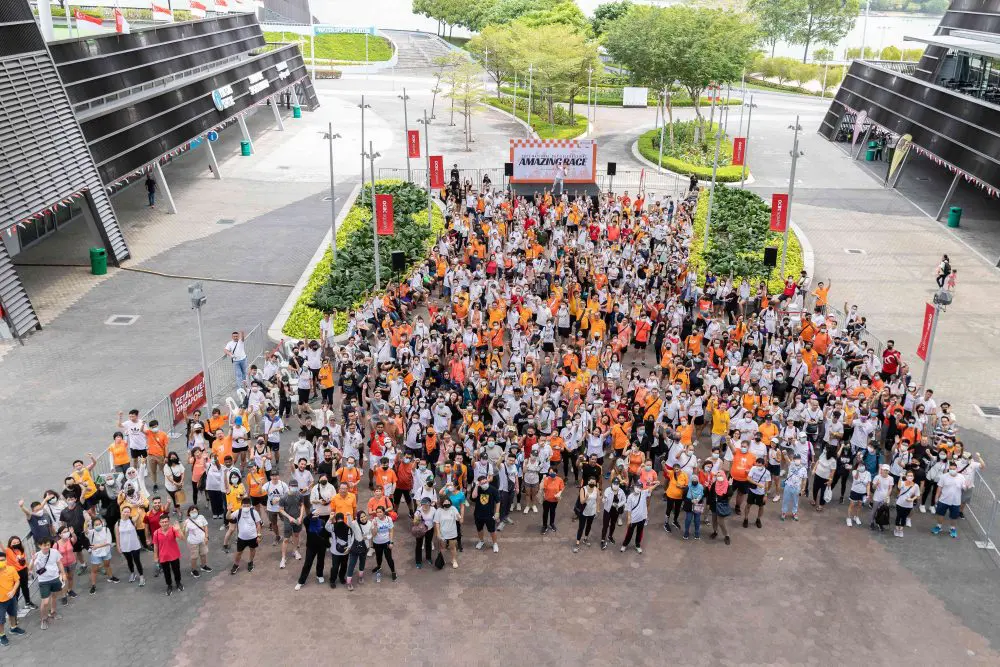
The first question to ask when choosing a team building activity is: how many people? Group size determines which formats are practical, how the facilitation team needs to be structured, and what the venue must support. Everything else, energy level, indoor or outdoor, competitive versus collaborative, follows from there.
For most corporate groups with no strong preference, Running Man is the default starting recommendation. It is high-energy, accessible to almost every group profile, and consistently delivers engagement across different team sizes and company cultures. After 10 years and over 3,000 events, it is the format we reach for first when a client gives us a short brief and a typical corporate group.
That said, one format does not fit every situation. This guide walks through how to think about the decision — starting with group size, then working through the other variables that shape which format will actually land.
Group size is the primary filter. It determines which formats are logistically viable, how the programme needs to be structured, and how the facilitation team is sized and deployed.
Group Size | What This Changes | Formats That Work Well |
Under 30 | Almost any format is viable. Smaller groups suit more intimate and interactive formats. | Running Man, Makan Kakis, Build A Dream Team, Wacky Wars, CSI Mystery |
30 to 80 | The sweet spot for most programmes. Full range of formats available. | Running Man, Wacky Wars, Amazing Race, Mini Olympics, Build A Dream Team, Property Typhoon |
80 to 150 | Cluster rotations start to add real value. Briefing logistics become more important. | Amazing Race, Sports Day, Mini Olympics, Running Man (adapted), Property Typhoon |
150 to 300 | Station-based and cluster formats are the default. Facilitation team size matters significantly. | Property Typhoon, Amazing Race, Sports Day, Wacky Wars (rotation) |
300+ | Programme design and facilitation deployment become the critical variables. Self-directed formats work best at very large scale. | Large-scale Amazing Race (Free and Easy), Sports Day, Property Typhoon |
Once you know the group size, the second question is what the event needs to do. Most corporate team building falls into one of three categories:
The team has reached a milestone, come through a demanding period, or the event is an annual cohesion celebration. The priority is a fun, memorable, high-energy shared experience. Competitive and movement-based formats work best here: Running Man, Wacky Wars, Pulse Amazing Race, Mini Olympics, Sports Day.
Participants may not know each other well; recent hires, cross-department groups, or teams that rarely interact. The goal is natural interaction and connection. Formats with structured team mixing and natural conversation built in work best: Build A Dream Team, Property Typhoon, Makan Kakis, Station-based races where teams rotate and encounter different groups.
The group needs to work together; communication, coordination, and collective problem solving are the actual objectives. Formats where the activity itself demands teamwork: Build A Car, DIY Coaster Adventure, Chain Reaction. Worth noting: these formats work well when the group profile is right, but they require participants who are genuinely engaged in the task. For groups that need higher energy to stay switched on, a competitive format with collaborative elements embedded will deliver better results.
The group profile shapes which formats will land and which will not. This is where the decision gets nuanced.
For a standard corporate group with mixed roles, seniority levels, and varying comfort with physical activity, the goal is a format that creates equal participation points for everyone. Running Man, Wacky Wars, and station-based formats all work well here because the structure of the programme creates clear roles, nobody is left deciding how much to participate.
Senior groups often have lower tolerance for formats that feel lightweight or purely fun. The activity needs some substance; a layer of strategy, decision-making, or a challenge worth solving. Property Typhoon, structured race formats with decision elements, and formats with a clear competitive arc tend to work well. Formats that rely on participants being willing to be silly or physically competitive are a higher risk with this group.
New team members, cross-department cohorts, or groups brought together from different offices need formats that break awkwardness without demanding too much too soon. Build A Dream Team and Property Typhoon are strong choices: structured enough that participation does not require existing chemistry, but interactive enough to create real connection. High-energy elimination-style formats can work once energy builds, but they need more warm-up for groups that are meeting for the first time.
In Singapore, this decision is more consequential than it looks. Heat, humidity, and unpredictable rain are not minor inconveniences, they actively affect participant energy and experience, usually within the first 30 minutes outdoors.
For groups above 100 participants, indoor is the more reliable default. The combination of scale and weather risk makes outdoor delivery harder to manage without meaningful contingency planning. For smaller groups, outdoor is viable, with the right timing and a clear backup plan.
The most manageable outdoor window is February to April. The highest-risk period is November to January (monsoon season). June to September is peak heat.
The assumption that indoor means lower energy or less engaging is wrong. High-energy indoor formats, Running Man, Squid Game Team Building, Wacky Wars, Mini Olympics adapted indoors, deliver the same competitive feel as outdoor events, in an air-conditioned environment. Engagement is driven by programme design and facilitation, not by whether the sun is out.
Duration determines how much the activity can deliver and how the programme should be structured.
2 to 3 hours works for a focused, single-format programme with a proper opening, activity run, and closing ceremony. This is the minimum time needed for the programme to build energy and feel complete rather than rushed.
A half-day (3.5 to 4 hours) is the most effective format for corporate team building in Singapore. It allows for a warm-up game, the main activity, and a proper finale with prizes and recognition. This is the duration that gives the facilitation team room to build energy properly and where the event feels like an event, not just an activity.
A full day allows for multiple activity segments, a meal break, and a more layered programme. Best suited to annual events, retreats, or milestone celebrations where the team building is the centrepiece of the day rather than a component of it.
A series of team-based games played together as a full group, building collective energy through shared challenges. The most consistently recommended format for first-time corporate clients. Works across almost every group profile and delivers high engagement without requiring participants to be particularly sporty or outgoing. Best for groups of 30 to 300; adaptable to cluster rotations above that.
A station-based race where teams move through challenges across locations. Naturally distributes participants, keeps energy sustained throughout, and works well when the venue has multiple spaces to use. Strong choice for groups that want movement and variety. Scales from 30 to 2,000+ participants with the right design.
High-energy team-versus-team games with direct competitive structure. Works well for groups that enjoy active competition and are comfortable committing. A step up in physical energy from Running Man, best for groups that already have some chemistry or are open to high-energy formats from the start.
Station-based format where teams rotate through physical challenges, accumulating points across the event. Accommodates mixed fitness levels when stations are designed around team strategy as much as individual performance. One of the most popular formats for large corporate groups in Singapore, scales from 80 to several hundred participants.
A strategic format combining decision-making, negotiation, and team movement across stations. More depth than pure physical formats; participants are thinking as well as moving. Works well across mixed seniority groups and corporate environments where purely high-energy games would feel out of place. Scales reliably to very large groups.
A structured, table-based activity combining strategy and team interaction. Inclusive regardless of fitness level or seniority. A strong default for diverse groups where equal participation is a priority. Works well when the goal is genuine cross-team connection rather than competition.
Collaborative build activities where teams work together toward a shared physical outcome. These formats work well when the group profile supports them: participants who are genuinely engaged in problem-solving and comfortable with a slower-paced, hands-on challenge. For groups that need energy and movement to stay engaged, a competitive format will typically deliver better results. Build-based activities are best paired with active warm-up games when energy needs to be established first.
A problem-solving format where teams work through a simulated investigation, piecing together clues and coordinating information. Works particularly well for analytical groups, leadership teams, or events where mental engagement is the explicit priority. Not the right choice for groups looking primarily for energy and fun; the format requires genuine engagement with the puzzle to land well.
PulseActiv’s culinary team building programme. The most relaxed and social format in the range. Works well when the objective is connection over a shared experience, or as part of a longer event that needs a lower-energy segment. Best for groups of 20 to 80.
If this is your situation… | Start here |
First-time client, short brief, standard corporate group | Running Man |
Large group (150+), need everything to run smoothly | Amazing Race or Sports Day format |
Mixed seniority, need equal participation for everyone | Build A Dream Team or Property Typhoon |
Group that wants to compete hard | Wacky Wars or Mini Olympics |
Cross-department mixing, participants don’t know each other | Property Typhoon or Build A Dream Team |
Leadership team, needs some substance | Property Typhoon or structured race with decision elements |
Relaxed bonding, lower energy needed | Makan Kakis or Build A Dream Team |
Problem-solving as the explicit objective | CSI Mystery (right group only) or Property Typhoon |
Tell us your group size, rough date, and what the event is for and we will give you a direct recommendation. We have run over 3,000 events across Singapore and can usually narrow it down within one conversation. Fill in our enquiry form to get started.
If you want to read more, here are more articles from us about Corporate Team Building Budget Guide, How to Plan a Corporate Team Building Event in Singapore.
Contact us here to enquiry more. Click here to read more articles like this.
Running Man is consistently one of the most popular and widely recommended formats for corporate groups in Singapore. It is high-energy, accessible to almost every group profile, and works across a wide range of group sizes. For larger groups of 150 or more, Pulse Amazing Race and Sports Day formats are also among the most frequently requested.
Repeat groups need something that feels genuinely different rather than a variation of what they have already done. Squid Game Team Building, Click Snap Move (technology-integrated race format), and Chain Reaction tend to work well for clients with an established team building history. The format itself should feel new, not just a refreshed version of the same programme.
Build A Dream Team and Property Typhoon both work well across seniority levels because they create structured participation points that do not depend on physical confidence or existing relationships. Avoid formats that rely on willingness to be physically competitive or silly; these tend to create visible stratification in mixed seniority groups.
Competitive formats produce more energy and excitement but require participants to be open and willing to commit. Collaborative formats produce more meaningful interaction across diverse groups and carry less risk of anyone feeling sidelined. For most corporate groups, a programme that combines both, competitive structure with moments of genuine collaboration built in, delivers the best outcome. Station-based formats like Amazing Race and Property Typhoon naturally include this combination.
A half-day (3.5 to 4 hours) is the most effective format for corporate team building. It allows for a warm-up, the main activity, and a proper closing ceremony; enough time for energy to build and the event to feel complete. Two to three hours works for focused programmes but leaves less room for the event to develop momentum. Full-day formats are best for annual events or retreats where team building is the centrepiece of the day.