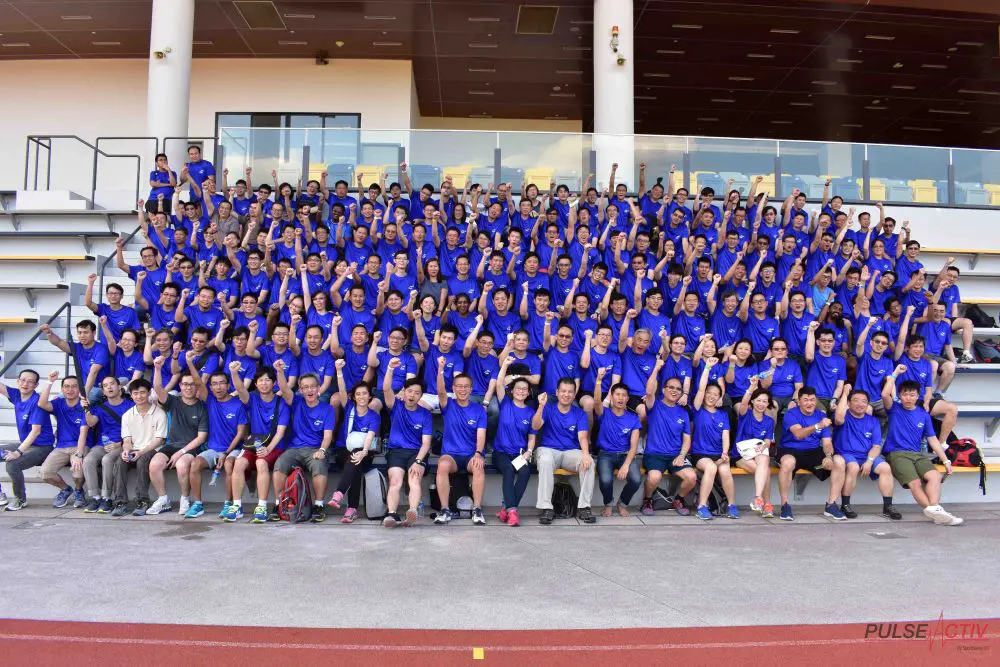
Race-style team building in Singapore comes in three operational format, sequential, free-for-all physical, and free-for-all digital and four PulseActiv programmes that map onto them: Amazing Race, Property Typhoon, Click Snap Move and Makan Kakis. The right choice isn’t the one that sounds most exciting in a proposal. It’s the format that holds up against your actual group size, demographics, venue and weather plan.
Having designed and delivered race routes across Singapore for more than a decade, from city tracks to Sentosa, Gardens by the Bay and island-wide formats, what we see consistently is this: the activity name is a small part of the decision. The bigger variables are operational. Route logic, station throughput, finishing-rate planning, briefing structure at scale, and the wet weather protocol all matter more than which race brand sits on the proposal. This guide walks through the four formats, the trade-offs that actually matter, and the planning rules we use to decide which one fits a given event.
Before comparing specific programmes, it helps to understand the three formats underneath them. A race can have any theme layered on top; travel, mystery, food, heritage, strategy, photo missions, company values. Operationally, every race we run falls into one of three formats.
Sequential is the format most people imagine when they hear “Amazing Race”. Teams start at one point, complete a challenge, receive the next clue, then move to the next station. They don’t know the full route from the start. The experience is built around discovery and progression.
It works when the group is small to mid-sized and the client wants the race to feel like a journey. Everyone moves through the same route, the flow is easier to control, and the event has a structured story arc. The limitation is scale. Above 300 pax, sequential starts to lose its element: teams converge at stations, waiting time increases, and the surprise softens. Fast passes, detours and bonus choices can add some power of choice on top, but the backbone stays fixed.
Each team receives a physical raceboard showing every station, point value and location. Teams choose their own route and submit the raceboard for tallying at the end. The mechanic is strategy: do you go for the nearest stations, or take the risk and travel further for higher points? Do you spread across easy stations, or focus on the high-value ones?
For large groups and mixed-age cohorts, this is usually the most scalable format. No early-finish gap. No team sitting around for 30 minutes because they happened to be faster. Everyone plays through the full window.
Digital races work the same way as physical free-for-all, but the raceboard becomes a web-based platform. Photo missions, video missions, GPS checkpoints, quiz challenges, virtual tasks; all submitted live with scoring updates visible to the room.
A practical note from our delivery experience: we moved off app-based platforms to web-based HTML for one reason. App downloads create friction. Not everyone wants to install a one-day app, and onboarding 100+ participants through downloads burns the first 20 minutes of the programme. Web-based platforms work off a QR scan; no install, no account creation, teams are playing within seconds. This is the difference between a digital race that flows and one that starts behind.
Four programmes, mapped onto those three formats. The differences below are about when each fits, not which is best because the right one depends entirely on the event.
Amazing Race is our classic sequential format. Teams move through a set route, complete challenges and unlock the next clue only after finishing the current one. Up to 4 to 6 stations, typically run across Sentosa, Orchard, the Civic District and other city locations where teams can move between landmarks on foot or by public transport.
Best fit: groups below 300 pax, first-timer corporate audiences, clients who want a structured journey and a visible storyline. The format works because everyone goes through the same route. The experience is shared, the briefing is straightforward, and the story arc is easy to follow.
The thing most clients don’t know to plan for is the finishing gap. In a sequential race, the fastest team typically finishes 30 minutes to 1 hour earlier than the last few. That gap isn’t a problem to eliminate; it’s a feature of the format. The problem is what happens during that gap. Our planning rule: design the route, station count and challenge time so that around 70% of teams finish within the window, then plan a finale, holding activity or mass closing game to absorb the spread. Without that, the fastest teams disengage while the rest are still running, and the energy drops before the prize presentation.
To add some power of choice inside a sequential structure, fast passes, detours and bonus routes work well. But the backbone stays the same: you only know the next station after completing the current one. For organisers comparing Amazing Race team building options, the question worth asking isn’t “how many stations are included?” It’s whether the route, station timing and finishing gap have actually been planned for.
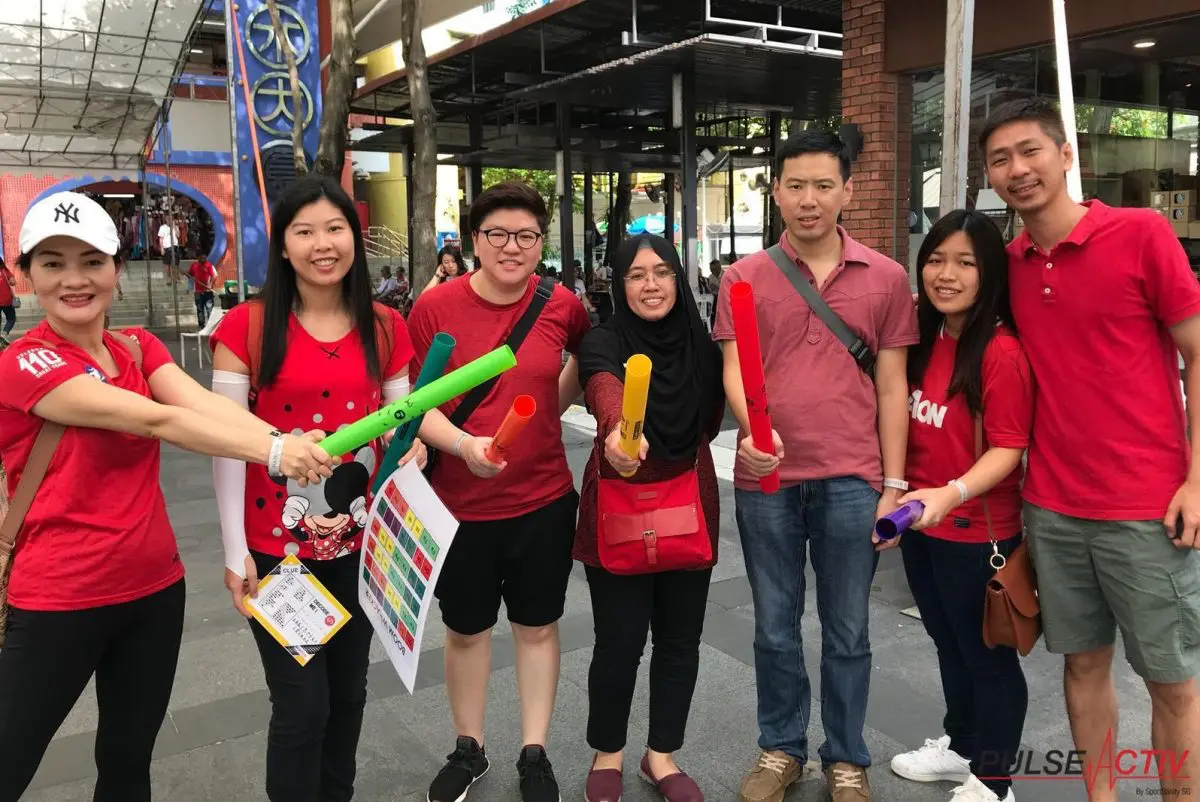
Property Typhoon is our free-for-all physical race, conceptualised from Monopoly. Up to 22 stations, each with point values, location and time-cost. Teams choose where to go and what to attempt within the race window. Strongest locations: Sentosa, Gardens by the Bay and city areas with enough landmark spread to give teams real route choices.
Best fit: groups of 300 pax and above, mixed-age and mixed-fitness teams, events where you want everyone playing through the full window and strategy as part of the experience. The format scales because there’s no convergence problem; teams distribute across stations rather than queuing at the same point.
Two planning advantages that don’t get talked about enough. First: no early-finish gap. Teams keep collecting points until time is up, then the raceboard is tallied. Pacing is clean. Second: content density. Because each station can be shorter, you can include more stations in the same window, which means more touchpoints for branded company content, themed challenges or culture messages. A sequential race with 5 long stations gives you 5 anchor points. A free-for-all with 18 short stations gives you 18.
The trade-off: too much choice can pull teams into long strategy huddles. The format has to balance station count against group dynamics. Too few stations and the format defeats itself. Too many and teams spend the first 15 minutes debating routes instead of playing.
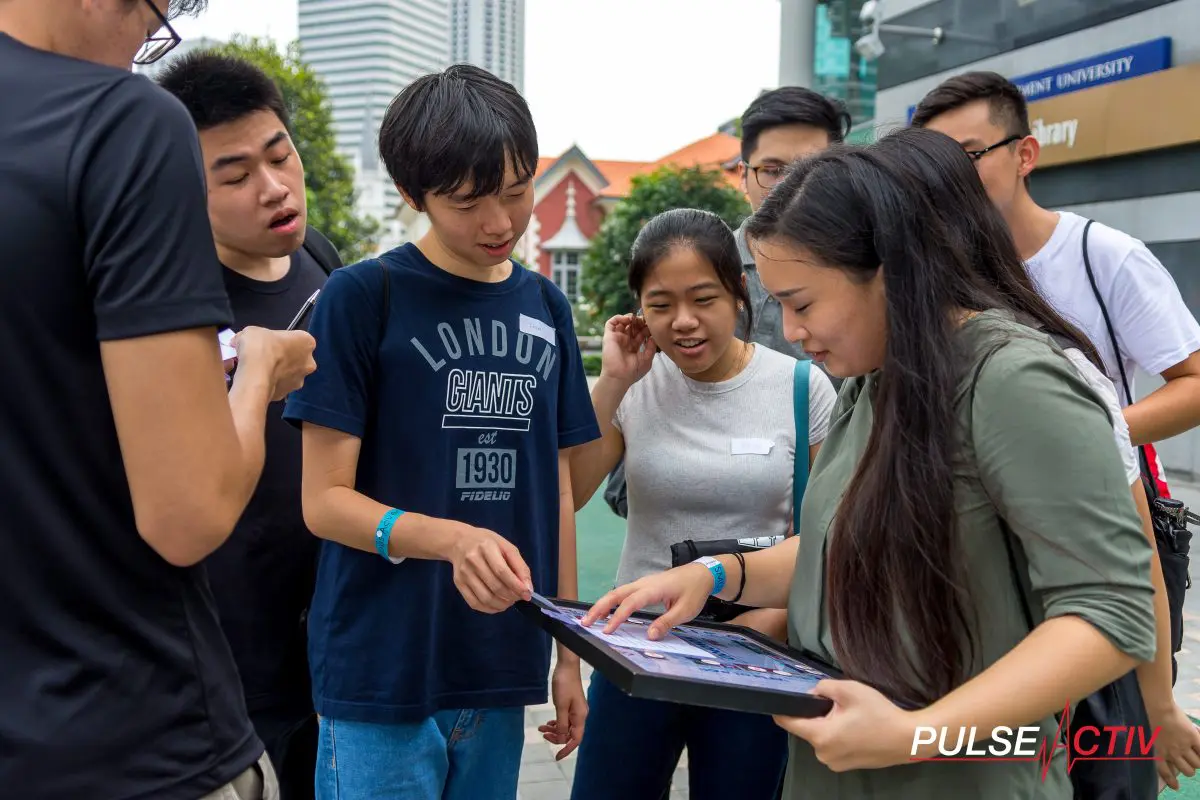
Click Snap Move runs on a web-based HTML platform. Up to 22 stations, with photo, video, GPS and quiz challenges, and live scoring visible to the room. No app download. Best for visually strong locations: Sentosa, Gardens by the Bay, Marina Bay, the Civic District: anywhere the location adds to the photo and video output.
Best fit: clients who want post-event visual content for internal comms, live leaderboard energy during the event, and digital missions that use the location well. The format generates a lot of usable photo and video material; useful for company newsletters, social media or year-end recaps.
Two honest constraints. First: tech novelty has worn off. Most participants use technology all day at work. A digital race needs to do more than just be on a phone; it needs missions that use the location, generate content, or create scoring stakes that wouldn’t exist without tech. Otherwise it becomes a list of photo tasks. Second: phone-sharing reality. Ten people will gather around a physical raceboard happily. They won’t gather around one phone. Digital formats have to be designed with device distribution in mind, usually 2 to 3 phones per team of 8 to 10, and missions that still require movement, discussion and collaboration off-screen.
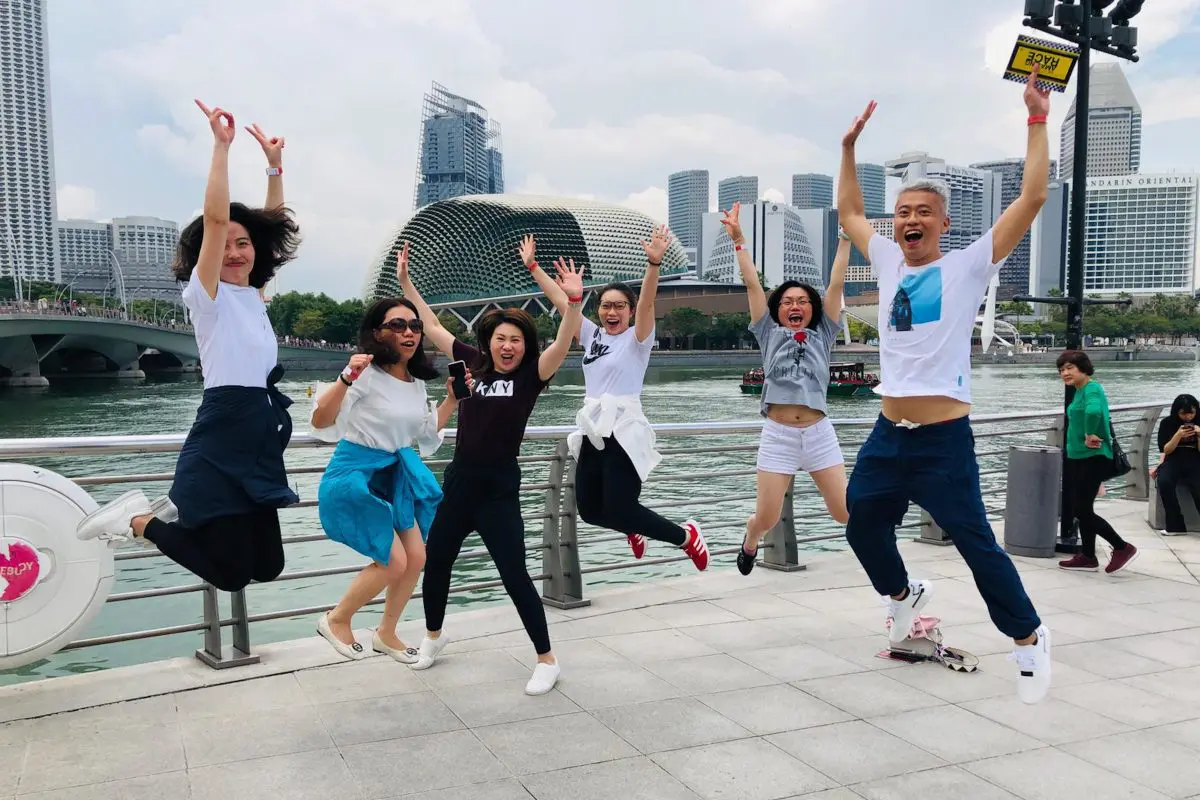
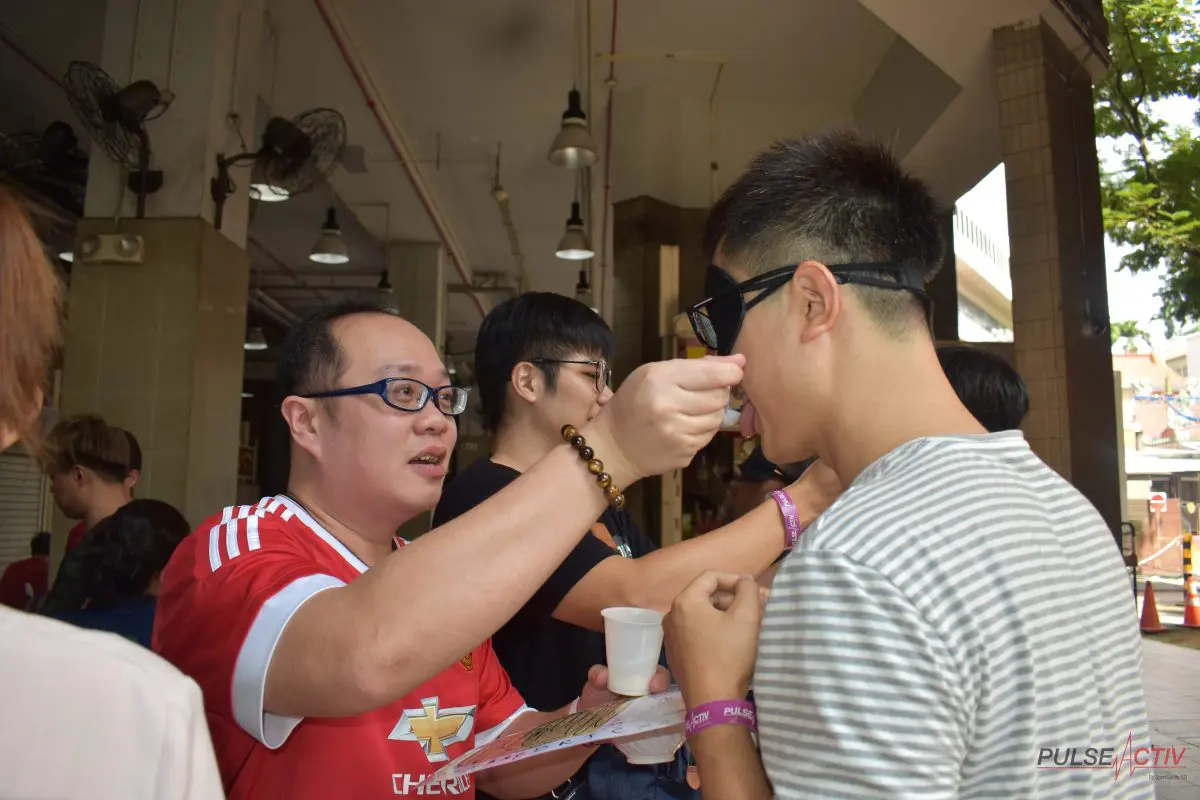
Makan Kakis is a food and culture race format. Up to 6 stations, multi-tier themed food challenges, hawker culture exploration. The pace is different from the other three; built around discovery and tasting, not sprint mechanics. Can be run in concentrated city areas or island-wide depending on the food story.
Best fit: smaller groups, clients who want food to be the anchor experience, international guests being introduced to Singapore food heritage, or teams who specifically don’t want a high-intensity race.
What it isn’t: a 500-pax race format. The station count is intentionally small because the experience is about quality of food encounters, not throughput. If a client wants to run a race for 400+ pax with fast movement across many checkpoints, Makan Kakis is the wrong base. Property Typhoon or Click Snap Move fits that brief better.
After all the format detail, the central decision usually collapses to one question: do you want surprise, or do you want strategy?
Sequential gives surprise. Teams don’t know what’s coming, every clue reveal is a moment, the event feels like a journey. The cost is control; the format gets harder to hold above 300 pax.
Free-for-all gives strategy. Teams plan, choose, calculate. The format scales cleanly and there’s no early-finish gap. The cost is the sense of journey; there’s no clue reveal, no progressive unlock.
Five levers that actually decide it:
Race timing is one of the most overlooked parts of planning, and the source of more day-of disappointment than any other variable.
For sequential races, the 70% rule is what we plan around. The route, station count and challenge times are designed so that roughly 70% of teams finish within the planned race window, with the fastest finishing 30 minutes to 1 hour earlier. That spread is normal. What kills the event is failing to plan for it; fastest teams sitting around while the rest are still running.
For free-for-all races, teams keep collecting points until the window ends. No finishing gap, but the same time discipline applies in a different form: if the station throughput is wrong, teams stand in queues.
Across any race format in Singapore, the time budget tends to break down as roughly 30 to 40% travel, 5 to 10% clue solving, and the rest on actual gameplay at stations. A 2-hour race is not 2 hours of gameplay. Once you factor in briefing, transitions, walking time, waiting and regrouping, the usable challenge time is much shorter than the headline figure. If a vendor proposal doesn’t reflect roughly this split, the timing won’t hold up on the day.
A common misconception: 30 teams need 30 stations. That’s wrong on both ends. You don’t need 30, and you also don’t need 5.
The real question is station throughput. If a single station takes 20 minutes per team, and that station has one setup, it clears three teams per hour. Over a 2-hour race window, that one setup clears six teams. If you have 30 teams running a free-for-all format with five stations of one setup each, the math doesn’t work; the event is designed to queue.
In free-for-all formats, teams don’t distribute evenly across stations. Some stations attract more traffic because they’re closer, worth more points, easier to brief, or located near popular landmarks. The right station and setup count is a probability calculation based on past data, plus route control mechanisms (point weighting, station spacing, facilitator placement) to nudge teams onto the right paths.
This is the question to ask any race vendor: how many stations, how many setups per station, and how many teams does each setup clear per hour for the activity we’re proposing? A vendor who can answer that confidently has done the math. A vendor who pivots to brochure language has not.
Tiered challenges layer a strategic dimension onto any race format. Teams choose between Level 1, Level 2 and Level 3 versions of a challenge; higher levels are worth more points but take more time or effort. Scoring mechanics like “collect a full set” or “first to top tier” add depth.
Worth using when the group is mixed in fitness and age, and you want everyone finding a level they’re comfortable with. Adds inclusivity without losing competitive stakes.
Skip it when the format is already strategy-heavy. Layering tiers on top of Property Typhoon, which is already a free-for-all with route choice, can muddy the scoring picture. The principle: scoring should be simple enough to brief in two minutes, deep enough to reward smart play, and not so complex that teams spend the race confused about how points work.
Singapore is a strong race environment because landmark density is high in several locations. But landmark density alone doesn’t make a good race route. The planning rule we use: landmarks shouldn’t be too close together (removes the sense of travel and surprise) or too far apart (people walk too long, energy drops). The sweet spot is enough distance that travel feels meaningful but not exhausting, and enough density that the route doesn’t drag.
Sentosa. Highest landmark density of any race location in Singapore. Suits Amazing Race, Property Typhoon and Click Snap Move. The constraint is heat; shaded transitions, hydration points and realistic walking distances need to be built into the route, especially for afternoon races.
City and Civic District. Strong landmark density combined with the most important operational feature for Singapore weather: MRT access and covered walkways. We choose city start points and checkpoints with MRT proximity not just for convenience but as the wet weather backup. If rain hits, teams can move sheltered. This is a deliberate planning choice, not a coincidence.
Orchard. Foot and public transport accessible. Best for Amazing Race when shopping belt discovery and street-level exploration are part of the experience. Crowd control matters; stations need careful placement to avoid blocking public areas.
Gardens by the Bay. Visually strong, which makes it the natural home for Click Snap Move and the photo missions that come with it. Property Typhoon also works because the open space allows free-for-all teams to spread out. Heat and walking distance still need to be planned.
Island-wide. Suits Makan Kakis. Not ideal for formats that require heavy facilitator support at every station, because manpower coverage and travel time become hard to control.
In Singapore, wet weather isn’t a contingency. It’s part of the design.
Cat 1 thunderstorm warning: the race does not flag off. Safety call is non-negotiable, and the position is clear from the start.
Short rain at the beginning or end: we absorb the delay with a mass activity, or end slightly early without compromising the experience.
Light rain mid-race: the decision belongs to the client, not the vendor pushing through. Some groups will play through with ponchos. Others prefer to pause or adjust the route. The vendor’s job is to surface the choice clearly, not to override it.
Standard inclusion across our race events: complimentary ponchos. Participants shouldn’t be put in a position to decide whether to buy rain gear mid-event. The moral dilemma of “do I spend $5 on a poncho” isn’t part of a corporate experience we run.
Pre-planned wet weather routes: where possible, we map alternative routes in advance with covered paths and MRT-accessible checkpoints. We also recommend having a venue base or endpoint, so if flag-off becomes impossible, backup indoor games can run from the venue rather than losing the entire programme.
A fuller breakdown of wet weather planning across all team building formats is covered in our wet weather backup plans for outdoor team building article.
From hundreds of race events, the consistent failure modes are the same:
This is the section most vendor proposals skip because the questions are uncomfortable to answer. Ask them anyway:
A vendor who answers these clearly has done the work. A vendor who pivots to “don’t worry, it will be fun” has not.
Yes. The four standard formats are starting points, not fixed templates. Most of our race events involve some level of customisation.
Common customisations: company values embedded into station challenges, themed routes tied to company history or product, custom scoring mechanics, hybrid formats that blend sequential and free-for-all elements, photo and video missions designed around brand assets, checkpoints built around specific venue landmarks. Tiered challenges can be added to any base format.
The principle: the format provides the operational backbone (route logic, station math, briefing structure, weather plan). The content provides the relevance. A Property Typhoon race with stations themed around your product roadmap is still operationally a Property Typhoon. The format stays proven; the content becomes specific.
Cost for a race-format corporate team building event in Singapore depends on group size, format chosen, location, station and setup count, customisation level, manpower, technology, F&B and venue, and wet weather backup requirements.
Most well-facilitated half-day race events for corporate groups in Singapore land in the range of $80 to $200 or more per person. Simpler formats for smaller groups land lower. Large-scale events with high station counts, tech platforms, heavy customisation or premium venues land higher.
For a line-by-line breakdown of what each budget category covers, see our corporate team building budget guide.
A good race format isn’t the one with the most stations or the most exciting tech. It’s the one that fits.
Group size, demographics, location, weather plan, timing and event objective all decide which format will hold up on the day. Sequential when surprise matters and the group is below 300. Free-for-all physical when scale and strategy matter. Free-for-all digital when visual output and live scoring add real value. Food-based when culture and discovery are the point.
After running race routes across Singapore for more than a decade, the unfair advantage isn’t the activity. It’s knowing where the landmarks sit relative to each other, how far the walk actually feels in the heat, where teams will bottleneck, how long each station really takes, what happens when the group crosses 300, how to brief a crowd that isn’t all paying attention, and how to keep the event moving when the weather doesn’t cooperate.
When shortlisting vendors, ask the practical questions. The right vendor answers with route logic, station math and operational experience. The wrong one sells back excitement.
Amazing Race is sequential — teams complete stations in a fixed order, unlocking clues one at a time. Best for smaller to mid-sized groups (under 300 pax), surprise-driven events and a structured journey feel. Property Typhoon is free-for-all — teams choose their own route from a raceboard of stations with point values. Best for larger groups, strategy, and events where you want everyone playing through the full window with no early-finish gap.
Free-for-all formats — Property Typhoon or Click Snap Move — are usually the safer call. They spread teams across stations rather than converging them, eliminate the finishing gap that sequential races create, and keep everyone playing until time is up. Sequential can still work above 300 with very tight planning, but the operational margin gets thin.
It is when the technology adds something the format would otherwise miss — photo and video output for internal comms, real-time scoring on a leaderboard, GPS missions that make use of the location. It isn’t worth it when tech is added for its own sake. A digital race that’s just photo tasks on a phone isn’t better than a physical one. Test the proposal against the experience it actually creates.
Some race formats adapt indoors, especially when the venue has multiple rooms, levels or activity zones. Indoor races usually involve less travel and more station-based gameplay. For organisers comparing options, indoor team building activities covers indoor formats in more depth.
Cat 1 thunderstorm warning means the race does not flag off — safety call is non-negotiable. Light rain mid-race is a decision the client makes with the vendor’s input, not one the vendor overrides. Standard inclusion across our race events: complimentary ponchos, pre-planned wet weather routes where possible, and a venue base for indoor backup games if flag-off becomes impossible.
Sentosa for landmark density, the Civic District and city areas for MRT access and covered walkways (which also serve as wet weather backup), Orchard for street-level exploration, Gardens by the Bay for visual and photo-based formats, and island-wide for food and culture races like Makan Kakis. The planning rule across all of them: landmarks should be close enough that travel doesn’t drain energy, far enough that the route feels meaningful.
Most race-format events run 2 to 3 hours for the main programme, on top of registration, briefing, F&B and prize presentation. The headline race window is not the same as gameplay time — once travel, clue solving, transitions and regrouping are factored in, the usable challenge time is roughly 50 to 60% of the window.
Yes — and most corporate race events involve some level of customisation. Company values embedded in stations, routes themed around company history or product, branded scoring mechanics, custom photo and video missions. The format provides the operational structure; the content makes it relevant to your company.