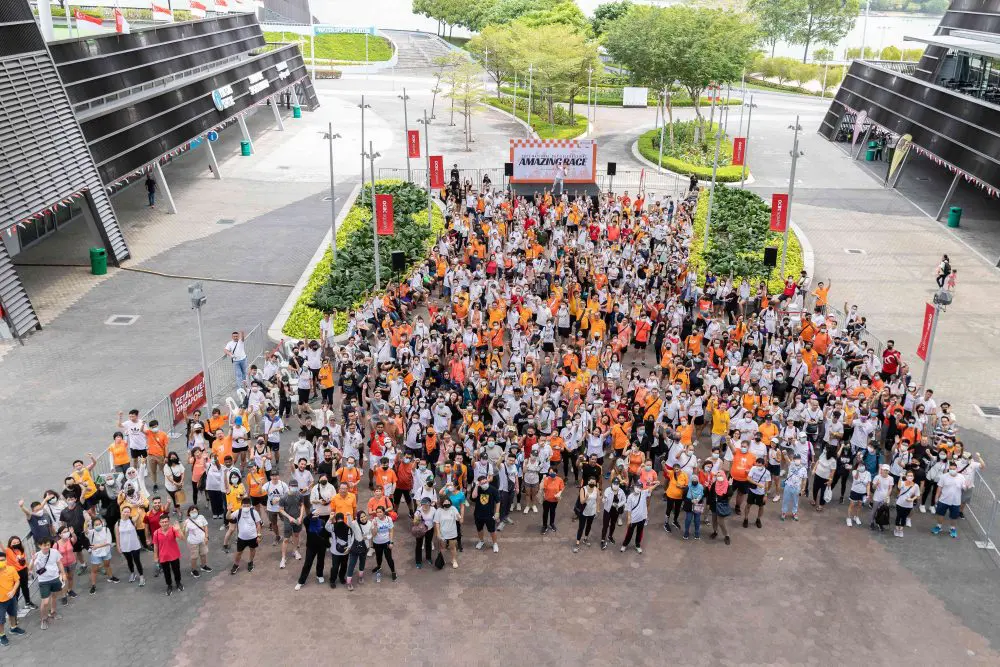
For a team building event of 100 or more employees in Singapore, the formats that work most consistently are Mini Olympics and Corporate Sports Day, Amazing Race, Property Typhoon and free-for-all station events, Running Man-style cluster games, indoor active formats, and collaboration build activities. But at 100 pax, the activity is no longer the main variable. Team structure, registration flow, briefing clarity, facilitator deployment, venue space and wet weather planning all start to shape the experience as much as the activity itself.
Having run hundreds of large corporate events in Singapore, including programmes for groups of 100, 200, 500 and above, what we see consistently is this: at 100 pax, an event is still personal enough to feel like one shared company experience, but large enough that poor structure becomes obvious very quickly. The activities that work are not necessarily the most complex ones. They are the ones that can split a group into smaller teams, keep everyone active, and still bring the full room back together for a strong shared moment.
100 pax is not a mega-event. It is also no longer small enough to run casually. A 40-pax format cannot simply be scaled up by inviting more people. The team structure, facilitator deployment, briefing approach and venue layout all need to be redesigned for the headcount.
At smaller scale, you can usually adjust on the spot. At 100 pax, every delay is multiplied across the group. Three minutes of confusion at registration is 300 minutes of wasted experience. A briefing that is one minute too long for 30 people is uncomfortable for 100. The planning lens has to shift from “what activity do we do” to “how does this activity actually run for 100 people”.
Before confirming anything, work through these questions:
For 100 pax, the most workable team size is 8 to 10 people per team. That gives you around 10 to 12 teams, which is a comfortable number for scoring, station rotation and facilitator coverage.
Beyond 10 to 12 people per team, quieter participants start to disappear into the background. A team of 15 has too many opinions, too much overlap on roles, and not enough opportunities for individual contribution within a single segment. Teams that are too small create a different problem: too many teams to manage, more scoring overhead, and a higher load on the facilitation crew.
Team structure also affects how the event moves. Smaller teams move faster between stations and queue less. Larger teams take longer to make decisions and slow down transitions. For a 100-pax event, 8 to 10 per team is the size that consistently produces the right balance of participation quality and event flow.
The activities below are the formats that scale most reliably at the 100 to 150 pax range. None of them is automatically the right choice. The right one depends on group profile, venue, weather plan and what the event is trying to achieve.
Mini Olympics team building works well at 100 pax because it is built around multiple stations and small teams running in parallel. Everyone stays active, waiting time is minimised, and the energy holds because nobody is standing around watching one team play.
The mistake to avoid is making every station overly physical. A good Mini Olympics for a corporate group mixes telematch-style warm-up games, simple relays, coordination challenges, non-contact sports, archery-style or target-based games and strategy stations. The point is participation across mixed fitness levels, not athletic performance. For 100 pax, Mini Olympics is often easier to control than a fully open-route outdoor race because everyone stays in a defined activity area where the facilitation team has visibility on every team at every moment.
Amazing Race team building brings movement, exploration and an element of adventure that station-based formats cannot replicate. For 100 pax, route planning is what makes or breaks it. Checkpoints need to be close enough to avoid excessive walking in Singapore heat, but spread out enough to prevent two teams arriving at the same station at the same time.
Things to lock in early: team pre-assignment, clear route design with realistic distances, station capacity rules, wet weather backup, and instructions simple enough to read on the move. Amazing Race scales well from 100 to around 200 to 300 pax. Beyond that, the experience starts to dilute as too many teams converge on the same checkpoints, and a cluster or free-for-all format usually works better. For larger crowds, see our guide on team building activities for large groups.
Property Typhoon and other free-for-all formats give teams autonomy. Instead of moving through a fixed rotation, teams choose which stations to visit and how to spend their time. This works well for 100 pax because it absorbs mixed interests and mixed fitness levels without forcing the whole room into the same activity at the same time.
The advantage is flexibility. The risk is fragmentation. Without a clear storyline, scoring system or shared objective tying everything together, a free-for-all event can feel scattered and lose its sense of being one shared experience. For 100 pax, this format works best when it has a strong unifying narrative, visible live scoring, and a finale that pulls everyone back into the same room for the result.
Running Man team building holds up well at 100 pax because it combines movement, teamwork, humour and simple missions in a format that feels collective rather than competitive in a strict sense. It is worth saying clearly: Running Man-style games are not necessarily intense. Many of the games are movement-based but not physically demanding, and the format includes communication, memory, observation, quick decision-making and light physical challenges.
For 100 pax, the format can run as an all-together event, a station-based rotation, a cluster setup, or a mix of mass games and breakout challenges. The format choice depends on the venue and the group. Whatever the structure, keep the rules simple. At 100 pax, every additional rule is another instruction the emcee has to land cleanly across the full room.
Indoor team building activities deserve their own mention for a Singapore-specific reason: heat and rain. An air-conditioned space helps participants maintain energy across a half-day programme and is more inclusive for mixed-age groups, participants in office attire, and anyone with physical limitations.
Indoor active formats include game show challenges, Running Man-inspired missions, team relays, station-based activities, strategy games, light physical challenges and collaboration games. The non-negotiable for 100 pax is venue: the room needs to have enough activity space, not just enough chairs. A function room that seats 100 comfortably may not have the floor area for movement-heavy activities. Always confirm activity footprint, not seated capacity.
Build-based programmes such as Chain Reaction, Coaster Adventure, One World Pipeline, The Big Picture and Build A Dream Team work well at 100 pax because each team contributes a smaller part to a larger shared outcome. The reveal at the end, when the contributions come together into one visible result, lands strongly with a full room.
There are two things to plan for at this scale. First, build activities work best when paired with one or two short lead-up games to warm up the room. Going straight into a build from a cold start, with 100 people who do not yet know what is expected, produces a slow first 15 minutes. Second, watch for passive participation. In a team of eight, it is easy for two or three people to do most of the building while others spectate. The format design needs to allocate clear roles so every participant has something to do.
Both indoor and outdoor work at 100 pax. The trade-offs are different and worth being honest about.
Outdoor formats bring movement, exploration and the kind of energy that a function room cannot replicate. They also bring heat, weather risk and route management. For Singapore, wet weather backup is not optional, it is part of the plan from day one. Outdoor at 100 pax also needs route control: how participants move between checkpoints, how the crew tracks teams, and how the schedule absorbs delays.
Indoor formats give comfort and control. Game shows, collaboration builds, indoor Running Man-style games, strategy challenges and active indoor activities all run well at 100 pax in a well-sized function room or ballroom. The trade-off is a more contained experience: less open movement, less use of natural energy, and a higher dependence on the emcee to drive pacing.
A useful rule of thumb: choose outdoor if the group is active and open to movement. Choose indoor if comfort, inclusiveness and controlled flow matter more. Choose hybrid (indoor base with selected outdoor segments) if the organiser wants movement but needs a reliable fallback.
The first 30 minutes of a 100-pax event decides the energy of the room for the rest of the programme. If registration drags, if team allocation is unclear, or if the briefing feels too long, a significant portion of the room starts the activity already half-disengaged. Recovering from a slow first 30 minutes is much harder than getting it right in the first place.
A strong 100-pax flow usually looks like this:
The emcee plays a much bigger role at 100 pax than at smaller events. They cannot just read instructions off a script. They need to manage crowd energy, simplify rules in the moment, control transitions and bring the full group back together cleanly between segments. A weak emcee at 100 pax is one of the fastest ways to lose a room.
Registration is not just marking attendance. At 100 pax, people arrive late, look for colleagues, check which team they are on, ask questions about timing and food, and figure out where they are supposed to be. None of this is unusual, but none of it happens cleanly without a plan.
For 100 pax, build registration around these elements:
Briefing at 100 pax needs to be simple and visual. Verbal instructions alone are not enough, because at this scale you cannot read the room to check whether the message landed. Use slides, physical demonstrations, clear examples and facilitator support on the ground. A briefing that works well for 30 people, where the facilitator can read the room and clarify, will not work for 100 without being redesigned.
For a 100-pax corporate team building event, plan for 8 to 10 event crew. The exact number depends on the activity format and venue layout, not just headcount.
A typical crew structure includes a lead emcee, station facilitators covering each activity zone, logistics crew managing equipment and transitions, registration support for the arrival window, scoring support for competitive formats, and an overall event lead handling timing and the run sheet. These roles are not interchangeable. A facilitator running a station cannot also manage registration. A scoring lead cannot also handle the music cues.
Manpower should be sized to the structure of the activity, not just the headcount. A simple indoor game show may need fewer facilitators than an outdoor Amazing Race because the latter requires people stationed across multiple checkpoints simultaneously. Station-based events generally need enough facilitators to staff every station at the same time, plus one or two floaters to manage timing and gaps. Under-facilitating a 100-pax event is one of the most visible failure points on the day: stations stall, transitions drag, and the emcee ends up carrying more than they should.
The jump from 50 to 100 pax is bigger than most organisers expect. The jump from 100 to 150 pax is smaller in scale terms but starts to push the event toward large-group territory. The table below sets out what changes at each step.
Planning Element | 50 Pax | 100 Pax | 150 Pax |
Team structure | 5–6 teams of 8–10 | 10–12 teams of 8–10 | 15–18 teams or cluster groups |
Briefing | Verbal works; easy to clarify | Slides, demo and facilitator support needed | Slides, demo, multiple briefing leads |
Registration | Single registration point is fine | Planned flow, holding area, latecomer plan | Multiple lanes, dedicated registration crew |
Facilitation crew | 4–6 crew | 8–10 crew | 10–14 crew |
Format options | Wide; easier to adjust on the spot | Station-based, cluster, all-together — all viable | Cluster or station-based preferred |
Venue | Standard function room | Confirm activity space, not just seating | Larger ballroom or multi-zone venue |
AV and crowd movement | Basic PA system | Strong PA, clear sightlines for briefing | Stronger AV, planned crowd flow paths |
Adjustability on the day | High | Medium — plan first, adjust second | Low — most decisions need to be locked in advance |
This is the section most vendors skip in their proposals. These are the questions worth asking before committing to any activity:
Most of these questions can be answered in a single email exchange. If a vendor cannot answer them clearly, that is the answer.
Cost for a 100-pax corporate team building event in Singapore depends on activity format, venue type, manpower, food and beverage, props, logistics, customisation and production requirements. For a well-facilitated half-day event with venue and basic catering, most groups land in the range of $80 to $200 or more per person, depending on the choices made across these categories.
When comparing quotes, the more useful question is what is actually included. Confirm:
For a full line-by-line breakdown of what each budget category typically covers, see our corporate team building budget guide.
For 100 or more employees, the best team building activity is not the one that sounds most exciting on a proposal. It is the one that can scale without losing engagement.
A good 100-pax event keeps waiting time low, makes instructions easy to follow, gives every participant something meaningful to do, and still creates a shared company-wide moment that people remember. The activity matters. But team structure, facilitation, briefing clarity, venue fit and the first 30 minutes of the programme matter at least as much.
The simplest test before you confirm anything: can this format actually keep 100 people involved from start to finish? If you cannot answer that confidently, the design is not ready yet.
For broader context on running a corporate event at this scale, see our guides on how to plan a corporate team building event and team building in Singapore.
Read our articles about Best Team Building Activities in Singapore and How to Choose the Right Team Building Activity.
Contact us here to enquiry or learn more about our activities. Click here to read more articles like this.
For 100 pax, the formats that scale most reliably are Mini Olympics and Corporate Sports Day, Amazing Race, Property Typhoon and free-for-all station events, Running Man-style cluster games, indoor active formats, and collaboration build activities. The right choice depends on group profile, venue, weather plan and what the event is trying to achieve, not just which format sounds most exciting.
8 to 10 people per team. That gives around 10 to 12 teams, which is the right balance for scoring, station rotation and facilitator coverage. Beyond 10 to 12 per team, quieter participants tend to disengage. Smaller teams create more overhead in scoring and facilitation.
The first 30 minutes sets the tone. A smooth arrival window, a clear briefing supported by slides and demonstration, a strong opening energiser, visible scoring through the main activity, and a finale that brings the full group back together are the elements that consistently hold engagement at this scale. A strong emcee is non-negotiable.
Plan for 8 to 10 event crew, structured across lead emcee, station facilitators, logistics support, registration crew, scoring support and an overall event lead. The exact number depends on activity format and venue layout. Outdoor station-based events typically need more facilitators than a single-room game show.
Yes, and for many Singapore groups indoor is the more practical choice given heat, humidity and rain risk. Game shows, collaboration builds, indoor Running Man-style games, strategy challenges and active indoor formats all work well at 100 pax. The non-negotiable is venue: confirm activity floor space, not just seated capacity.
Yes. Amazing Race scales well from 100 to around 200 to 300 pax with proper route planning, team pre-assignment, station capacity rules and a confirmed wet weather backup. Beyond that range, the experience starts to dilute as too many teams converge on the same checkpoints, and a cluster or free-for-all format usually works better.
For a well-facilitated half-day event with venue and basic catering, most 100-pax groups in Singapore land in the range of $80 to $200 or more per person. The exact figure depends on venue type, activity format, manpower, customisation and add-ons. When comparing quotes, focus on what is included rather than the headline rate.