Categories
Blogs

Wet Weather Backup Plans for Outdoor Team Building in Singapore

Wet Weather Backup Plans for Outdoor Team Building in Singapore: How to Protect the Experience When It Rains

Wet weather planning for an outdoor corporate team building event in Singapore comes down to one principle: the goal isn’t to pretend the original plan can still happen; it’s to preserve 80 to 90% of the experience through a planned switch. The Cat 1 thunderstorm rule is non-negotiable, but everything else is judgment based on rain intensity, where the weather is heading, ground condition, activity format, group size and client comfort.

Having delivered outdoor events across Singapore through every monsoon season, (races, sports days, family days, CSR programmes, mass-participation events at Sentosa, East Coast Park, Gardens by the Bay and city locations), what we see consistently is this: most wet weather plans fail because they were treated as a contingency line in the proposal, not as part of the event design. This guide covers the decision framework we use, format-by-format contingencies, what an actual backup venue looks like, and the operational moves that decide whether a wet weather event collapses or pivots cleanly.

The Cat 1 Rule, and What Comes After

Cat 1 is the clearest line. If there’s a Cat 1 thunderstorm warning, outdoor activities do not flag off. Safety is non-negotiable and the call is the same every time.

Beyond Cat 1, the decision is situational. We look at several factors together: how heavy the rain is right now, whether it’s likely to get heavier, lightning risk, the format the client has chosen, ground condition, what participants are wearing, group profile, and client comfort. Light drizzle doesn’t always mean stopping. Some groups are fine continuing, and for certain formats light drizzle is manageable, sometimes even refreshing in Singapore heat.

What matters is the trajectory. A light drizzle under a clear sky is one situation. A light drizzle under a very dark sky, or with heavier rain forecast within the hour, is a different situation. The worst scenario isn’t “it’s raining”. The worst is participants scattered outdoors when the rain suddenly becomes unsafe or too heavy to manage.

We don’t treat any weather forecast as gospel. NEA and MSS forecasts help us prepare, and we cross-check signals before the event, but the final call combines the forecast with real on-ground judgement: what the sky looks like, what the radar shows in the next 30 to 60 minutes, what the wind is doing, and how the site is responding. Forecasts are signals, not decisions.

The Four-Step Wet Weather Decision

Wet weather decisions for an outdoor event come down to a simple four-step process. The steps are the same whether the event is a 50-pax sports day or a 1,000-pax family day.

Step 1: Assess the Weather Risk

Cat 1, heavy rain, light drizzle, passing shower, or a forecasted risk. If Cat 1, we don’t proceed outdoors. If light rain, we assess activity type, ground condition and client comfort. If heavy rain, we assess whether to delay, shorten or move indoors.

Step 2: Assess the Activity Format

Some activities move indoors cleanly. Some can be modified. Some become a completely different programme. A race in the rain is not the same as a race in good weather. A sports day on a field is not the same as a sports day in a sports hall. We’re honest with the client that the experience changes, even if we can still deliver something good.

Step 3: Decide How Much of the Experience Can Be Preserved

The aim is not to pretend the wet weather version is identical to the original plan. The aim is to preserve as much of the intended experience as possible. With proper planning, we can usually still deliver 80 to 90% of the energy, engagement and team outcome through a modified format or backup games. Wet weather puts a damper on an event. What matters is how fast and how well the team reacts.

Step 4: Communicate Clearly and Move Fast

Once the decision is made, communication is everything. Facilitators, client representatives, participants, transport vendors, venue contacts, logistics teams; all of them need to know what’s happening. The larger the event, the earlier the call needs to be made, because communication delays compound.

When the Wet Weather Decision Actually Gets Made

Wet weather planning is not a day-of conversation. For any outdoor event, the overall wet weather plan is part of the booking — programme design, venue choice and contingency format are all confirmed with weather in mind from the start.

The detailed wet weather plan gets revisited closer to the event, typically around one month out once the final programme, venue, group size and logistics are locked in. If forecasts show high rain risk in the days leading up to the event, that conversation gets brought forward and stress-tested in more detail.

For large events, the decision logic moves earlier. With 500 or 1,000 participants, you cannot wait until the last minute to change venue, change reporting point or change activity format. Communication takes longer, transport changes affect more people, and the backup plan needs more lead time to set up. The bigger the event, the earlier we advise the client and prepare the switch.

On event morning, the final call is usually a joint decision. We advise based on safety, format feasibility and experience quality. The client also needs to be part of the decision because they know their people, their internal expectations and their risk comfort level. For borderline weather, the experience of the event manager matters a lot. A more experienced event manager knows when to hold, when to pause, when to shift and when to advise the client not to take the risk.

Format-by-Format Wet Weather Plans

Different formats need different contingencies. Below is how the wet weather plan changes across the most common outdoor event types.

Mini Olympics and Corporate Sports Day

For Mini Olympics and Corporate Sports Day events, we try to recommend a venue with both indoor and outdoor space; typically a stadium-plus-sports-hall combination, or a venue where the outdoor field has a covered backup hall nearby. This is the cleanest setup because the pivot is immediate and the programme can continue with minimal disruption.

Ground condition is critical for sports. Even light rain on a field or court raises injury risk for running games, ball games and relay formats. For larger sports days, we often recommend indoor sports halls as the primary venue. It feels less “outdoor”, but it removes weather risk entirely and the energy of a sports hall packed with teams competing is often just as strong.

If the client insists on a fully outdoor sports day, the backup format matters. Many Running Man-style team games work better indoors than full-court sports because they require less space. There’s a real space trade-off to plan around: one futsal court can host one sport like dodgeball or captain’s ball at a time, but the same space can host six smaller team-based games if the format is redesigned. The backup isn’t just moving the same game indoors. It’s often redesigning the programme so the available space can hold the group properly.

Simple games like charades or quick icebreakers can be created on the go, but they have limited holding power. They’re useful for absorbing a 15-minute delay. They are not enough to replace a half-day sports day for a large group.

Build-Based and CSR Activities

Build-based and CSR formats, Build A Bike, Chain Reaction, Coaster Adventure, Robotics Donation Challenge, usually move indoors more easily than races or sports days. The main programme happens in one controlled space, so rain has less direct impact on the experience itself.

What still matters is the logistics layer. Loading access for materials, setup paths from the loading bay to the room, table layout, movement flow, and whether materials can be kept dry during setup all become wet weather variables. If the venue has poor loading access or if materials need to be moved through an unsheltered path, rain affects the event even when the activity is indoors. For CSR drives where donation items go to beneficiaries, protecting those items from rain is a separate planning step.

Outdoor Games (Wacky Wars, Squid Game, Telematch)

Outdoor games can be modified, but not every game moves indoors cleanly. Some need running lanes, open ground or specific terrain. Moved indoors, they may become slower, smaller or less physical. The backup game list has to be prepared before the event, not improvised when it rains.

The indoor version should still match the spirit of the original programme. If the client booked something high-energy and competitive, the backup shouldn’t pivot to a quiet sit-down activity unless there’s no other choice. For Telematch and mass-participation outdoor events, the wet weather decision needs to be made earlier because the operational reset takes longer — moving 200 or 500 people, briefing them on a new format, and resetting the programme is not a 10-minute exercise.

Outdoor Race Formats

For race events specifically, Amazing Race, Property Typhoon, Click Snap Move, wet weather planning is covered in detail in our race format team building guide. Headlines: Cat 1 = no flag-off, complimentary ponchos as standard across all our race events, pre-planned wet weather routes mapped with covered paths and MRT-accessible checkpoints, and a venue base or endpoint so backup indoor games can run from the venue if flag-off becomes impossible.

Family Day and Dinner & Dance with Outdoor Components

Family Day events are the most weather-sensitive. They typically include children, elderly participants, carnival booths, inflatables, food vendors, fringe activities and outdoor entertainment. If there’s lightning, safety becomes the primary concern — but it’s not just the activities that are affected. Crowd movement to shelter, transport, vendor setup, food service and guest comfort all change at the same time.

The worst wet weather event we’ve had to manage was a large Family Day at Sentosa with lightning and thunder throughout. The issue wasn’t only that outdoor activities couldn’t continue. It was crowd movement, shelter, vendor setup, food safety, children, elderly participants and transport; every part of the event was affected simultaneously. The lesson: for large outdoor events, wet weather can’t be treated as a small backup note. It has to be built into the site plan, the communication plan, the manpower plan and the client decision timeline from the start.

For Dinner & Dance events, wet weather usually affects outdoor pre-event activities, cocktail areas, photo zones or fringe activities. The main ballroom programme typically continues, but the outdoor components need a backup location or indoor substitute confirmed in advance.

What an Ideal Wet Weather Backup Venue Looks Like

A good wet weather backup venue has enough indoor space for the expected group size, sheltered access from drop-off points, nearby toilets and holding areas, space for briefing and mass gathering, adequate power and AV support, flooring that’s safe when participants come in wet, a layout that supports multiple activity zones, easy loading access for logistics, and a clear plan for how participants move from outdoor to indoor if the switch happens mid-event.

For races, having a venue base or endpoint is the simplest backup architecture. If the race can’t flag off, indoor backup games can run from that same venue. For sports events, the ideal is a field-plus-sports-hall combination; outdoor primary, indoor immediately available.

The honest reality: backup venues are hard to book last minute in Singapore. Good corporate event venues are already difficult to secure. So for any larger outdoor event, clients shouldn’t assume an indoor space can be found when the forecast looks bad three days out. The backup needs to be confirmed early, with deposits or holds in place where the event scale justifies it.

Cost is part of this conversation. Saving on the wet weather plan puts the participant experience at risk. There’s also an underappreciated trade-off: a venue with fixed infrastructure, (built-in shelter, permanent stage, in-built AV), can sometimes be cheaper than setting up tentage at an outdoor venue. This is true for both smaller events (where built shelter beats temporary tentage on cost) and larger ones (where the tentage build, A-shaped or long-tent, adds significant cost and setup time). Long tents are more structured and useful for certain layouts; A-shaped tents have their own limitations on rain angle and flooring. The right answer depends on group size, activity format and venue access — not a default choice.

And while we’re on the wet weather topic, heat is part of the same conversation. People plan around rain and forget about Singapore heat; a fully outdoor event without shade, hydration points and rest plans can be just as compromised by sun as by rain. The infrastructure that protects against rain (tentage, sheltered walkways, indoor backup space) often serves the heat plan too.

What PulseActiv Pre-Positions for Wet Weather

For race events, complimentary ponchos are standard inclusion. Participants shouldn’t be put in a position to decide whether to buy rain gear in the middle of a corporate event. The moral dilemma of “do I spend $5 on a poncho” isn’t part of an experience we run.

Beyond ponchos, the preparation depends on the format. The standard wet weather toolkit across our outdoor events includes indoor backup games ready to deploy, modified station plans for different rain scenarios, alternative routes with covered paths, adjusted manpower deployment for the backup format, AV setups that can be relocated quickly, materials protected from rain at every handling point, backup props in case the originals get soaked, revised briefing slides for the indoor format, and a clear communication chain for client and facilitators when the plan changes.

The real difference isn’t the items on the list. It’s the planning mindset. A vendor who treats wet weather as a single proposal line will react when it rains. A vendor who treats it as part of the event design will have the backup running before the rain becomes a problem.

The Borderline Conversation

The hardest wet weather conversation is the borderline call. The client has paid for an outdoor experience. They’re emotionally committed. Their team is looking forward to the race or sports day. But the forecast shows rain risk, and the weather on the day is uncertain.

The way to handle it is honesty. Don’t oversell certainty. No forecast is 100% accurate, no vendor can guarantee outdoor weather, and pretending otherwise sets up a worse conversation when the rain actually arrives.

Two framings consistently work. The first: “We can still try to proceed if conditions remain safe, but we should be prepared that the experience may change. If the rain becomes heavier or there’s lightning risk, safety has to come first. Our recommendation is to prepare the indoor backup now so we can preserve the energy of the event if we need to switch.” The second: “The goal is not to cancel the experience. The goal is to protect the experience. If we wait too long and the weather worsens, the group gets stuck, communication becomes messy, and the event feels reactive. If we prepare earlier, we have more control.”

Clients almost always agree when the conversation is framed around safety, experience quality and operational control. What they push back on is being told “don’t worry, it’ll be fine” because they know that’s not a real assessment.

Cost conversations also need to happen early. If the wet weather backup requires another venue, tentage, replacement equipment or additional manpower, those costs shouldn’t appear as a surprise at the last minute. Companies invest significant time organising these events, and they don’t want a last-minute change unless it’s necessary. Surfacing the backup cost at the planning stage, even if it never gets activated, keeps the conversation clean if the weather forces the switch.

Singapore Weather Patterns Worth Planning Around

Singapore weather is unpredictable, but it isn’t random. Per NEA and MSS data, Singapore has two main monsoon seasons:

  • Northeast Monsoon (December to early March) — typically the wettest period, with more sustained rain and overcast days
  • Southwest Monsoon (June to September) — generally drier than the NE monsoon but still with periodic showers
  • Inter-monsoon months (April–May and October–November) — known for intense afternoon thunderstorms and lightning activity

For outdoor event planning, the inter-monsoon months in particular are worth watching because the afternoon thunderstorms can be sudden and severe. A morning that looks clear can shift to a Cat 1 warning within an hour.

Client psychology around weather follows a predictable pattern. If it rains heavily two or three days before the event, the client panics, even if the actual event-day forecast is different. This is common and human. Our role is to interpret the risk calmly, look at the actual forecast and radar for the event window, and prepare the right backup without overreacting two days out.

Some Singapore outdoor locations are more exposed than they look on paper. Sentosa beaches, East Coast Park, Gardens by the Bay outdoor sections and Hort Park can all be affected by rain, heat and limited shelter. They’re still excellent event locations, but the wet weather and heat plan needs to be realistic about how exposed the site actually is, especially for family days and larger group events with children or elderly participants.

For city races, MRT access and covered walkways aren’t just conveniences. They’re the wet weather backup built into the route. We choose city start points and checkpoints near MRT specifically so teams can move sheltered if the weather changes mid-event.

Where Wet Weather Plans Go Wrong

From hundreds of outdoor events, the consistent failure modes:

  • Treating wet weather as a proposal line item, not part of the event design. The plan exists on paper but hasn’t been operationally rehearsed for the actual venue, format and group.
  • Waiting too long to make the call. The client hopes the rain will pass, everyone wants to preserve the original plan, and the decision drifts past the point where a clean pivot is still possible. Facilitators are already deployed, participants are scattered, and the backup becomes harder to execute.
  • Assuming a backup venue will be available on demand. Good Singapore venues are already hard to secure. Trying to book one three days before an event when the forecast turns is rarely going to work.
  • Designing the backup format as a smaller version of the original. A 4-station sports day can’t just compress to a 1-station indoor version; the energy collapses. The backup needs to be designed as its own programme, not a downgrade.
  • Skipping the client conversation early in planning. The borderline weather decision is much harder if the client hasn’t been briefed on the backup options and cost implications well in advance.
  • Underestimating heat. Wet weather planning often focuses on rain and forgets the equally valid scenario of an open outdoor venue with no shade, no hydration plan and 80 participants in office attire.

What to Ask Before Confirming an Outdoor Event

If you’re planning an outdoor corporate event in Singapore, these are the questions worth raising with any vendor before confirming:

  • What’s your Cat 1 protocol?
  • What’s the specific wet weather plan for our chosen format — not a generic line, but the actual indoor or modified version?
  • Is there a confirmed backup venue, or only a backup format?
  • How many days before the event do you finalise the wet weather plan?
  • Who makes the final call on event morning, at what time, and how is it communicated?
  • Are ponchos or wet weather gear included for participants?
  • If we need to activate the backup, what’s the additional cost and what’s covered without extra charge?
  • For larger events: how does communication scale to 200, 500 or 1,000 participants if the plan changes?
  • What’s the heat plan (shade, hydration, rest points) if the weather is hot rather than wet?

A vendor who answers these clearly has run outdoor events through Singapore weather. A vendor who pivots to “we have a wet weather plan” without details has not.

How Wet Weather Affects Event Cost

Wet weather backup can add cost in specific scenarios: short-notice indoor venue rental, tentage setup, additional manpower for the pivot, replacement equipment or props, and adjusted F&B logistics if the venue changes.

Most of these costs can be planned for in advance rather than absorbed as last-minute surprises. The principle is the same as any contingency: surface the cost during planning so the client can decide their comfort level. For larger events, a small wet weather buffer in the budget is usually worth it. The alternative, losing the entire programme because the backup wasn’t pre-arranged, is far more expensive in lost participant experience and goodwill.

For a fuller breakdown of how to structure a corporate event budget, including contingency line items, see our corporate team building budget guide.

Final Thoughts: The Difference Is the Plan

Wet weather will always affect outdoor events in Singapore. That part is constant. The variable is whether the event feels like it collapsed, or whether the team had a plan, communicated clearly and still delivered a strong experience.

The difference comes down to four things: a contingency built into the event design from the start, a clear decision framework that doesn’t rely on optimism, an experienced event manager who knows when to call the switch, and honest client communication that surfaces the trade-offs early rather than at 8am on event day.

Wet weather isn’t a vendor problem to hide. It’s a planning conversation to have. The right vendor will have it openly with you. The wrong one will reassure you it’ll be fine and leave you exposed when it isn’t.

We also have an article about Best Team Building Activities in Singapore.

Contact us here to enquiry or learn more about our activities. You can also read more articles like this on our blog.

Frequently Asked Questions

For any large outdoor corporate event in Singapore, yes. For smaller events with simpler activities, a backup format (rather than a backup venue) may be sufficient. The trigger is usually group size, vendor setup complexity and how much of the experience depends on outdoor space. Races and sports days almost always benefit from a venue base. Casual outdoor activities for a small team may not.

Cat 1 means lightning risk is high enough that outdoor activities should not proceed. For any outdoor event we run, Cat 1 means we do not flag off — safety is non-negotiable. The plan switches to the indoor backup, a modified format or a hold, depending on the event design.

Forecasts from NEA, MSS and consumer weather apps are useful signals, especially in the 24- to 48-hour window before an event. They are not 100% accurate, and they should never be the sole basis for an event-day decision. The right approach is to use the forecast to prepare contingencies in advance, then combine it with on-ground judgement — sky condition, radar, wind direction — closer to event time.

For our race events, complimentary ponchos are standard inclusion. For other outdoor event formats, ponchos can be included on request — and we’d usually recommend it for any outdoor programme with weather risk, especially family days and large group events. Participants shouldn’t have to decide whether to buy rain gear mid-event.

It depends on rain intensity and the activity format. For short rain at the start or end, we typically absorb the delay with a mass activity or end slightly early. For sustained or heavy rain mid-event, the call gets made jointly with the client based on the trajectory of the weather and the safety of the activity. The backup plan, prepared in advance, is what makes this switch possible without losing the room.

Outright cancellation is rare for corporate team building events because the operational and goodwill cost is high. The more common decision is a pivot — moving indoors, switching to a modified format, or starting later. For genuine safety reasons (Cat 1 thunderstorm sustained through the planned event window, for example), a postponement may be the better call than running a compromised programme. This is a conversation we’d advise on if it gets to that point.

The Northeast Monsoon (December to early March) is typically the wettest period. The inter-monsoon months (April–May and October–November) carry the risk of intense afternoon thunderstorms. The Southwest Monsoon (June to September) is generally drier but still has periodic showers. For outdoor events, none of these months are off-limits — but the wet weather contingency planning needs to be tighter during the higher-risk windows.

The overall wet weather plan should be part of the event booking — venue choice, programme design and backup format all confirmed with weather in mind from the start. The detailed plan gets revisited around one month before the event, and stress-tested again in the final week if forecasts show high rain risk. For events of 500 pax or more, the contingency timeline moves earlier because communication and operational changes take longer to execute.
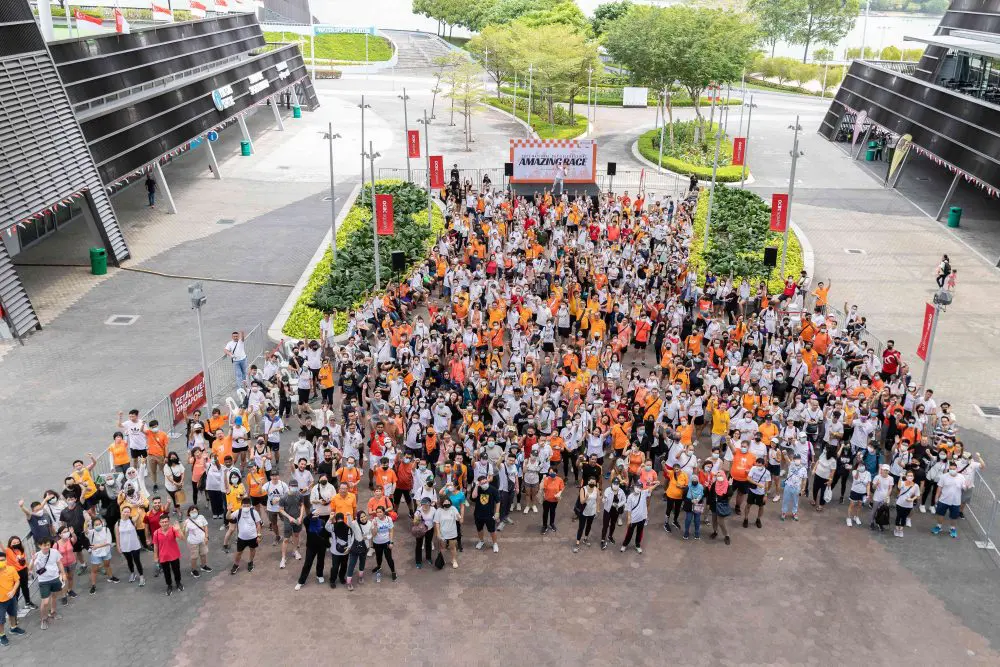
Outdoor Running Man team Building Activity
Categories
Blogs

Race Format Team Building in Singapore

Race Format Team Building in Singapore: How to Choose Between Sequential, Strategic and Tech-Driven Races

Race-style team building in Singapore comes in three operational format, sequential, free-for-all physical, and free-for-all digital and four PulseActiv programmes that map onto them: Amazing Race, Property Typhoon, Click Snap Move and Makan Kakis. The right choice isn’t the one that sounds most exciting in a proposal. It’s the format that holds up against your actual group size, demographics, venue and weather plan.

Having designed and delivered race routes across Singapore for more than a decade, from city tracks to Sentosa, Gardens by the Bay and island-wide formats, what we see consistently is this: the activity name is a small part of the decision. The bigger variables are operational. Route logic, station throughput, finishing-rate planning, briefing structure at scale, and the wet weather protocol all matter more than which race brand sits on the proposal. This guide walks through the four formats, the trade-offs that actually matter, and the planning rules we use to decide which one fits a given event.

The Three Race Format Types

Before comparing specific programmes, it helps to understand the three formats underneath them. A race can have any theme layered on top; travel, mystery, food, heritage, strategy, photo missions, company values. Operationally, every race we run falls into one of three formats.

Sequential (Station-by-Station)

Sequential is the format most people imagine when they hear “Amazing Race”. Teams start at one point, complete a challenge, receive the next clue, then move to the next station. They don’t know the full route from the start. The experience is built around discovery and progression.

It works when the group is small to mid-sized and the client wants the race to feel like a journey. Everyone moves through the same route, the flow is easier to control, and the event has a structured story arc. The limitation is scale. Above 300 pax, sequential starts to lose its element: teams converge at stations, waiting time increases, and the surprise softens. Fast passes, detours and bonus choices can add some power of choice on top, but the backbone stays fixed.

Free-for-All, Physical Raceboard

Each team receives a physical raceboard showing every station, point value and location. Teams choose their own route and submit the raceboard for tallying at the end. The mechanic is strategy: do you go for the nearest stations, or take the risk and travel further for higher points? Do you spread across easy stations, or focus on the high-value ones?

For large groups and mixed-age cohorts, this is usually the most scalable format. No early-finish gap. No team sitting around for 30 minutes because they happened to be faster. Everyone plays through the full window.

Free-for-All, Digital

Digital races work the same way as physical free-for-all, but the raceboard becomes a web-based platform. Photo missions, video missions, GPS checkpoints, quiz challenges, virtual tasks; all submitted live with scoring updates visible to the room.

A practical note from our delivery experience: we moved off app-based platforms to web-based HTML for one reason. App downloads create friction. Not everyone wants to install a one-day app, and onboarding 100+ participants through downloads burns the first 20 minutes of the programme. Web-based platforms work off a QR scan; no install, no account creation, teams are playing within seconds. This is the difference between a digital race that flows and one that starts behind.

The Four PulseActiv Race Formats

Four programmes, mapped onto those three formats. The differences below are about when each fits, not which is best because the right one depends entirely on the event.

Amazing Race — Sequential, Surprise-Driven

Amazing Race is our classic sequential format. Teams move through a set route, complete challenges and unlock the next clue only after finishing the current one. Up to 4 to 6 stations, typically run across Sentosa, Orchard, the Civic District and other city locations where teams can move between landmarks on foot or by public transport.

Best fit: groups below 300 pax, first-timer corporate audiences, clients who want a structured journey and a visible storyline. The format works because everyone goes through the same route. The experience is shared, the briefing is straightforward, and the story arc is easy to follow.

The thing most clients don’t know to plan for is the finishing gap. In a sequential race, the fastest team typically finishes 30 minutes to 1 hour earlier than the last few. That gap isn’t a problem to eliminate; it’s a feature of the format. The problem is what happens during that gap. Our planning rule: design the route, station count and challenge time so that around 70% of teams finish within the window, then plan a finale, holding activity or mass closing game to absorb the spread. Without that, the fastest teams disengage while the rest are still running, and the energy drops before the prize presentation.

To add some power of choice inside a sequential structure, fast passes, detours and bonus routes work well. But the backbone stays the same: you only know the next station after completing the current one. For organisers comparing Amazing Race team building options, the question worth asking isn’t “how many stations are included?” It’s whether the route, station timing and finishing gap have actually been planned for.

Amazing Race Singapore Team Building

Property Typhoon — Strategic, Power of Choice

Property Typhoon is our free-for-all physical race, conceptualised from Monopoly. Up to 22 stations, each with point values, location and time-cost. Teams choose where to go and what to attempt within the race window. Strongest locations: Sentosa, Gardens by the Bay and city areas with enough landmark spread to give teams real route choices.

Best fit: groups of 300 pax and above, mixed-age and mixed-fitness teams, events where you want everyone playing through the full window and strategy as part of the experience. The format scales because there’s no convergence problem; teams distribute across stations rather than queuing at the same point.

Two planning advantages that don’t get talked about enough. First: no early-finish gap. Teams keep collecting points until time is up, then the raceboard is tallied. Pacing is clean. Second: content density. Because each station can be shorter, you can include more stations in the same window, which means more touchpoints for branded company content, themed challenges or culture messages. A sequential race with 5 long stations gives you 5 anchor points. A free-for-all with 18 short stations gives you 18.

The trade-off: too much choice can pull teams into long strategy huddles. The format has to balance station count against group dynamics. Too few stations and the format defeats itself. Too many and teams spend the first 15 minutes debating routes instead of playing.

Click Snap Move — Tech-Enabled, Visual Content

Click Snap Move runs on a web-based HTML platform. Up to 22 stations, with photo, video, GPS and quiz challenges, and live scoring visible to the room. No app download. Best for visually strong locations: Sentosa, Gardens by the Bay, Marina Bay, the Civic District: anywhere the location adds to the photo and video output.

Best fit: clients who want post-event visual content for internal comms, live leaderboard energy during the event, and digital missions that use the location well. The format generates a lot of usable photo and video material; useful for company newsletters, social media or year-end recaps.

Two honest constraints. First: tech novelty has worn off. Most participants use technology all day at work. A digital race needs to do more than just be on a phone; it needs missions that use the location, generate content, or create scoring stakes that wouldn’t exist without tech. Otherwise it becomes a list of photo tasks. Second: phone-sharing reality. Ten people will gather around a physical raceboard happily. They won’t gather around one phone. Digital formats have to be designed with device distribution in mind, usually 2 to 3 phones per team of 8 to 10, and missions that still require movement, discussion and collaboration off-screen.

Makan Kakis — Hawker Culture and Food Discovery

Makan Kakis is a food and culture race format. Up to 6 stations, multi-tier themed food challenges, hawker culture exploration. The pace is different from the other three; built around discovery and tasting, not sprint mechanics. Can be run in concentrated city areas or island-wide depending on the food story.

Best fit: smaller groups, clients who want food to be the anchor experience, international guests being introduced to Singapore food heritage, or teams who specifically don’t want a high-intensity race.

What it isn’t: a 500-pax race format. The station count is intentionally small because the experience is about quality of food encounters, not throughput. If a client wants to run a race for 400+ pax with fast movement across many checkpoints, Makan Kakis is the wrong base. Property Typhoon or Click Snap Move fits that brief better.

Sequential vs Free-for-All: The Trade-Off That Actually Matters

After all the format detail, the central decision usually collapses to one question: do you want surprise, or do you want strategy?

Sequential gives surprise. Teams don’t know what’s coming, every clue reveal is a moment, the event feels like a journey. The cost is control; the format gets harder to hold above 300 pax.

Free-for-all gives strategy. Teams plan, choose, calculate. The format scales cleanly and there’s no early-finish gap. The cost is the sense of journey; there’s no clue reveal, no progressive unlock.

Five levers that actually decide it:

  • Group size. Below 300, sequential holds. Above 300, free-for-all is the safer call.
  • Mixed-age and mixed-fitness groups favour free-for-all because teams self-pace.
  • Time pacing. Sequential = finishing gap to plan around. Free-for-all = clean tally at the end.
  • Content density. Free-for-all allows more stations, more company content embedded across the race.
  • Event objective. Surprise and story → sequential. Strategy and autonomy → free-for-all.

The 70% Rule and the Race Time Budget

Race timing is one of the most overlooked parts of planning, and the source of more day-of disappointment than any other variable.

For sequential races, the 70% rule is what we plan around. The route, station count and challenge times are designed so that roughly 70% of teams finish within the planned race window, with the fastest finishing 30 minutes to 1 hour earlier. That spread is normal. What kills the event is failing to plan for it; fastest teams sitting around while the rest are still running.

For free-for-all races, teams keep collecting points until the window ends. No finishing gap, but the same time discipline applies in a different form: if the station throughput is wrong, teams stand in queues.

Across any race format in Singapore, the time budget tends to break down as roughly 30 to 40% travel, 5 to 10% clue solving, and the rest on actual gameplay at stations. A 2-hour race is not 2 hours of gameplay. Once you factor in briefing, transitions, walking time, waiting and regrouping, the usable challenge time is much shorter than the headline figure. If a vendor proposal doesn’t reflect roughly this split, the timing won’t hold up on the day.

How Many Stations and Setups Do You Actually Need?

A common misconception: 30 teams need 30 stations. That’s wrong on both ends. You don’t need 30, and you also don’t need 5.

The real question is station throughput. If a single station takes 20 minutes per team, and that station has one setup, it clears three teams per hour. Over a 2-hour race window, that one setup clears six teams. If you have 30 teams running a free-for-all format with five stations of one setup each, the math doesn’t work; the event is designed to queue.

In free-for-all formats, teams don’t distribute evenly across stations. Some stations attract more traffic because they’re closer, worth more points, easier to brief, or located near popular landmarks. The right station and setup count is a probability calculation based on past data, plus route control mechanisms (point weighting, station spacing, facilitator placement) to nudge teams onto the right paths.

This is the question to ask any race vendor: how many stations, how many setups per station, and how many teams does each setup clear per hour for the activity we’re proposing? A vendor who can answer that confidently has done the math. A vendor who pivots to brochure language has not.

The Tiered Challenges Option

Tiered challenges layer a strategic dimension onto any race format. Teams choose between Level 1, Level 2 and Level 3 versions of a challenge; higher levels are worth more points but take more time or effort. Scoring mechanics like “collect a full set” or “first to top tier” add depth.

Worth using when the group is mixed in fitness and age, and you want everyone finding a level they’re comfortable with. Adds inclusivity without losing competitive stakes.

Skip it when the format is already strategy-heavy. Layering tiers on top of Property Typhoon, which is already a free-for-all with route choice, can muddy the scoring picture. The principle: scoring should be simple enough to brief in two minutes, deep enough to reward smart play, and not so complex that teams spend the race confused about how points work.

Singapore Race Locations: Where Each Format Works

Singapore is a strong race environment because landmark density is high in several locations. But landmark density alone doesn’t make a good race route. The planning rule we use: landmarks shouldn’t be too close together (removes the sense of travel and surprise) or too far apart (people walk too long, energy drops). The sweet spot is enough distance that travel feels meaningful but not exhausting, and enough density that the route doesn’t drag.

Sentosa. Highest landmark density of any race location in Singapore. Suits Amazing Race, Property Typhoon and Click Snap Move. The constraint is heat; shaded transitions, hydration points and realistic walking distances need to be built into the route, especially for afternoon races.

City and Civic District. Strong landmark density combined with the most important operational feature for Singapore weather: MRT access and covered walkways. We choose city start points and checkpoints with MRT proximity not just for convenience but as the wet weather backup. If rain hits, teams can move sheltered. This is a deliberate planning choice, not a coincidence.

Orchard. Foot and public transport accessible. Best for Amazing Race when shopping belt discovery and street-level exploration are part of the experience. Crowd control matters; stations need careful placement to avoid blocking public areas.

Gardens by the Bay. Visually strong, which makes it the natural home for Click Snap Move and the photo missions that come with it. Property Typhoon also works because the open space allows free-for-all teams to spread out. Heat and walking distance still need to be planned.

Island-wide. Suits Makan Kakis. Not ideal for formats that require heavy facilitator support at every station, because manpower coverage and travel time become hard to control.

Wet Weather Planning for Race Events

In Singapore, wet weather isn’t a contingency. It’s part of the design.

Cat 1 thunderstorm warning: the race does not flag off. Safety call is non-negotiable, and the position is clear from the start.

Short rain at the beginning or end: we absorb the delay with a mass activity, or end slightly early without compromising the experience.

Light rain mid-race: the decision belongs to the client, not the vendor pushing through. Some groups will play through with ponchos. Others prefer to pause or adjust the route. The vendor’s job is to surface the choice clearly, not to override it.

Standard inclusion across our race events: complimentary ponchos. Participants shouldn’t be put in a position to decide whether to buy rain gear mid-event. The moral dilemma of “do I spend $5 on a poncho” isn’t part of a corporate experience we run.

Pre-planned wet weather routes: where possible, we map alternative routes in advance with covered paths and MRT-accessible checkpoints. We also recommend having a venue base or endpoint, so if flag-off becomes impossible, backup indoor games can run from the venue rather than losing the entire programme.

A fuller breakdown of wet weather planning across all team building formats is covered in our wet weather backup plans for outdoor team building article.

What Goes Wrong With Race Events

From hundreds of race events, the consistent failure modes are the same:

  • Wrong format for the group size. Running Amazing Race for 400 pax is the most common one. The format can’t hold its sequential element at that scale.
  • Under-stationed events. The throughput math is wrong. Teams queue, stations jam, the event feels poorly run regardless of the activity choice.
  • Briefing failure at scale. Not everyone listens. The fix is layered: clear slides, visual raceboards, repeated instructions, and facilitator support on the ground. Briefing at 200 pax is a different problem from briefing at 30, not a shorter version of it.
  • Drop-outs and team imbalance. At larger outdoor events, plan for 5 to 10% attrition. Teams need to be sized to absorb it without leaving someone with two members at a station.
  • Tech failures in digital races. Onboarding, connectivity at outdoor sites, scoring sync. The move from app to HTML solved the worst of these, but the digital flow still needs to be tested in the actual race environment, not just in an office.
  • Phone-sharing reality. A team won’t gather around one phone the way they will around a raceboard. Plan device count and team roles accordingly.

What to Ask Before Confirming a Race Vendor

This is the section most vendor proposals skip because the questions are uncomfortable to answer. Ask them anyway:

  • Which race format are you proposing; sequential, free-for-all physical, or free-for-all digital?
  • Why is that format suitable for our group size and demographics?
  • How many stations and how many setups per station?
  • How many teams can each setup clear per hour?
  • What’s the travel / clue / gameplay time split for our route?
  • If it’s sequential, what finishing rate are you planning around?
  • What happens if it rains? Are ponchos included? Is there a pre-planned wet weather route?
  • If it’s digital, is it app-based or web-based? How many devices per team?
  • Can stations be customised with our company content?
  • What’s the latecomer or drop-out plan?
  • How will facilitators support the route on event day?

A vendor who answers these clearly has done the work. A vendor who pivots to “don’t worry, it will be fun” has not.

Can the Race Format Be Customised?

Yes. The four standard formats are starting points, not fixed templates. Most of our race events involve some level of customisation.

Common customisations: company values embedded into station challenges, themed routes tied to company history or product, custom scoring mechanics, hybrid formats that blend sequential and free-for-all elements, photo and video missions designed around brand assets, checkpoints built around specific venue landmarks. Tiered challenges can be added to any base format.

The principle: the format provides the operational backbone (route logic, station math, briefing structure, weather plan). The content provides the relevance. A Property Typhoon race with stations themed around your product roadmap is still operationally a Property Typhoon. The format stays proven; the content becomes specific.

How Much Does Race Team Building Cost in Singapore?

Cost for a race-format corporate team building event in Singapore depends on group size, format chosen, location, station and setup count, customisation level, manpower, technology, F&B and venue, and wet weather backup requirements.

Most well-facilitated half-day race events for corporate groups in Singapore land in the range of $80 to $200 or more per person. Simpler formats for smaller groups land lower. Large-scale events with high station counts, tech platforms, heavy customisation or premium venues land higher.

For a line-by-line breakdown of what each budget category covers, see our corporate team building budget guide.

Final Thoughts: Race Format Is About Fit, Not Excitement

A good race format isn’t the one with the most stations or the most exciting tech. It’s the one that fits.

Group size, demographics, location, weather plan, timing and event objective all decide which format will hold up on the day. Sequential when surprise matters and the group is below 300. Free-for-all physical when scale and strategy matter. Free-for-all digital when visual output and live scoring add real value. Food-based when culture and discovery are the point.

After running race routes across Singapore for more than a decade, the unfair advantage isn’t the activity. It’s knowing where the landmarks sit relative to each other, how far the walk actually feels in the heat, where teams will bottleneck, how long each station really takes, what happens when the group crosses 300, how to brief a crowd that isn’t all paying attention, and how to keep the event moving when the weather doesn’t cooperate.

When shortlisting vendors, ask the practical questions. The right vendor answers with route logic, station math and operational experience. The wrong one sells back excitement.

Contact us here to enquiry or learn more about our activities. You can read more articles like this on our blog.

Frequently Asked Questions

Amazing Race is sequential — teams complete stations in a fixed order, unlocking clues one at a time. Best for smaller to mid-sized groups (under 300 pax), surprise-driven events and a structured journey feel. Property Typhoon is free-for-all — teams choose their own route from a raceboard of stations with point values. Best for larger groups, strategy, and events where you want everyone playing through the full window with no early-finish gap.

Free-for-all formats — Property Typhoon or Click Snap Move — are usually the safer call. They spread teams across stations rather than converging them, eliminate the finishing gap that sequential races create, and keep everyone playing until time is up. Sequential can still work above 300 with very tight planning, but the operational margin gets thin.

It is when the technology adds something the format would otherwise miss — photo and video output for internal comms, real-time scoring on a leaderboard, GPS missions that make use of the location. It isn’t worth it when tech is added for its own sake. A digital race that’s just photo tasks on a phone isn’t better than a physical one. Test the proposal against the experience it actually creates.

Some race formats adapt indoors, especially when the venue has multiple rooms, levels or activity zones. Indoor races usually involve less travel and more station-based gameplay. For organisers comparing options, indoor team building activities covers indoor formats in more depth.

Cat 1 thunderstorm warning means the race does not flag off — safety call is non-negotiable. Light rain mid-race is a decision the client makes with the vendor’s input, not one the vendor overrides. Standard inclusion across our race events: complimentary ponchos, pre-planned wet weather routes where possible, and a venue base for indoor backup games if flag-off becomes impossible.

Sentosa for landmark density, the Civic District and city areas for MRT access and covered walkways (which also serve as wet weather backup), Orchard for street-level exploration, Gardens by the Bay for visual and photo-based formats, and island-wide for food and culture races like Makan Kakis. The planning rule across all of them: landmarks should be close enough that travel doesn’t drain energy, far enough that the route feels meaningful.

Most race-format events run 2 to 3 hours for the main programme, on top of registration, briefing, F&B and prize presentation. The headline race window is not the same as gameplay time — once travel, clue solving, transitions and regrouping are factored in, the usable challenge time is roughly 50 to 60% of the window.

Yes — and most corporate race events involve some level of customisation. Company values embedded in stations, routes themed around company history or product, branded scoring mechanics, custom photo and video missions. The format provides the operational structure; the content makes it relevant to your company.

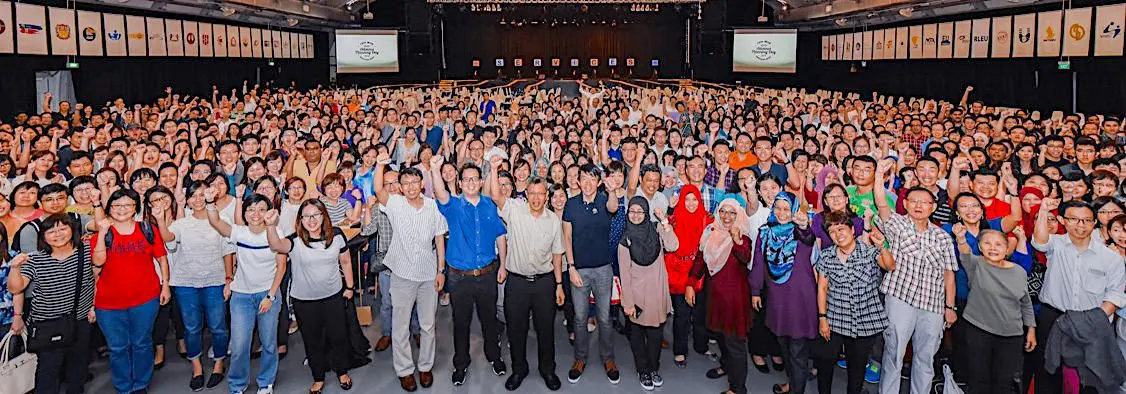
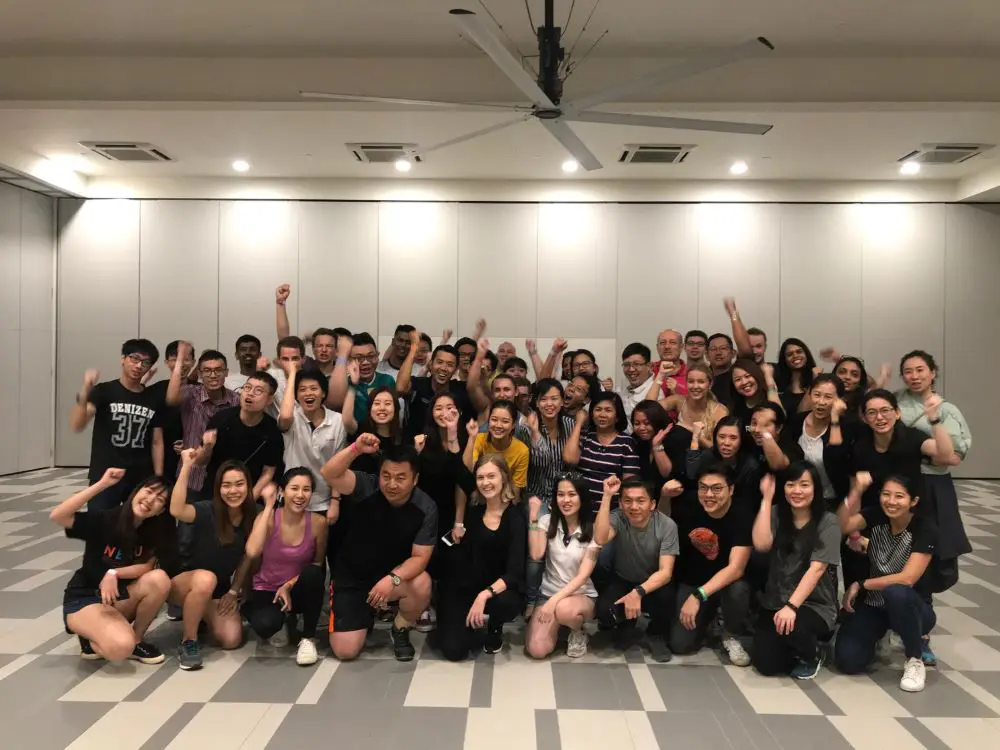
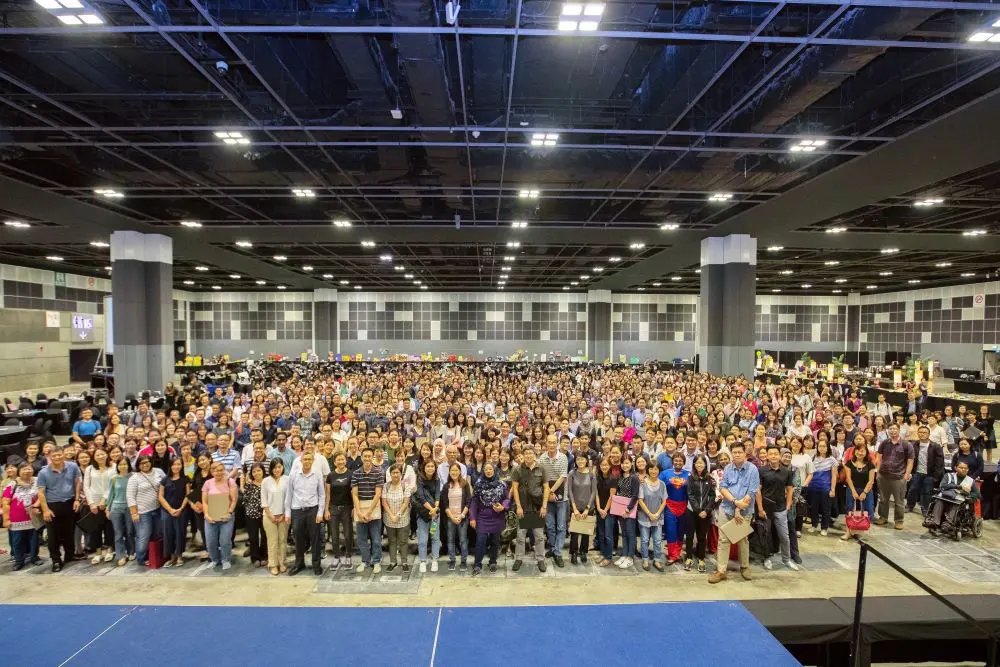
Team Building Events Gallery - Group Photo
Categories
Blogs

Team Building Activities for 100+ Employees in Singapore

Team Building Activities for 100+ Employees in Singapore: What Works at This Scale

For a team building event of 100 or more employees in Singapore, the formats that work most consistently are Mini Olympics and Corporate Sports Day, Amazing Race, Property Typhoon and free-for-all station events, Running Man-style cluster games, indoor active formats, and collaboration build activities. But at 100 pax, the activity is no longer the main variable. Team structure, registration flow, briefing clarity, facilitator deployment, venue space and wet weather planning all start to shape the experience as much as the activity itself.

Having run hundreds of large corporate events in Singapore, including programmes for groups of 100, 200, 500 and above, what we see consistently is this: at 100 pax, an event is still personal enough to feel like one shared company experience, but large enough that poor structure becomes obvious very quickly. The activities that work are not necessarily the most complex ones. They are the ones that can split a group into smaller teams, keep everyone active, and still bring the full room back together for a strong shared moment.

Why 100 Pax Is a Different Planning Threshold

100 pax is not a mega-event. It is also no longer small enough to run casually. A 40-pax format cannot simply be scaled up by inviting more people. The team structure, facilitator deployment, briefing approach and venue layout all need to be redesigned for the headcount.

At smaller scale, you can usually adjust on the spot. At 100 pax, every delay is multiplied across the group. Three minutes of confusion at registration is 300 minutes of wasted experience. A briefing that is one minute too long for 30 people is uncomfortable for 100. The planning lens has to shift from “what activity do we do” to “how does this activity actually run for 100 people”.

Before confirming anything, work through these questions:

  • Can everyone participate at the same time, or will some teams be waiting?
  • How many teams should the group be split into, and how will teams be assigned?
  • Will any station create a bottleneck?
  • Can the emcee brief the full group clearly from one point in the room?
  • Are there enough facilitators to manage stations, scoring and questions simultaneously?
  • Does the venue have enough usable activity space, not just enough chairs?
  • What happens if it rains, or if a significant group arrives late?

The Ideal Team Size for 100 Employees

For 100 pax, the most workable team size is 8 to 10 people per team. That gives you around 10 to 12 teams, which is a comfortable number for scoring, station rotation and facilitator coverage.

Beyond 10 to 12 people per team, quieter participants start to disappear into the background. A team of 15 has too many opinions, too much overlap on roles, and not enough opportunities for individual contribution within a single segment. Teams that are too small create a different problem: too many teams to manage, more scoring overhead, and a higher load on the facilitation crew.

Team structure also affects how the event moves. Smaller teams move faster between stations and queue less. Larger teams take longer to make decisions and slow down transitions. For a 100-pax event, 8 to 10 per team is the size that consistently produces the right balance of participation quality and event flow.

Best Team Building Activities for 100+ Employees

The activities below are the formats that scale most reliably at the 100 to 150 pax range. None of them is automatically the right choice. The right one depends on group profile, venue, weather plan and what the event is trying to achieve.

1. Mini Olympics and Corporate Sports Day

Mini Olympics team building works well at 100 pax because it is built around multiple stations and small teams running in parallel. Everyone stays active, waiting time is minimised, and the energy holds because nobody is standing around watching one team play.

The mistake to avoid is making every station overly physical. A good Mini Olympics for a corporate group mixes telematch-style warm-up games, simple relays, coordination challenges, non-contact sports, archery-style or target-based games and strategy stations. The point is participation across mixed fitness levels, not athletic performance. For 100 pax, Mini Olympics is often easier to control than a fully open-route outdoor race because everyone stays in a defined activity area where the facilitation team has visibility on every team at every moment.

2. Amazing Race-Style Team Building

Amazing Race team building brings movement, exploration and an element of adventure that station-based formats cannot replicate. For 100 pax, route planning is what makes or breaks it. Checkpoints need to be close enough to avoid excessive walking in Singapore heat, but spread out enough to prevent two teams arriving at the same station at the same time.

Things to lock in early: team pre-assignment, clear route design with realistic distances, station capacity rules, wet weather backup, and instructions simple enough to read on the move. Amazing Race scales well from 100 to around 200 to 300 pax. Beyond that, the experience starts to dilute as too many teams converge on the same checkpoints, and a cluster or free-for-all format usually works better. For larger crowds, see our guide on team building activities for large groups.

3. Property Typhoon and Free-for-All Station Formats

Property Typhoon and other free-for-all formats give teams autonomy. Instead of moving through a fixed rotation, teams choose which stations to visit and how to spend their time. This works well for 100 pax because it absorbs mixed interests and mixed fitness levels without forcing the whole room into the same activity at the same time.

The advantage is flexibility. The risk is fragmentation. Without a clear storyline, scoring system or shared objective tying everything together, a free-for-all event can feel scattered and lose its sense of being one shared experience. For 100 pax, this format works best when it has a strong unifying narrative, visible live scoring, and a finale that pulls everyone back into the same room for the result.

4. Running Man-Style Team Building

Running Man team building holds up well at 100 pax because it combines movement, teamwork, humour and simple missions in a format that feels collective rather than competitive in a strict sense. It is worth saying clearly: Running Man-style games are not necessarily intense. Many of the games are movement-based but not physically demanding, and the format includes communication, memory, observation, quick decision-making and light physical challenges.

For 100 pax, the format can run as an all-together event, a station-based rotation, a cluster setup, or a mix of mass games and breakout challenges. The format choice depends on the venue and the group. Whatever the structure, keep the rules simple. At 100 pax, every additional rule is another instruction the emcee has to land cleanly across the full room.

5. Indoor Active Team Building

Indoor team building activities deserve their own mention for a Singapore-specific reason: heat and rain. An air-conditioned space helps participants maintain energy across a half-day programme and is more inclusive for mixed-age groups, participants in office attire, and anyone with physical limitations.

Indoor active formats include game show challenges, Running Man-inspired missions, team relays, station-based activities, strategy games, light physical challenges and collaboration games. The non-negotiable for 100 pax is venue: the room needs to have enough activity space, not just enough chairs. A function room that seats 100 comfortably may not have the floor area for movement-heavy activities. Always confirm activity footprint, not seated capacity.

6. Collaboration and Build-Based Activities

Build-based programmes such as Chain Reaction, Coaster Adventure, One World Pipeline, The Big Picture and Build A Dream Team work well at 100 pax because each team contributes a smaller part to a larger shared outcome. The reveal at the end, when the contributions come together into one visible result, lands strongly with a full room.

There are two things to plan for at this scale. First, build activities work best when paired with one or two short lead-up games to warm up the room. Going straight into a build from a cold start, with 100 people who do not yet know what is expected, produces a slow first 15 minutes. Second, watch for passive participation. In a team of eight, it is easy for two or three people to do most of the building while others spectate. The format design needs to allocate clear roles so every participant has something to do.

Indoor vs Outdoor Team Building for 100 Pax

Both indoor and outdoor work at 100 pax. The trade-offs are different and worth being honest about.

Outdoor formats bring movement, exploration and the kind of energy that a function room cannot replicate. They also bring heat, weather risk and route management. For Singapore, wet weather backup is not optional, it is part of the plan from day one. Outdoor at 100 pax also needs route control: how participants move between checkpoints, how the crew tracks teams, and how the schedule absorbs delays.

Indoor formats give comfort and control. Game shows, collaboration builds, indoor Running Man-style games, strategy challenges and active indoor activities all run well at 100 pax in a well-sized function room or ballroom. The trade-off is a more contained experience: less open movement, less use of natural energy, and a higher dependence on the emcee to drive pacing.

A useful rule of thumb: choose outdoor if the group is active and open to movement. Choose indoor if comfort, inclusiveness and controlled flow matter more. Choose hybrid (indoor base with selected outdoor segments) if the organiser wants movement but needs a reliable fallback.

How to Keep 100 Employees Engaged

The first 30 minutes of a 100-pax event decides the energy of the room for the rest of the programme. If registration drags, if team allocation is unclear, or if the briefing feels too long, a significant portion of the room starts the activity already half-disengaged. Recovering from a slow first 30 minutes is much harder than getting it right in the first place.

A strong 100-pax flow usually looks like this:

  • 15 to 30 minutes for arrival and registration, with a clear holding plan for early arrivals
  • Short welcome and clear briefing, supported by slides and demonstration
  • Simple opening energiser to lift the room energy
  • Main activity in teams or clusters
  • Visible scoring updates or progress points to keep stakes alive
  • Strong finale and prize presentation to close on a high

The emcee plays a much bigger role at 100 pax than at smaller events. They cannot just read instructions off a script. They need to manage crowd energy, simplify rules in the moment, control transitions and bring the full group back together cleanly between segments. A weak emcee at 100 pax is one of the fastest ways to lose a room.

Registration and Briefing Matter More Than Organisers Expect

Registration is not just marking attendance. At 100 pax, people arrive late, look for colleagues, check which team they are on, ask questions about timing and food, and figure out where they are supposed to be. None of this is unusual, but none of it happens cleanly without a plan.

For 100 pax, build registration around these elements:

  • Pre-assigned teams shared in advance, so participants know their team before they arrive
  • A clear registration point that is visible from the entry
  • Visible team lists, signage or QR check-in for faster processing
  • A holding area or activity zone for early arrivals so the room does not feel empty and waiting
  • A latecomer plan, including how late arrivals join their team without disrupting the briefing
  • A 15 to 30 minute arrival window, not a single hard start time
  • Music or light engagement during the arrival window to keep the room warm

Briefing at 100 pax needs to be simple and visual. Verbal instructions alone are not enough, because at this scale you cannot read the room to check whether the message landed. Use slides, physical demonstrations, clear examples and facilitator support on the ground. A briefing that works well for 30 people, where the facilitator can read the room and clarify, will not work for 100 without being redesigned.

How Many Facilitators Are Needed for a 100-Person Event?

For a 100-pax corporate team building event, plan for 8 to 10 event crew. The exact number depends on the activity format and venue layout, not just headcount.

A typical crew structure includes a lead emcee, station facilitators covering each activity zone, logistics crew managing equipment and transitions, registration support for the arrival window, scoring support for competitive formats, and an overall event lead handling timing and the run sheet. These roles are not interchangeable. A facilitator running a station cannot also manage registration. A scoring lead cannot also handle the music cues.

Manpower should be sized to the structure of the activity, not just the headcount. A simple indoor game show may need fewer facilitators than an outdoor Amazing Race because the latter requires people stationed across multiple checkpoints simultaneously. Station-based events generally need enough facilitators to staff every station at the same time, plus one or two floaters to manage timing and gaps. Under-facilitating a 100-pax event is one of the most visible failure points on the day: stations stall, transitions drag, and the emcee ends up carrying more than they should.

50 Pax vs 100 Pax vs 150 Pax: What Changes?

The jump from 50 to 100 pax is bigger than most organisers expect. The jump from 100 to 150 pax is smaller in scale terms but starts to push the event toward large-group territory. The table below sets out what changes at each step.

Planning Element

50 Pax

100 Pax

150 Pax

Team structure

5–6 teams of 8–10

10–12 teams of 8–10

15–18 teams or cluster groups

Briefing

Verbal works; easy to clarify

Slides, demo and facilitator support needed

Slides, demo, multiple briefing leads

Registration

Single registration point is fine

Planned flow, holding area, latecomer plan

Multiple lanes, dedicated registration crew

Facilitation crew

4–6 crew

8–10 crew

10–14 crew

Format options

Wide; easier to adjust on the spot

Station-based, cluster, all-together — all viable

Cluster or station-based preferred

Venue

Standard function room

Confirm activity space, not just seating

Larger ballroom or multi-zone venue

AV and crowd movement

Basic PA system

Strong PA, clear sightlines for briefing

Stronger AV, planned crowd flow paths

Adjustability on the day

High

Medium — plan first, adjust second

Low — most decisions need to be locked in advance

What to Ask Before Confirming a 100-Pax Team Building Activity

This is the section most vendors skip in their proposals. These are the questions worth asking before committing to any activity:

  • How many teams will the group be split into?
  • What is the recommended team size?
  • Will everyone be active at the same time, or do teams rotate?
  • How long does the briefing take?
  • How many facilitators will be deployed, and what does each role cover?
  • How many stations or activity zones are there?
  • Will there be waiting time between stations, and if so, how is it managed?
  • What happens if it rains?
  • Is the venue suitable for activity space, or only for seating?
  • How will scoring be managed and made visible?
  • How will latecomers be handled?
  • Is the activity suitable for mixed age groups and different fitness levels?

Most of these questions can be answered in a single email exchange. If a vendor cannot answer them clearly, that is the answer.

How Much Does Team Building for 100 Employees Cost in Singapore?

Cost for a 100-pax corporate team building event in Singapore depends on activity format, venue type, manpower, food and beverage, props, logistics, customisation and production requirements. For a well-facilitated half-day event with venue and basic catering, most groups land in the range of $80 to $200 or more per person, depending on the choices made across these categories.

When comparing quotes, the more useful question is what is actually included. Confirm:

  • Facilitator count and crew structure
  • Emcee support
  • Props and equipment
  • Scoring and live display
  • Logistics and transport
  • Registration support
  • Prizes and door gifts
  • Water and refreshments during the activity, not just at the meal break
  • Wet weather planning
  • Venue and F&B

For a full line-by-line breakdown of what each budget category typically covers, see our corporate team building budget guide.

Final Thoughts: The Best 100-Pax Activities Are Designed, Not Just Chosen

For 100 or more employees, the best team building activity is not the one that sounds most exciting on a proposal. It is the one that can scale without losing engagement.

A good 100-pax event keeps waiting time low, makes instructions easy to follow, gives every participant something meaningful to do, and still creates a shared company-wide moment that people remember. The activity matters. But team structure, facilitation, briefing clarity, venue fit and the first 30 minutes of the programme matter at least as much.

The simplest test before you confirm anything: can this format actually keep 100 people involved from start to finish? If you cannot answer that confidently, the design is not ready yet.

For broader context on running a corporate event at this scale, see our guides on how to plan a corporate team building event and team building in Singapore.

Read our articles about Best Team Building Activities in Singapore and How to Choose the Right Team Building Activity.

Contact us here to enquiry or learn more about our activities. Click here to read more articles like this.

Frequently Asked Questions

For 100 pax, the formats that scale most reliably are Mini Olympics and Corporate Sports Day, Amazing Race, Property Typhoon and free-for-all station events, Running Man-style cluster games, indoor active formats, and collaboration build activities. The right choice depends on group profile, venue, weather plan and what the event is trying to achieve, not just which format sounds most exciting.

8 to 10 people per team. That gives around 10 to 12 teams, which is the right balance for scoring, station rotation and facilitator coverage. Beyond 10 to 12 per team, quieter participants tend to disengage. Smaller teams create more overhead in scoring and facilitation.

The first 30 minutes sets the tone. A smooth arrival window, a clear briefing supported by slides and demonstration, a strong opening energiser, visible scoring through the main activity, and a finale that brings the full group back together are the elements that consistently hold engagement at this scale. A strong emcee is non-negotiable.

Plan for 8 to 10 event crew, structured across lead emcee, station facilitators, logistics support, registration crew, scoring support and an overall event lead. The exact number depends on activity format and venue layout. Outdoor station-based events typically need more facilitators than a single-room game show.

Yes, and for many Singapore groups indoor is the more practical choice given heat, humidity and rain risk. Game shows, collaboration builds, indoor Running Man-style games, strategy challenges and active indoor formats all work well at 100 pax. The non-negotiable is venue: confirm activity floor space, not just seated capacity.

Yes. Amazing Race scales well from 100 to around 200 to 300 pax with proper route planning, team pre-assignment, station capacity rules and a confirmed wet weather backup. Beyond that range, the experience starts to dilute as too many teams converge on the same checkpoints, and a cluster or free-for-all format usually works better.

For a well-facilitated half-day event with venue and basic catering, most 100-pax groups in Singapore land in the range of $80 to $200 or more per person. The exact figure depends on venue type, activity format, manpower, customisation and add-ons. When comparing quotes, focus on what is included rather than the headline rate.

Team Building Events Gallery - Group Photo
Categories
Blogs

How to Choose a Team Building Vendor in Singapore

How to Choose a Team Building Vendor in Singapore

What to Look For and What to Watch Out For

There is no shortage of team building vendors in Singapore. A search will surface dozens of providers ranging from full-service event companies with dedicated facilitation teams to one-person operators running a single format. From the outside, the market is difficult to read. Proposals look similar. Pricing varies considerably. And because the quality of the experience depends almost entirely on what happens on the day, it is hard to evaluate a vendor before you have committed to them.

This guide is for HR managers, L&D professionals, and corporate event organisers who want a structured way to evaluate team building vendors in Singapore, starting from whether to hire a vendor at all, through to the specific questions you should ask before signing.

Should You Organise In-House or Hire a Vendor?

The first decision is not which vendor to choose. It is whether to use a vendor at all. Both approaches are viable. The right choice depends on your internal capacity, the scale of the event, and the kind of experience you want to create.


Organising In-House

Hiring a Professional Vendor

Cost

Lower direct cost; no event management fees

Higher cost; reflects expertise, equipment, facilitation, and logistics management

Time and effort

Significant internal time required for planning, logistics, and day-of management

Most planning and day-of operations handled by the vendor; internal team can participate fully

Quality of experience

Depends heavily on internal capacity and experience; higher risk of gaps in facilitation quality

Consistent, professionally designed and facilitated experience

Flexibility

Easy to adjust plans in real time; no external dependencies

Changes require vendor coordination; less agile for last-minute shifts

Objective viewpoint

Internal planners may bring unconscious bias or limited perspective to activity design

External vendor brings fresh perspective; no internal dynamics or preferences affecting design

Best for

Small teams, limited budget, simple activities, strong internal event capability

Larger groups, higher-stakes events, where quality and participant experience matter most

One factor worth naming directly: when internal staff organise the event, they are managing it rather than participating in it. The person running registration, managing logistics, and tracking the run sheet on the day is not fully present as a colleague. A professional vendor handling the operational weight frees your team to show up as employees, which is often the point of the event.

For most medium to large corporate events in Singapore, the case for using a vendor is strong. The expertise gap is real, the time cost of internal planning is often underestimated, and the difference between a professionally facilitated event and a self-organised one is visible on the day.

How to Find and Shortlist Vendors

Start with a straightforward search. Most reputable team building vendors in Singapore maintain a strong search presence. Look through each vendor’s website to get a sense of the activities they offer, the scale they work at, and the clients they have worked with.

Pay close attention to the photography. A vendor’s real event photos are one of the most reliable indicators of what you will actually get. Many vendors use stock images or heavily staged shots on their websites. Check their gallery, their social media, or ask directly for event photos from past programmes. Real photos from real events, showing real participants engaged in the activity, tell you far more than a polished proposal document.

Shortlist two to four vendors to contact properly. When you reach out, provide as much information as possible upfront. The more context a vendor has, the more accurate their proposal will be, and the better you can assess whether they have genuinely understood your brief. Key information to provide:

  • Event date and time
  • Expected number of participants
  • Participant demographics: mix of seniority, departments, age range, any specific diversity considerations
  • Your objectives for the event
  • Any activities you have run previously that participants have enjoyed or found less effective
  • Preferred location or venue type
  • Budget range

How a vendor responds to this brief is itself an evaluation signal. Do they read it carefully and ask follow-up questions, or do they send a generic proposal that could have been written for anyone? A vendor who engages with your brief is more likely to design an event that serves your actual situation.

The Five Things That Actually Determine Quality

1. Who Is Running the Event on the Day

This is the single most important question to answer before confirming any vendor, and the one most commonly glossed over in the sales process.

Most team building providers in Singapore use external facilitators rather than full-time employees. This is standard practice and not inherently a problem. What matters is the layer above the facilitators: whether the provider actively trains, manages, and maintains quality standards across the people they deploy, or whether facilitators are simply sourced on demand and parachuted in with minimal oversight.

A provider with a well-managed external facilitation pool, where facilitators are trained in the specific programmes and consistently briefed before events, delivers reliably consistent results. The facilitators know the formats, they have run them many times, and there is a clear standard they are held to. This is very different from a provider who outsources facilitation to whoever is available, with no training investment and no quality accountability.

The same applies to the host or emcee role. A professionally trained host who has experience in corporate team building reads a room differently from a general events host or an everyday person pressed into the role. The ability to manage energy, keep timing, and adapt to an unexpected moment on the day is a trained skill. Ask what the host’s background is and how they are prepared for a programme like yours.

The question to ask: how do you train and manage the facilitators and hosts you deploy? A provider who has thought about this will give you a specific answer. A provider who hasn’t will pivot to describing the programme instead.

2. Whether the Programme Is Genuinely Customised

Most providers say they customise. Very few do it in any meaningful way. The difference between genuine customisation and superficial personalisation is one of the most important distinctions in the market, and almost impossible to detect from a proposal alone.

Superficial personalisation: your company name appears in the slides, one activity element has been renamed to reference a company value, the programme is otherwise identical to the one delivered to every other client.

Genuine customisation: the programme has been configured to serve your group profile, your objective, and the specific dynamics of your event. Team compositions are structured with a purpose. The warm-up is designed for the energy level and familiarity of your specific group. The activity format has been chosen because it is the right fit for your people, not because it is the vendor’s easiest offering.

The clearest signal of genuine customisation is the quality of questions a vendor asks before making a recommendation. A vendor who proposes a specific programme before understanding your group composition and objective is selling off a menu. A vendor who asks about these things first and uses the answers to shape the recommendation is doing the real work.

3. The Scope of What They Manage

Before committing to any vendor, map out everything that needs to happen between brief and event completion, and ask explicitly which items the vendor owns versus which remain with you.

Areas where scope is often unclear include: registration management and participant flow on arrival, directing latecomers, emcee coverage and whether it is included or an add-on, setup access and teardown coordination, and post-event logistics. A vendor who cannot give you a clear and specific breakdown of their scope and yours is a vendor who may create gaps on the day.

Full-service providers take end-to-end ownership: programme, facilitation, equipment, emcee, setup, and often logistics coordination. Your internal team’s role is limited to providing the brief, managing participant communications, and being present on the day. For organisations with limited event management capacity, this model reduces coordination overhead significantly.

4. What Is Included and What Is Not

A vendor’s headline price rarely tells the full story. Before accepting any quote, get explicit clarity on what the price covers and what it does not.

The baseline to check: is a professional emcee included, or is facilitation limited to activity running? What equipment is provided, and is it appropriate for your group size and format? Is there a specific list of games and activities within the programme, and how much range or flexibility is there? Can you see photos of the equipment and activity setups in use at real events?

Common items that are sometimes excluded from initial quotes and added later: customisation that was described as standard, additional facilitators above a minimum ratio, transport of equipment to the venue, and any F&B or catering coordination. Before signing, ask: is this quote the full cost for what we have discussed? Are there items commonly added at a later stage? A vendor who is confident in their pricing will answer both without hesitation.

An apple-to-apple comparison across vendors requires getting to a consistent scope baseline. If one quote includes emcee, full equipment, and facilitation at a certain ratio, and another quote does not, comparing headline prices is misleading. Clarify the scope of each quote before treating them as comparable.

5. How They Communicate: Including When They Are Busy

The way a vendor communicates throughout the sales and planning process is a reliable signal of how they will operate when it matters. This includes not just how quickly they respond, but the quality and attentiveness of the response itself.

A vendor who sends a thoughtful, specific reply to your initial inquiry, even if they are at capacity, is demonstrating the same quality of attention they will bring to your event. A vendor who sends a generic reply, deflects details, or takes an unreasonable amount of time to follow up on straightforward questions is showing you the operational standard to expect.

This matters especially when the vendor is busy. Any provider worth working with will have periods of high demand. The quality of their response under pressure, whether they are still attentive, clear, and proactive even when stretched, is often more revealing than their response when they have plenty of capacity.

Check their event photography and the overall standard of how they present themselves. Providers who take their own work and presentation seriously tend to take their clients’ events seriously.

Payment Terms and Contracts: What to Check

Before confirming any vendor, review the commercial and contractual terms as carefully as you review the programme.

Payment terms vary across the market. Most vendors require a deposit to confirm the booking, with the balance due before or on the event date. Understand the payment schedule, what the deposit confirms, and whether it is refundable under any circumstances.

Cancellation and postponement policy is one of the most important terms to check and one of the most often overlooked. Understand: what is the policy if you need to cancel, at what notice period do charges apply, and what does the vendor’s policy look like if they need to cancel or make a significant change to the programme? The answer tells you about the vendor’s confidence in their own reliability and how they handle risk sharing with clients.

Confirm that the quote you are signing against is all-in. Ask directly: does this cover everything required to run the event as described, or are there additional costs that commonly arise after this stage? A clear, confident answer to this question is a signal of a well-run operation. Evasiveness or a list of potential add-ons at this point is worth noting.

Red Flags to Watch For

Great Proposal, Generic Questions

A strong proposal produced without meaningful questions about your group and objective is almost always a template. It has been sent to dozens of clients with minor surface-level changes. Ask yourself honestly: did this vendor learn anything specific about us before making this recommendation?

Stock Photos or Limited Real Event Photography

A vendor who cannot show you recent, real photography from events of comparable scale and format to yours is a vendor whose actual event quality is unverified. Proposals are easy to write well. Events are harder to run well. Real photos are one of the most honest indicators of what the experience actually looks like on the day.

Vague Answers to Operational Questions

Questions about facilitation team composition, emcee coverage, equipment, and what happens if something goes wrong should produce specific, confident answers. If a vendor becomes vague or deflects when you ask who will actually be running the event, how many facilitators will be on the ground, or what the contingency plan is, that usually reflects either inexperience or a delivery model they prefer not to explain in detail.

Costs That Keep Appearing After the Initial Quote

A well-run vendor provides a clear, comprehensive quote that covers the full scope of what has been discussed. If additional costs appear through the planning process that were not disclosed upfront, this reflects either a low-ball quoting strategy or a disorganised commercial process. Either way, it makes budgeting unreliable and creates friction when it should not exist.

One Format, Every Client

A vendor who recommends the same programme to every client regardless of group profile or objective is not doing consultative work. They are selling what they have. A reputable vendor should be able to offer a genuine range of activities suited to different objectives, demographics, and group sizes, and should be able to explain specifically why a particular format is the right choice for your situation.

The Evaluation Checklist

Area

What to Ask

What to Look For

Facilitation and hosting

How do you train and manage the facilitators and hosts you deploy?

Specific answer on training approach, programme briefing process, and quality standards; not a deflection to programme content

Customisation

How did you arrive at this recommendation for our group?

Specific reference to your brief, group profile, and objective

Scope

What do you manage vs what does our team handle?

Detailed breakdown across planning and event day including emcee, registration, setup

Inclusions

What is included in this quote and what is not? What is commonly added later?

Comprehensive answer: emcee, facilitators, equipment, games range all clarified

Photography

Can you share real event photos from events similar to ours?

Recent, real photography at comparable scale and format; no stock images

Payment and terms

What are the payment terms, deposit, and cancellation policy?

Clear schedule; cancellation terms disclosed upfront; no surprises

All-in confirmation

Is this the full cost for what we have discussed?

Direct yes, with any genuine exceptions explained clearly

Communication quality

Assess across the full inquiry process

Specific, attentive, proactive, including when the vendor is busy

Full-Service vs Programme-Only: Choosing the Right Model


Full-Service Provider

Programme-Only Provider

What they manage

Programme, facilitation, emcee, logistics, equipment, often catering coordination

Programme and facilitation; venue, catering, logistics managed by client

Best for

Teams with limited internal event capacity; single point of contact preferred

Teams with strong internal support or specific venue and catering preferences

Planning involvement

Provider manages most operational detail; client focuses on brief and participant comms

Client carries more coordination responsibility throughout planning

Day-of experience

Provider team handles setup, transitions, wrap-up; client participates fully

Client team manages more on-the-day logistics alongside provider facilitation

Cost

Higher, reflecting broader scope

Lower headline cost; client absorbs coordination overhead

Evaluating Team Building Vendors in Singapore?

We are happy to answer every question on this list. Tell us your group size, event date, and what you want your team to experience, and we will send you a comprehensive proposal covering programme, facilitation, logistics, and full pricing with no surprises.

Read our articles about Best Team Building Activities in Singapore and How to Choose the Right Team Building Activity.

Contact us here to enquiry or learn more about our activities. Click here to read more articles like this.

Frequently Asked Questions

For small teams with a limited budget and strong internal event capability, organising in-house can be a practical choice. For most medium to large corporate events, hiring a professional vendor produces a meaningfully better experience. The expertise gap is real, the time cost of internal planning is consistently underestimated, and the difference between a professionally facilitated event and a self-organised one is visible to participants. The other consideration is participation: internal organisers manage the event rather than experience it, which defeats part of the purpose.

Not by itself, no. Most team building providers in Singapore work with external facilitators, and this is standard practice across the industry. What matters is whether the provider has genuine management and training in place. A provider who trains their facilitators in specific programme formats, briefs them properly before each event, and holds them to a quality standard delivers consistent results regardless of employment structure. The risk is with providers who source facilitators on demand with no training investment. Ask specifically how a vendor prepares and manages the people they deploy, rather than asking about employment terms.

The only way to compare meaningfully is to get every quote to the same scope baseline. Ask each vendor whether their quote includes an emcee, the full facilitation team at an appropriate ratio for your group size, all equipment and props, setup and teardown, and any customisation discussed. If the scope is different across quotes, either ask the vendors to requote on a consistent basis or add up the true cost of the missing items before comparing. Comparing headline prices across different scopes is a reliable path to choosing the wrong vendor.

A fair cancellation policy typically applies charges on a sliding scale based on notice period: full refund or minimal charge for cancellations well in advance, partial charges as the event date approaches, and a higher charge or no refund for very late cancellations that leave the vendor unable to redeploy resources. What matters is that the policy is disclosed clearly before you sign, is proportionate, and covers both directions: what happens if you cancel, and what happens if the vendor needs to make a significant change. A vendor who cannot articulate their cancellation terms clearly before signing is one to probe further.

An apple-to-apple comparison means evaluating quotes at an equivalent scope. Team building proposals often differ in whether they include an emcee, the number of facilitators, the range of games or activities covered, equipment quality, and logistics management. If you are comparing a quote that includes all of these with one that covers only the activity and a single facilitator, the lower-priced option may not be cheaper once the missing items are accounted for. Ask each vendor to describe precisely what their quote includes before treating the numbers as directly comparable.

It matters as a signal of experience and flexibility more than as a direct benefit. A vendor with a broad and well-developed programme repertoire has typically run enough events to know which formats work for which group profiles. When they recommend a specific activity for your situation, that recommendation is informed by real experience rather than defaulting to the one format they know. It also gives you confidence that if your requirements change, the vendor can adapt rather than having to start the selection process again.

Look at the quality of their communication across the whole inquiry process, not just the speed. A vendor who gives you a specific, well-considered reply that demonstrates they read your brief carefully is showing you the same attention they will bring to your event. Speed matters, but attentiveness and quality matter more. Pay particular attention to how they respond when they are clearly busy: a vendor who maintains quality communication under pressure is a more reliable operating partner than one who only communicates well when they have plenty of capacity.

Team Building Large Group Size Shot
Categories
Blogs

Team Building for New Employee Onboarding in Singapore: A Guide for HR and L&D Managers

Team Building for New Employee Onboarding in Singapore: A Guide for HR and L&D Managers

When a new batch of employees joins an organisation, the way the first few weeks are structured has a lasting effect on how quickly they integrate, how comfortable they feel, and how long they stay. A well-designed onboarding team building programme is one of the most effective tools HR and L&D managers have for accelerating that process. But the way most organisations approach it leaves a significant amount of value on the table.

This guide is written for HR and L&D managers planning team building for batch hires: graduate intakes, large cohort joiners, or any situation where a significant number of new employees join at the same time and need to build connections with each other and with the organisation quickly.

Why Onboarding Team Building Is Different

An onboarding team building event is not the same as a regular corporate team building event. In a standard team building event, participants already know each other. There are existing relationships, informal dynamics, and a shared context to work with or reshape. The facilitator is working with something that already exists.

In a batch hire onboarding event, nobody knows anyone. Every participant is in the same position: new, uncertain, trying to read the room, and forming their first impressions of the company and the people in it. The stakes are higher because first impressions are hard to reverse. And the opportunity is larger because the connections formed in the first few weeks tend to be the ones that last.

An onboarding team building programme that works does several things at once. It accelerates connection between new hires who would otherwise take months to build familiarity organically. It communicates something about what the company’s culture actually feels like, not through a slide deck but through direct experience. And it gives new employees a shared memory before the formal onboarding content begins, which makes everything that follows land slightly differently.

Done well, new hires leave the day with names they recognise, faces they remember, and the beginning of genuine comfort in a new environment. That is a meaningful head start on integration, and it has a measurable effect on early engagement and retention.

Beyond the Activity: Curating a Full Onboarding Experience

Team building for onboarding does not have to mean a single activity bolted onto an induction schedule. For organisations that want a more intentional approach, it is possible to design an onboarding programme that weaves team building throughout the day rather than treating it as a separate block.

We have worked with government agencies and large organisations to design and manage full onboarding launch programmes, including fireside chats with senior leaders, coordinated segment handoffs between departments, exploratory activities that introduce participants to the organisation, and team building experiences woven into the flow of the day. In these programmes, team building is not a standalone event. It is the connective tissue between the different parts of the day, keeping energy and connection high across what is otherwise a content-heavy experience.

For HR teams who want to design an onboarding experience rather than just book an activity, this kind of curated programme is worth considering. It requires more planning and closer collaboration with the provider, but it produces a meaningfully different experience for new hires, one that feels cohesive rather than assembled from parts.

When to Run the Onboarding Team Building Event

The timing question is one HR managers get wrong more often than any other. The instinct is to run the team building event once new hires have had a few days to settle in, usually at the end of the first week or into the second week. The reasoning is that it feels less overwhelming after some initial orientation.

In practice, the first day or two of onboarding is often the lowest-connection period of a new employee’s tenure. People sit through inductions, work through paperwork, and spend time with their individual hiring managers. There is very little structured opportunity to build relationships with the cohort. Running the team building event in the first two to three days, before habits form and before people start retreating to their separate departments, is typically more effective.

The general principle: run the team building event early enough that the connections formed become the baseline for how the cohort relates to each other throughout the rest of onboarding, not an afterthought at the end.

Timing

What Happens

Our Take

Day 1 or 2

Runs during the initial orientation block; everyone is equally new and the ice breaking stakes are low

Works very well for batch hires; sets the tone immediately

End of Week 1

Some familiarity exists but cohort connections are still forming; team building consolidates early impressions

Good option if day 1 logistics do not allow it

Week 2 or later

Informal cliques and comfort zones have already started to form; harder to break through

Less effective for integration; better positioned as a morale event than a bonding one

Onboarding Team Building Formats That Work

Not all team building formats translate equally well to an onboarding context. The dynamics of a batch hire group, where everyone is equally new and nobody has an existing social anchor, favour certain approaches over others.

Formats that work well for onboarding share a few characteristics. They force genuine interaction across the cohort, not just within fixed small teams. They have a warm, inclusive energy that does not require existing confidence or familiarity to participate. They move quickly enough that quieter participants are carried along by the structure. And they generate shared experiences that participants can reference with each other afterward.

The warm-up structure matters more in an onboarding event than in almost any other context. In a regular team building event, some participants already know each other and can carry the early energy. In an onboarding event, nobody has that resource. A mass energizer and a well-designed ice breaker do real work here: they drop the social guard before the main activity begins. Without them, even a well-designed programme gets off to a slow start.

Running Man: High Energy, Large Cohorts, Instant Shared Memory

Running Man is a game-show inspired format built around a series of fun team games, with an all-team battle finale that brings the full cohort together. It works particularly well for onboarding because the activities are designed to be light, entertaining, and inclusive. The format removes the awkwardness of structured socialising by giving participants something to do together before they have to figure out what to say to each other.

For large batch hires of 80 to 300 participants, Running Man handles scale well. The team structure means participants are immediately placed into groups with people they do not know, which accelerates connection. The game-show energy and the shared finale create a genuine group memory on day one. This suits companies with an energetic, high-performance, or informal culture.

Build A Dream Team: Connection Through Shared Discovery

Build A Dream Team is a series of table-based team games that builds in intensity across the session. The learn-through-play philosophy makes it well suited to onboarding because the experience is designed around discovering what a high-performing team looks and feels like, through doing rather than being told.

For new hires who are absorbing the company’s culture and values, the experience of working through a series of escalating challenges with people they have just met creates a natural conversation about how teams work well. It is not a presentation on collaboration. It is an experience of it. Build A Dream Team works well for professional services, banking, and consulting cohorts of 20 to 100 participants.

Amazing Race: Explore, Move, Connect

Amazing Race is a sequential checkpoint race where teams navigate between stations and complete challenges at each one. For onboarding events with space to move, it is effective because participants spend sustained time with a small group of new colleagues, which builds genuine familiarity rather than surface-level introductions. Checkpoints can also incorporate company-specific content, such as questions about the organisation’s history, values, or work, without it feeling like a quiz.

Amazing Race is best suited to cohorts of up to 150 to 200 participants. Above that threshold, checkpoint congestion reduces the smoothness of the experience. For larger batches, Running Man or formats with simultaneous play are more suitable.

Explore the New Office: A Different Kind of Onboarding Experience

For companies moving into a new building or welcoming a batch hire into a space that is new to everyone, an exploratory onboarding programme built around the office itself is one of the most effective ways to help people feel at home quickly.

We have worked with multiple companies relocating to new developments across Singapore, including Guoco Midtown and Punggol Digital District. These programmes are designed to help employees discover not just the facilities and layout of their new workplace, but the surrounding area: the good food options, the budget finds, the quiet spots, the facilities worth knowing about, the things that make working in that location part of daily life rather than just a commute to a new building.

The format typically combines structured exploration with team-based discovery challenges. Teams move through the space or neighbourhood with a set of missions that encourage them to find things, ask questions, and share what they discover. The result is that participants leave knowing their new environment and knowing each other, both of which are genuinely useful outcomes for any new hire.

For onboarding cohorts joining a company in a new space, this format has a practical advantage over standard activity-based team building: the content is directly relevant to their daily work life. Knowing where to eat lunch, where the best quiet desk is, or which facilities are worth using is not trivial. It is the kind of local knowledge that usually takes months to accumulate informally. A well-designed exploration programme compresses that learning and delivers it as a shared experience with new colleagues.

Values and Culture Integration: Bonding With Purpose

For organisations where onboarding has a strong values or culture dimension, team building can be designed around shared purpose rather than pure activity. We have worked with government agencies to create onboarding programmes that go beyond social bonding: programmes that help new hires understand and internalise the organisation’s values through structured shared experiences.

This has included formats designed around the concept of batch friendships, where cohort members are paired or grouped in ways that encourage sustained connection beyond event day. It has also included experiences that incorporate working with difference, including programmes designed around disability inclusion awareness, where new hires engage with the organisation’s commitment to an inclusive workplace through activity rather than a workshop.

Values-based onboarding programmes require closer collaboration between the HR team and the event provider, because the activity design needs to serve a specific outcome rather than simply deliver an enjoyable experience. But when it works, the result is a cohort that leaves with not just social connections but a genuine understanding of what the organisation stands for, which is a meaningful foundation for the rest of their time there.

Activity Selector: Onboarding Batch Hire Format Guide

Format

Best For

Group Size

Energy Level

Key Onboarding Benefit

Running Man

Energetic cultures, large batches, mixed demographics

80 to 300+

High

Instant shared memory; cohesion through shared competition

Build A Dream Team

Professional cohorts, smaller batches, culture-forward companies

20 to 100

Medium

Learn-through-play; deepens connection through shared challenge

Amazing Race

Active groups, venue with space to move, mid-size batches

Up to 150 to 200

Medium to high

Sustained small-group interaction; embeds company content naturally

Explore the Space

New office or building, relocating companies, cohorts joining a new site

Any size

Medium

Practical familiarity with workplace and area; shared discovery

Values-Based Programme

Government agencies, purpose-driven organisations, culture-led onboarding

Any size

Varies

Values internalisation; inclusive culture from day one

CSI

White-collar, analytical, graduate-track cohorts

30 to 150

Medium

Collaborative problem-solving; mirrors real working dynamics

Makan Kakis

Frontline, operationally diverse, culture-building focus

20 to 120

Low to medium

Accessible and inclusive; natural conversation starter

Onboarding as a Year-Long Journey, Not a Single Event

For some organisations, particularly those running graduate programmes or structured development tracks, onboarding does not end after the first week. It continues across six to twelve months, with planned touchpoints that maintain cohort connection, reinforce culture, and develop the batch hire as a group rather than letting them disperse into individual departmental routines.

The engagement dynamic between fresh graduates and experienced hires is meaningfully different here. Fresh graduates arrive with high curiosity and low ego investment. They are not yet set in professional habits, which makes them genuinely receptive to experiences designed to shape how they think about work, teams, and culture. They engage more readily, participate more openly, and tend to form stronger cohort bonds when given the structure to do so.

Experienced hires are more selective. They have seen onboarding before, often poor versions of it, and they approach the process with more scepticism. They will participate, but the experience needs to be genuinely good to earn their engagement. A programme that feels formulaic or beneath their level will be tolerated, not embraced. For experienced hire cohorts, the format and quality of the experience matters more, not less.

For year-long onboarding programmes, the approach is to design a sequence of touchpoints that serve different purposes at different stages of the journey. An early event focuses on connection. A mid-year event checks in on how the cohort is settling and builds on existing relationships. A year-end event celebrates the milestone and reinforces the network that has formed. Each event serves the same fundamental purpose of keeping the cohort together as a group, but the tone and format evolves as the relationships deepen.

The through-line across all of it is learn through fun. Values and culture are easiest to communicate when people are engaged and enjoying themselves. A cohort that has shared enjoyable experiences together absorbs organisational culture more readily than one that has sat through it. This is not about making onboarding light. It is about delivering serious outcomes through experiences people actually want to participate in.

Digital Gamification: Treasure Hunts and Platform-Based Exploration

A growing number of organisations are moving onboarding exploration experiences onto digital platforms. Instead of a guided walk or a printed mission sheet, participants complete challenges via an app or web-based platform: scanning QR codes to unlock clues, submitting photo missions as proof of completion, earning points on a live leaderboard, and competing in real time with their team.

The platform layer changes the experience in a few meaningful ways. Real-time leaderboards introduce a competitive element without requiring physical proximity, which means large groups can run the same experience simultaneously across a building or even across multiple floors. Photo missions create a social record of the day that participants can look back at. Digital check-ins remove the logistical friction of paper-based hunts and make it easier to run the experience at scale with fewer facilitators on the ground.

Themed treasure hunts add a narrative layer that makes the experience more memorable. The format can be built around a story, a character, a mission concept, or a world, using original theming rather than borrowing from existing franchises. A well-designed original theme creates the same immersion and engagement as a recognisable one, and it gives the organisation the freedom to weave its own culture and values into the narrative in ways that a licensed concept would not allow. The goal is the experience, not the brand: participants remember that they went on a themed adventure on their first day, not what the theme was called.

For Singapore’s newer commercial and tech precincts, digital gamification is particularly well suited because the environments themselves are designed to be discovered. Buildings with multiple levels of facilities, rooftop spaces, ground-floor amenities, and surrounding neighbourhood features give participants genuine terrain to explore. The platform turns that complexity into an asset rather than a source of confusion.

Building a Professional Network From Day One

One of the most underused outcomes of a well-designed onboarding team building programme is professional network formation. When new hires join a large organisation, the people they work with in their immediate team are often the only people they get to know for months. The broader organisational network, the contacts across departments, seniority levels, and functions that are genuinely useful for getting things done, takes much longer to build organically.

An onboarding team building event, designed with this in mind, can compress that process significantly. When team compositions are deliberately cross-functional and cross-level, new hires spend a full day collaborating with people they would not normally encounter in their day-to-day role. That interaction, especially when it involves solving problems or competing together, creates a foundation for professional connection that a formal introduction never would.

The practical effect is that new hires who go through a well-mixed onboarding event know more people across the organisation from day one. When they need to navigate a process in a different department, reach out for information, or build cross-functional relationships later in their tenure, they already have a face and a memory to connect with. That is not a small advantage. Professional networks within organisations are one of the strongest predictors of engagement, productivity, and retention.

For year-long onboarding programmes, network formation becomes a design goal across the full sequence of touchpoints, not just the opening event. Each successive event can be configured to expand the network rather than reinforce the same small-group connections: different team mixes, different cross-functional groupings, different contexts for interaction. By the end of the year, a well-designed programme has helped each new hire build a meaningful set of connections across the organisation that would otherwise have taken two to three years to form.

What to Brief Your Provider On

An onboarding team building event requires a different briefing than a standard one. The more context you give your provider, the better they can configure the programme for the specific dynamics of a new-hire cohort.

The most important thing to communicate is that participants do not know each other at all. A provider who understands onboarding dynamics will configure the warm-up accordingly. A warm-up designed for an existing team is very different from one designed to do genuine ice breaking for a group that has never met.

Other things to cover in your brief:

  • The size and composition of the batch hire, including any diversity of background, seniority level, or role type that should inform how teams are mixed
  • Whether you are joining a new office space, relocating, or working within an established building
  • What the company culture feels like and what impression you want new hires to leave with
  • Any values, themes, or specific organisational priorities you want the experience to reflect
  • Whether there are accessibility, cultural, or other considerations that should shape the format or activity design
  • What the rest of the onboarding schedule looks like and where team building sits in the day
  • Whether any senior leaders will be present and whether they have a role in the programme
  • How much of the day you want to manage internally versus hand off to the provider

A good provider will ask many of these questions themselves. If they do not ask about group composition, company culture, or what the new hires are walking into, the programme you receive will be a standard one, not one designed for onboarding.

What HR Managers Often Get Wrong

Choosing a format that is too high-pressure for the context. Intensely competitive formats that put individuals on the spot in front of people they do not yet know can increase anxiety rather than reduce it. The goal in the first day or two is connection, not performance. Choose a format where participation feels safe before it feels challenging.

Rushing or skipping the warm-up. In a regular team building event, a shortened warm-up is inconvenient. In an onboarding event, it is a genuine problem. Without a proper mass energizer and ice breaker, participants carry first-day social caution into the main activity and the programme takes longer to generate real engagement. The warm-up is not optional.

Timing the event too late. By the second or third week, new hires have already started to form clusters within their departments. The window for cohort-wide connection is widest in the first few days. An onboarding team building event held in week three is enjoyable, but it does less integration work.

Treating it as a reward rather than a tool. An onboarding team building event is a deliberate intervention designed to accelerate connection and communicate culture. When it is designed as an icebreaker tacked onto the end of orientation day, the outcome reflects that positioning.

Underestimating the culture signal. Every decision in an onboarding programme communicates something about the organisation. A well-designed, well-facilitated event tells new hires that the company takes the experience of its people seriously. New hires notice the difference.

Planning an Onboarding Team Building Programme for Your New Batch Hire?

Tell us your cohort size, join date, and a bit about your company culture and what you want new hires to experience. We will recommend the right format and walk you through what a well-designed onboarding programme looks like from start to finish.

Read our guide about How to Plan A Corporate Team Building Event.

Contact us here to enquiry more or fill out a form for a quote. Click here to read more articles like this.

Frequently Asked Questions

The first two to three days is typically the most effective window. At this point, everyone is equally new, no informal clusters have formed yet, and the connections made during the event have the best chance of becoming the baseline for how the cohort relates to each other going forward. Events run in week two or later are still valuable for morale and engagement, but they do less integration work.

The key difference is starting point. In a regular team building event, the facilitator is working with existing dynamics. In an onboarding event, nobody knows anyone. This changes how the warm-up is designed, which formats are most suitable, and what the event is fundamentally trying to achieve. Onboarding team building is about forming connections that would otherwise take months. Regular team building is usually about strengthening or realigning connections that already exist.

Yes, and this is one of the more underused approaches in Singapore’s corporate landscape. An exploratory programme built around a new building or district can help employees discover their workspace, the surrounding area, the food options, the facilities, and the things worth knowing about their new location, as a shared experience with new colleagues. It combines the practical benefit of orienting people to their environment with the social benefit of a team building event. For companies relocating or moving into a new development, this kind of programme is worth considering.

Yes, and the most effective way to do it is through experience rather than explicit messaging. Company values can be woven into challenge design, activity framing, and the facilitator’s commentary throughout the programme. For organisations with a strong values focus, it is also possible to design a programme specifically around culture or values themes, including programmes that address topics like inclusion and working with difference. These require closer collaboration between the HR team and the provider, but the outcome is a cohort that leaves with both social connections and a felt understanding of what the organisation stands for.

For the team building event, mixing across departments almost always produces better outcomes. The goal is cohort-level connection. New hires who go through the experience with people from across the organisation have a broader network of familiar faces from day one. Cross-department mixing is also much easier to achieve at the team building event than at almost any other point in onboarding.

A curated onboarding programme weaves team building into the broader structure of the day rather than treating it as a separate block. This can include fireside chats, structured introductions to the organisation, exploratory segments, and activity-based experiences, all sequenced and managed as a cohesive experience rather than a schedule of separate items. For organisations that want to design an onboarding day rather than just book an activity, this kind of end-to-end approach is worth discussing with a provider who has experience running it.

For graduate cohorts and structured development programmes, a year-long sequence of touchpoints tends to produce better outcomes than a single event. The opening event focuses on connection and first impressions. Mid-year and year-end touchpoints build on the relationships formed and mark milestones in the cohort’s journey. Each event in the sequence can serve a different purpose while maintaining the cohort as a group across the full first year. For ad-hoc or individual batch hires, a well-designed single event is usually sufficient. The decision depends on how intentional the organisation wants to be about cohort development over time.

Yes, and the difference affects format choice and experience design. Fresh graduates are typically more open, more curious, and more willing to engage enthusiastically in new experiences. The format and facilitation style can lean into that energy. Experienced hires are more selective and more likely to assess whether the experience is worth their engagement. For experienced hire cohorts, the quality of the facilitation and the design of the programme matters more. A well-run, thoughtfully designed experience will earn their participation; a generic or poorly facilitated one will not.

A digital treasure hunt is an exploration or discovery experience delivered via a platform or app. Participants complete missions on their phones: scanning QR codes, submitting photos, answering questions, and earning points in real time. Teams can see where they stand on a live leaderboard throughout the experience. The digital layer makes it easy to run at scale across large buildings or across multiple floors simultaneously. For onboarding, the missions can be designed around the office environment, the surrounding neighbourhood, and company culture, so participants discover their new workplace while getting to know their cohort.

The connection between day-one experience quality and longer-term retention is well-documented. Employees who feel they belong early in their tenure are more likely to stay. An onboarding team building programme does not directly drive retention, but it accelerates the formation of the connections and the sense of belonging that do. The professional network angle is also relevant here: new hires who know more people across the organisation from early in their tenure navigate more effectively, contribute more quickly, and are less likely to feel isolated or overlooked in their first year.

Categories
Blogs

Team Building Event Planning Timeline: A Step-by-Step Guide for Singapore Organisers

Team Building Event Planning Timeline: A Step-by-Step Guide for Singapore Organisers

Planning a corporate team building event is more involved than most people expect. Between locking in a programme, sourcing and booking a venue, managing catering, collecting dietary requirements, communicating with participants, and coordinating logistics on the day itself, there are a lot of moving parts that all need to be confirmed in the right sequence.

After more than 10 years and over 3,000 corporate events across Singapore, we have a clear picture of what the planning process looks like when it goes well, and what breaks down when key decisions are made too late or in the wrong order. This guide gives you a practical, phase-by-phase timeline you can follow regardless of group size or programme type.

The short answer on lead time: for most corporate team building events in Singapore, six to eight weeks is a workable runway. For groups of 200 and above, eight to twelve weeks is more realistic. Events squeezed into under four weeks are possible, but your options narrow and the pace of decisions needs to be fast from everyone involved.

The Full Planning Timeline at a Glance

Phase

Timeframe

Key Actions

Define the brief

8 to 10 weeks out

Lock in group size, date, budget range, indoor or outdoor, catering requirements, and objective

Select your provider

7 to 8 weeks out

Request proposals, evaluate experience and service model, confirm scope of responsibilities

Secure the venue

6 to 8 weeks out

Match venue to programme needs, confirm catering arrangements, lock in booking

Confirm programme flow

4 to 6 weeks out

Agree on programme structure, theming, team groupings, and segment sequencing

Communicate to participants

Group-size dependent: 4 to 8 weeks out

Send event comms based on headcount; build in 1 to 2 weeks for design and approval

Final headcount and logistics

1 to 2 weeks out

Confirm final numbers, dietary requirements, and day-of responsibilities

Event day

Day of

Arrive early, trust your provider, participate as an employee

Phase by Phase: What to Do and When

Eight to Ten Weeks Out: Define the Brief

Before speaking to a single vendor or shortlisting venues, get five things confirmed: who is coming, when, roughly what budget you are working with, whether the event is indoors or outdoors, and what you want participants to experience.

The decision that most organisers overlook at this stage is catering. Whether you need a full lunch, a dinner, a tea break, or no catering at all has a direct impact on how long you need the venue. A two-hour programme with a one-hour lunch requires three or more hours of rental. A programme with a tea break buffet needs different space and a different turnaround. Getting catering requirements clear at the brief stage means every other decision, venue selection, provider scoping, and budget allocation, is made with accurate information rather than adjusted later.

Catering formats to decide at brief stage: full lunch or dinner (typically requires 45 to 60 minutes and dedicated dining space), tea break or light refreshments (can often be staged within the programme flow), or no catering if the event is purely a programme block. Each option changes the total time you need from the venue and affects what you pay.

The event objective shapes everything downstream. Energy and celebration, team connection, collaboration, and relaxed bonding are different goals that require different programme formats. Getting the objective clear at the brief stage ensures the activity you end up with is chosen for the right reasons.

Seven to Eight Weeks Out: Select Your Provider

Corporate team building providers in Singapore operate very differently from one another. Understanding the service model before you commit is just as important as evaluating the programme itself.

The first question to ask any provider is whether they are a one-stop shop. A full-service provider handles the programme, facilitators, equipment, emcee, setup, and in some cases catering coordination. A programme-only provider supplies the activity format and facilitation team but leaves venue sourcing, catering, and logistics management to you. Neither is better by definition. The right answer depends on how much you want to manage yourself.

If you prefer a hands-off experience and want a single point of contact for the event, a full-service provider makes sense. If you already have a preferred venue or caterer, or if your company has in-house event support, a more focused programme provider may fit better. Be honest about your capacity and what you actually have time to coordinate before deciding.

Key questions to ask before committing to any provider:

  • Are you a one-stop shop or do we need to source the venue and catering separately? If one-stop, what is included and what is charged additionally?
  • Are there service charges on top of the quoted price? What is the total cost including GST and any add-ons?
  • If catering is included, are we locked into your partner caterers or can we choose our own? Is there a surcharge for using an external caterer?
  • How many facilitators will be on the ground for our group size? What is the facilitation ratio?
  • What does your team handle on the day versus what does our team need to manage? For example, registration, participant herding, directing latecomers, internal announcements.
  • What is the cancellation and postponement policy?

On evaluating experience: proposals are easy to put together. What you want to see is real evidence of how a provider actually operates. Look at their social media, event photos, and the way they present and communicate. Are the photos recent and do they reflect the kind of scale and format you are planning? Does the way they write and present feel professional and considered? A provider who takes their own work seriously tends to take your event seriously.

One important thing to understand going into this relationship: the provider is an expert in programme formats, facilitation, and event execution. You are the expert on your people. A good provider will ask you questions about your group before pushing a format. They should try to understand your team before telling you what they need. At the same time, they should be willing to give you a clear recommendation rather than just reflecting your brief back at you. The best working relationships are collaborative. You bring the context; they bring the expertise.

Six to Eight Weeks Out: Secure the Venue

Venue selection for team building events is driven by programme requirements, not the other way around. Before committing to any space, share your confirmed programme type with the shortlisted venues and ask directly: does this space work for this format? Programme requirements vary significantly. Build activities need more floor space per team. Game-show formats need sightlines and staging areas. Outdoor programmes need contingency shelter. A venue that looks right on a site visit can create real problems if the layout is wrong for the activity.

Catering at the venue stage is the other key decision. If you are working with a full-service provider who handles catering, confirm how their caterer integrates with the venue. If you are sourcing catering independently, confirm whether the venue has an in-house caterer, whether you can bring an external one, and whether corkage or surcharges apply. These details matter for total cost and for who is managing what on the day.

Confirm the total rental duration you need based on programme length plus catering time plus setup access for the provider. Trying to add an hour to a venue booking late in the planning process is frustrating and sometimes not possible.

Four to Six Weeks Out: Confirm the Programme Flow

It is too early at this stage for a detailed run sheet. What you are aligning on is the overall flow and structure of the event: the sequence of segments, approximate time allocations, where catering sits in relation to the programme, whether there is a warm-up or energizer before the main activity, and whether any internal business content needs to be incorporated.

This is also when customisation decisions are made: company theming or branding, team groupings, specific messaging you want woven into the programme. If there is a leadership address, an award presentation, or any internal segment attached to the event, confirm how long it runs and where it fits in the flow. These segments do not disappear when they are left unconfirmed at this stage; they appear on the day and compress the programme time.

Also confirm at this stage the division of responsibilities between your team and the provider. Who manages registration on arrival? Who directs participants when they arrive? Who communicates with latecomers? Who handles internal announcements? A clear line between what the provider owns and what your internal team owns prevents confusion on the day and makes sure nothing falls through the middle.

Four to Eight Weeks Out: Communicate to Participants

When to send event communications depends significantly on your group size. For very large events, the communication timeline is not just about informing participants, it is about giving yourself enough design and approval time before the send date.

Group Size

When to Send Comms

Notes

Up to 100 participants

Around 4 weeks out

Sending about a month before the event is typically sufficient; response turnaround is faster for smaller groups

100 to 200 participants

4 to 6 weeks out

More coordination time needed; build in time for dietary collection and team grouping decisions

200 to 500 participants

6 to 8 weeks out

Allow 1 to 2 weeks before the send date to design communications and go through internal approvals; the communications itself needs lead time to prepare properly

For large groups, the mistake is calculating backwards from the event date and only accounting for the communication being received. You also need to account for the time to design the communication, get internal sign-off, and manage the back and forth that usually happens with larger organisations. Start that process earlier than feels necessary.

Your participant communication should cover: date, time, venue, what to wear or bring, dietary and accessibility information you need from them, and enough about the event to generate anticipation without giving away everything. For events where team groupings matter, inform participants whether they will be mixed with other departments so it does not come as a surprise on the day.

Dietary collection for large groups is a logistics task that is consistently underestimated. For a group of 150, you may be managing 20 to 30 different dietary requirements. Collect it properly, pass it to the caterer with confirmation, and follow up. Last-minute gaps at the event almost always trace back to this step being rushed.

One to Two Weeks Out: Final Headcount and Logistics

Confirm your final participant count with the venue and provider. Most contracts have a cutoff for headcount changes, typically five to seven working days before the event. Beyond that point, adjustments may carry a cost.

Check in with your provider on any outstanding items: final catering numbers, any last-minute programme adjustments, the detailed run sheet if it has not been shared yet, and confirmation of setup access and arrival time at the venue.

If there is an internal stakeholder giving an address at the event, confirm their timing this week. Internal speakers who are briefed at the last minute tend to go long. That time comes out of the programme.

Send a final reminder to participants three to five days before the event. Keep it short: date, time, venue, what to wear, where to go on arrival.

Event Day

Arrive early. For most events, being on-site 30 to 45 minutes before the participant arrival window opens is enough to check setup, sync with the lead facilitator on the day’s flow, and handle any last-minute questions without pressure.

Once the event is running, your most valuable contribution as an organiser is to participate. Your team notices whether the person who organised the event is engaged or stressed, present or managing a clipboard. A good team building provider runs these events week in and week out. Their facilitators are experienced at managing energy, reading the room, keeping timing on track, and handling the unexpected without it surfacing to participants. Let them do their job.

This is also the point of working with a full-service provider: the heavy lifting of the day, setup, facilitation, transitions, wrap-up, is handled so that you and your colleagues can show up as employees, not event managers. That experience is part of what the event is designed to create. You being present in it, rather than running it, makes a difference.

Planning Timeline by Group Size

Group Size

Recommended Lead Time

Key Considerations

Under 50 participants

4 to 6 weeks

Most formats viable; venue options broad; communications and dietary management simpler

50 to 100 participants

6 to 8 weeks

Standard planning runway; allow time for dietary collection and any customisation requirements

100 to 200 participants

8 weeks minimum

Facilitation team size becomes critical; team grouping decisions take more internal coordination

200 to 500 participants

10 to 12 weeks

Programme format selection narrows; venue and catering commitments require earlier decisions; communications design needs 1 to 2 weeks lead time before send

500+ participants

12 weeks or more

Dedicated project management needed; early programme confirmation affects all downstream decisions

The Most Common Planning Mistakes

Most events that do not go well trace back to a small number of recurring problems.

Starting too late. Singapore team building venues and providers book quickly, especially in Q4 from October to December. Companies that leave the process until six weeks before a November event often find that preferred dates, venues, or formats are already unavailable.

Skipping catering decisions at the brief stage. This is one of the most underestimated early decisions. Catering format drives rental duration, which drives venue cost and logistics. Organisers who finalise catering late often end up either over-paying for venue time they did not need or scrambling to extend a booking that has already been set.

Not being clear about who handles what. The boundary between what the provider manages and what the internal team manages is often left vague. On the day, this creates friction around registration, participant flow, and late arrivals. Agree on the division of responsibilities explicitly, and make sure both sides are clear before the event.

Evaluating providers only on the proposal. A proposal is a sales document. What reflects actual capability is how a provider operates in real life: the quality and consistency of their event photos, the way they present and communicate, how they respond to questions, and whether they ask the right things about your group. Check these before committing.

Attaching too much internal content to the event. A management address or award presentation before a team building programme is not inherently a problem. But when it runs long and compresses the activity, participants feel it. The energy going into the programme is different when the group has been sitting for 45 minutes first. If internal content is part of the event, confirm the timing and hold to it.

Underestimating the communications timeline for large groups. For a 400-person event, the communications cannot be sent four weeks out as if it were a 50-person one. The preparation, design, and approval of the communications itself takes time. Factor that in.

Planning a Team Building Event in Singapore?

Tell us your group size, preferred date, and what you want your team to experience. We will come back with a programme recommendation and a clear picture of what planning looks like from there.

Read our guides about Common Mistake when Planning a Team Building Event, How to Plan a Corporate Team Building Event and Choosing the Right Venue for Your Event.

Contact us here to learn more about these activities. Click here to read more articles like this. 

Frequently Asked Questions

For most corporate events of 50 to 200 participants, six to eight weeks of lead time is a workable runway. For larger events or events in peak periods such as Q4 (October to December), eight to twelve weeks is safer. The two constraints that run out first are venue availability and provider availability for your preferred date, both of which become harder to secure as you get closer to the event.

The objective. Before choosing a programme, a venue, or a vendor, be clear on what you want participants to experience or feel by the end of the event. Energy and celebration, team connection, collaboration, or relaxed bonding are different objectives that require different programme formats. Getting this wrong at the brief stage means everything downstream is optimised for the wrong outcome.

Yes, it is possible, but it comes with real constraints. Your programme options narrow significantly because some formats require more lead time for materials or customisation. Venue availability becomes a genuine challenge. And the planning pace required from everyone involved, you, the venue, and the provider, leaves less room to catch problems before the day. If you are working with a tight timeline, the best approach is to be very direct with providers about your constraints and ask them to tell you honestly what is and is not achievable.

Collect dietary requirements as part of your participant communication three to four weeks before the event. Use a simple form that captures halal, vegetarian, vegan, and specific allergy needs. Pass the full list to your caterer with enough lead time for them to plan accordingly, and confirm receipt. For events above 100 participants, assign someone to double-check the caterer’s final tally against your list a week before the event. Last-minute dietary gaps are almost always the result of this step being done late or incompletely.

Look at the programme recommendation and the reasoning behind it. A good proposal explains why this format suits your group size, profile, and objective. Check what is explicitly included in the price versus what is charged additionally. Ask about the facilitation team. Review the run sheet structure to understand how the time is allocated. And check the terms around headcount changes, cancellations, and postponements before signing.

Team Building Events Gallery - Group Photo
Categories
Blogs

Indoor vs Outdoor Team Building Activities in Singapore

Indoor vs Outdoor Team Building Activities in Singapore

For groups above 100 participants, indoor team building is the safer default in Singapore. The combination of heat, humidity, and unpredictable rain makes outdoor formats a calculated risk rather than a straightforward choice. That does not mean outdoor is off the table, it means the decision needs to be made with a clear view of the trade-offs, not just based on what sounds more fun.

Over 10 years of designing and delivering corporate team building events in Singapore, we have run both formats extensively. The honest assessment: outdoor is enjoyable in the right conditions, but indoor consistently delivers more predictable engagement, and most of the time, participants cannot tell the difference once the programme starts. This guide covers everything that should inform that decision: weather, cost, group size, energy, logistics, and what experience tells us about how each format actually performs on the day.

Singapore Weather Reality

Singapore’s weather is consistently hot and humid throughout the year, with no true dry season. Heat and humidity alone are enough to affect participant comfort within 30 minutes of outdoor activity, regardless of the time of year.

In our experience, participants are usually excited about being outdoors at the start. That energy fades noticeably once the heat sets in, and many quietly wish they were somewhere air-conditioned. We have seen this at events where the client was certain their team would love the outdoor setting. By the halfway mark, the mood shifts.

Beyond the baseline, there are two periods that carry additional risk. The monsoon season from November to January brings heavier and more prolonged rain, making outdoor events during this period significantly harder to manage without a strong contingency plan. June to September is peak heat, when the full effect of sun and humidity is most pronounced. For outdoor events in either period, timing and contingency planning are not optional extras, they are essential parts of the brief. Haze from regional fires is an additional variable that can affect outdoor plans with limited notice. Build a clear trigger point into your contingency plan: at what PSI reading does the event move indoors?

Singapore Event Calendar: Better and Harder Months for Outdoor Events

Use this as a general guide when planning outdoor events. Singapore has no truly ideal outdoor season, but some months carry more risk than others.

Period

Outdoor Suitability

What to Plan For

February to April

Most manageable window

Post-monsoon, lower rainfall probability, slightly cooler mornings. Still hot and humid, but the most predictable period for outdoor planning.

May to October

Moderate to high risk

Hot and humid throughout. June to September is peak heat. Participant energy drops noticeably with prolonged sun exposure. Plan activity pacing carefully and build in shade and hydration breaks.

November to January

Highest risk

Northeast monsoon season. Higher probability of prolonged afternoon rain. A confirmed indoor contingency is not optional if your date falls in this window.

As a general rule: if your preferred date falls in the monsoon window and you have flexibility, consider shifting to the February to April period. If the date is fixed, plan for indoor as the default and treat outdoor as a bonus if the weather holds.

Cost Comparison: Indoor vs Outdoor

Outdoor events are commonly assumed to be the cheaper option. In practice, this is often not the case, particularly for larger groups.

Indoor

Indoor venues carry a higher upfront rental cost, but that rate typically includes tables, chairs, AV, and basic infrastructure. Setup complexity is lower, logistics are more contained, and there is no contingency cost to plan for. The total spend is more predictable from the start.

Outdoor

Outdoor space is rarely free. Parks and managed outdoor areas often require permits. Once you add tentage (for weather cover), generators for power and fans, tables and chairs, transport and setup costs, and a contingency budget, the total spend climbs quickly. For smaller groups below 80 participants, the fixed cost of outdoor setup can make it more expensive per head than an indoor alternative. The cost is also harder to pin down upfront because contingency requirements vary.

Group Size and Suitability

There is no absolute rule based on group size alone, but some practical patterns apply consistently.

Outdoor formats can work for groups from around 30 to 500 participants, but the logistical complexity increases significantly with scale. Coordinating movement, maintaining engagement, and managing safety across a large outdoor area introduces points of failure that do not exist in a controlled indoor environment.

Indoor formats scale more effectively. From 30 participants up to large-scale events with several hundred, indoor execution is easier to control, easier to adapt on the day, and less dependent on factors outside the organiser’s control. For groups above 100, indoor is the more reliable choice unless there is a specific format or client requirement that makes outdoor the right fit.

Energy and Engagement

Outdoor activities are often assumed to produce better energy because of the movement and change of environment. The initial excitement is real. What does not always follow is sustained engagement. Heat and fatigue set in, and after the first 30 minutes outdoors, the energy curve tends to flatten or drop.

Indoor programmes, when well-designed and properly facilitated, produce more consistent engagement throughout. The assumption that indoor equals boring is one of the most persistent misconceptions we encounter. Engagement is driven by programme design and facilitation quality, not by whether the event is held inside or outside. A well-run indoor programme will consistently outperform a poorly executed outdoor one, every time.

Hybrid Approach: Best of Both Worlds

A hybrid format often produces the best overall outcome. Participants enjoy going outdoors, but most do not want to stay in the heat for an extended period. A short outdoor segment, such as a mini race or movement-based opening activity, followed by a longer indoor programme allows you to capture the outdoor energy and novelty without exposing the group to the full effects of heat and weather.

The main practical constraint is venue availability. Spaces that offer both a usable outdoor area and a proper indoor facility are more limited in Singapore. If a hybrid format is the goal, venue selection needs to happen before the programme is finalised, not after.

Best Time of Year for Outdoor Team Building

February to April is generally the most suitable period for outdoor team building in Singapore. Rainfall is lower and heat, while still present, is more manageable than at the peak of the year. This does not mean outdoor events are straightforward during these months, only that the risk is relatively lower.

November to January carries the highest rain risk due to the monsoon season, and any event during this window should have a detailed rain contingency plan confirmed before booking. June to September is peak heat, and the full effect of the sun and humidity is most pronounced during this period.

What We Tell Clients Who Insist on Outdoor

When clients are set on an outdoor format, the first conversation is usually about walking through what that actually involves. Most people picture the enjoyable part of the experience and underestimate what comes with it: the heat after the first 30 minutes, the contingency logistics, the additional setup costs, and what happens to the programme if the weather does not cooperate.

In most cases, once these are laid out clearly, clients naturally move towards either an indoor format or a hybrid. The goal is not to talk anyone out of what they want. It is to make sure the decision is made with a realistic picture of what outdoor delivery actually requires at scale.

What Indoor Team Building Actually Looks Like

Indoor team building is not limited or repetitive. It covers a wide range of formats, energy levels, and group profiles. The categories below reflect the main types.

Activity-Based Programmes (High Energy)

These are movement-driven formats adapted for indoor spaces. They maintain high energy and competitive engagement while keeping participants in a comfortable environment. Running Man, Squid Game Team Building, Wacky Wars, and Mini Olympics (adapted indoors) work particularly well for groups that want the outdoor feel without the weather exposure.

Build-Based Activities (Collaborative)

Build-based formats focus on teamwork, problem-solving, and collective achievement. Participants work together towards a shared physical outcome. DIY Coaster Adventure, Build A Car, and Build A Dream Team fall into this category. These work well for groups where the goal is collaboration and cross-team interaction rather than pure competition.

Interactive and Game-Based Formats

These are easier to manage for mixed groups and work well when physical intensity needs to be kept moderate. Minute To Win It, CSI Mystery, and Property Typhoon fall into this category. They are structured, engaging, and accessible regardless of fitness level or age range.

Culinary and Creative Activities

For groups where the priority is bonding over a shared experience rather than competition, culinary and creative formats offer a different kind of engagement. Makan Kakis, our culinary team building programme, is a strong example. Craft-based activities and painting workshops also fall in this space. These tend to work well for smaller groups or as part of a longer event that balances active and relaxed segments.

Choosing the Right Venue

Venue plays a significant role in how any team building event lands. For indoor events, the key considerations are sufficient open space with minimal pillars, built-in logistics such as tables and chairs, good AV infrastructure, and a central location accessible for the group. Team building activities consistently require more floor space than standard seating layouts, always confirm the usable area rather than the stated capacity.

For groups wanting the option to go outdoors, venues that offer both indoor and outdoor spaces are ideal but more limited in Singapore. If a hybrid format is part of the plan, confirm the outdoor area and its usability before committing to the venue.

Indoor vs Outdoor: Side-by-Side Comparison

Factor

Indoor Team Building

Outdoor Team Building

Weather risk

Minimal

High

Comfort

Air-conditioned

Heat, humidity, rain exposure

Cost predictability

More predictable

Variable due to setup and contingency

Engagement

Consistent with good programme design

High initial energy, may drop after 30 minutes

Logistics

Easier to manage

More complex

Group control

Strong

More difficult for large groups

Flexibility

Easier to adapt on the day

Limited once setup is fixed

Best group size

30 to 1,000+ pax

30 to 500 pax

When Should You Choose Indoor vs Outdoor?

Choose indoor team building when:

  • Group size is above 100 participants
  • Comfort and consistent engagement are priorities
  • The programme is structured or time-sensitive
  • You want minimal weather and logistics risk

Choose outdoor team building when:

  • The group actively prefers movement and open space
  • The format is location-based (such as Pulse Amazing Race or Running Man)
  • The event is scheduled in February to April where possible
  • A detailed contingency plan is already in place

Not Sure Which Format Fits Your Group?

We work with clients to match format to group size, event date, and objective, then build the contingency in from the start. Fill in our enquiry form and we will give you a direct recommendation.

Read our guides about Indoor Team Building Activities, Outdoor Team Building Activities and Half-day Team Building Activities for Corporate Events.

Contact us here to enquiry or learn more about these activities. Click here to read more articles like this. 

Frequently Asked Questions

Outdoor team building is possible year-round but carries consistent weather risk due to heat, humidity, and unpredictable rain. The highest-risk period is November to January (monsoon season). The safest window is February to April. Regardless of timing, proper contingency planning is essential for any outdoor event.

Outdoor is not always cheaper. Once permits, tentage, generators, furniture, transport, and contingency setup are included, the total cost can equal or exceed an indoor event. For groups below 80 participants, fixed outdoor setup costs can actually make outdoor more expensive per head. Indoor costs are generally more predictable and easier to manage against a set budget.

It is possible, but not recommended without a detailed backup plan. Rain disruptions are more frequent between November and January. If an outdoor event is planned during this period, a confirmed indoor contingency space and a clear trigger plan should be in place before the event is confirmed.

Several indoor formats are specifically designed for high energy and movement. Running Man, Squid Game Team Building, Wacky Wars, and Mini Olympics (adapted indoors) all maintain the competitive, active feel of an outdoor event while keeping participants comfortable. The energy level is driven by programme design and facilitation, not by the setting.

Good indoor venues for team building should have sufficient open space with minimal pillars, built-in furniture and AV infrastructure, and a central location accessible to the group. Hotels with function rooms, managed event spaces, and community club halls are common options at different budget levels. Venues that offer both indoor and outdoor components are ideal for hybrid formats but are more limited in availability.

Team Building Events Gallery - Group Photo
Categories
Blogs

Team Building Activities for Large Groups in Singapore

Team Building Activities for Large Groups in Singapore

For large corporate team building events in Singapore, the formats that scale most reliably are race and station-based programmes, Olympics and Sports Day formats, indoor cluster events, and collaborative build activities. But at scale, the activity choice matters less than how the programme is designed. Sub-group structure, facilitation team size, game briefing logistics, and venue space requirements all change significantly above 100 participants, and getting any one of them wrong affects the entire group.

Having run large-scale corporate events across Singapore for over a decade, including events for groups of 500, 1,000, and upwards of 3,000 participants, we know that most issues at large-group events are not about the activity. They are about execution. This guide covers what works, how these events are structured differently from smaller gatherings, and what consistently catches even experienced event organisers off guard when they scale up.

One principle runs through all of it: at large group scale, every minute counts. One minute of unnecessary waiting for 200 participants is 200 minutes of dead time. The way a programme is designed, briefed, and run either compounds or eliminates that waste across every transition in the event.

What Changes When You Scale Above 100 Participants

Running a team building event for 30 people and running one for 200 people are fundamentally different undertakings. The activity may be the same. The design, logistics, facilitation resourcing, and timing structure are not.

At small group scale, informal facilitation and flexible pacing work. At large group scale, every variable needs to be planned for in advance because the cost of a single point of failure is multiplied across the whole group.

The threshold where this shift becomes significant is around 80 to 100 participants. Above that number, registration logistics, crowd briefing, game explanation, sub-group management, and venue space requirements all behave differently. Vendors who run events at this scale regularly plan for these variables as a matter of course. Vendors who mainly work with smaller groups almost always underestimate them, and it shows immediately on the day.

Activity Formats That Work for Large Groups

Race and Exploration Formats

Pulse Amazing Race is a station-based format where teams move through a series of challenges across locations, with each station designed as a distinct team task. The structure naturally distributes participants and keeps energy high throughout.

Property Typhoon, which blends strategic decision-making with team movement across stations, also performs well at scale. We have delivered this format for groups of over 2,000 participants, and for one semiconductor client, it has been commissioned multiple times, which is the clearest indicator that the experience delivers at that scale.

For organisations wanting a technology-integrated format, Click Snap Move incorporates real-time scoring, location-based challenges, and digital coordination across large areas. The platform is web-based rather than app-based: at large group scale, onboarding participants onto a platform needs to happen in under one to two minutes. A web-based approach requires no download and no account creation, the only realistic way to onboard 200 or more participants without losing the first 20 minutes of the programme.

Olympics and Sports Day Formats

Mini Olympics and Sports Day formats are among the most popular choices for large corporate groups in Singapore. The station-based structure means participants are always active, waiting time is minimised, and energy is sustained across the full event. These formats scale effectively from 100 participants up to several hundred and accommodate mixed fitness levels because stations can be designed around team strategy rather than individual physical performance.

For very large groups, scaling up the number of stations running simultaneously is the primary lever for eliminating bottlenecks. We have delivered sports day formats for groups of 500 and above using this approach, and it consistently produces one of the highest energy-to-effort ratios of any large-group format.

High-Energy Indoor Cluster Formats

Running Man is not a race format. It is a series of team-based games where everyone plays together, building collective energy through shared challenges. It works well up to around 300 participants: beyond that, the intimacy of the format starts to erode as settling teams down and transitioning between games takes progressively longer at higher headcounts.

For groups above 300, a cluster approach works better, combining collaborative elements, team-versus-team competition, and structured cross-group interaction. Wacky Wars follows a similar pattern and is likewise best adapted into cluster rotations for large groups.

Collaborative and Build-Based Formats

Build A Dream Team scales well at large group sizes because it is inherently table-based and does not require significant floor movement. Teams work in parallel without the coordination overhead of race or station formats.

For build-based programmes such as Build A Car and DIY Coaster Adventure, the consideration at large scale is participation quality: as groups grow very large, the risk of passive participation within teams increases. These formats benefit from stronger team segmentation and clear individual role assignments when run for groups above 150 to 200 participants.

Build A Car Past Activity TB 4

Telematch and Traditional Sports Day Formats

Telematch is a naturally more intense format. It is designed around community spirit rather than structured competition, with segments that pay homage to the traditional sports day format before opening into activity breakouts. Unlike conventional team building where participants play every game throughout the event, Telematch intensity means participants rotate through a selection of games rather than the full set. This is by design: asking a group to sustain high physical intensity across every station is not realistic or enjoyable.

The programme is balanced deliberately, pairing intense physical stations with lighter, less demanding ones to ensure everyone finds something that suits their participation level. Traditional team building, by contrast, is designed so that everyone plays every game. The energy arc is different: it builds gradually and is sustained through programme flow rather than physical intensity. Both formats have their place, and the choice depends on the group profile, the occasion, and what the event needs to achieve.

How Large Events Are Structured: Three Formats

Large-group team building events are structured in one of three ways, and the choice between them shapes everything: participant experience, facilitation requirements, and the type of engagement the event creates.

All-together formats run the entire group through the same activity simultaneously. This works well when games are not overly intense and the collective energy of everyone participating at once is part of the experience. The limitation is timing: the gap between the first team to finish a segment and the last grows with group size, and managing that gap without killing energy requires careful programme design.

Cluster formats divide participants into sub-groups that rotate through stations in parallel. The key benefit is structured cross-team interaction: groups that would not otherwise meet during the event are brought together deliberately through the rotation. This structure also eliminates the waiting time problem, keeps everyone active, and gives facilitators manageable units to work with. It requires more coordination but consistently delivers a tighter event experience for groups above 150.

Free for All (Power of Choice) gives participants autonomy over which stations they visit and in what order. This format is particularly effective for very large groups or events where participants have different interests and fitness levels. Rather than forcing every participant through the same sequence, Power of Choice allows the event to cater to a genuinely diverse group. The facilitation challenge is ensuring that stations remain populated evenly and that the energy of the event does not fragment into isolated pockets.

Facilitation Team Requirements at Scale

For large corporate events, the facilitation team is sized and structured based on the programme, not a simple headcount ratio. The team type matters as much as the number: logistics support roles, active facilitation roles, and game-specific coordinators each serve a different function and cannot be substituted for one another.

For a 200-person event, we typically deploy 15 to 20 people. For groups of 300 and above, that number scales to 25 to 30 or more. This team includes a lead emcee managing the full group, station and cluster facilitators running the activity, a dedicated registration and logistics crew managing arrivals and flow, and a coordination lead overseeing timing and transitions.

The nature of the game also shapes how the team is deployed. Race formats require logistics coordinators tracking teams across locations. Station-based formats need a facilitator at every station simultaneously. All-together formats demand stronger emcee presence and more support facilitators managing crowd energy. There is no single formula: the facilitation team needs to be built around the programme.

At large group scale, a single point of failure in facilitation affects every participant in that cluster. Vendors who deploy teams sized for smaller events are a common source of disappointing outcomes, and one of the most frequent things we hear from clients who have had a bad experience elsewhere.

What Clients Consistently Underestimate at Large Group Scale

Registration Always Takes Longer Than Expected

For large groups, a predictable pattern plays out at almost every event: participants are given a start time, and a significant proportion arrive in the last 10 minutes. For 200 people, this creates a concentrated registration bottleneck that delays the programme start if the check-in process has not been designed for volume. Build enough registration lanes, assign dedicated registration crew, and treat the registration window as a logistics problem, not an administrative one.

Drop-Out Rate Increases With Group Size

In smaller events, it is obvious when someone is missing. In a group of 200, participants know they are less visible, and some will use that. Work commitments, phone calls, and quiet exits are more common at large group scale than clients anticipate. This is worth accounting for in your confirmed headcount and in how sub-groups are structured, so that a few absences do not unbalance a team or leave a station short.

Game Explanation Takes Significantly Longer

Briefing 200 people on game rules requires multiple communication channels working together: clear slides, a strong emcee, physical demonstrations by facilitators, and time built in for questions. Different people process information differently, and at scale there is no way to check understanding individually. The briefing that works for 30 people, where the facilitator can read the room and clarify, does not work for 200. This is one of the most underestimated time costs in large-event planning and one of the most common causes of a slow start.

Space Requirements Are Consistently Underestimated

Large-group team building requires substantially more floor area than a venue’s stated seating capacity suggests. Active programmes, station-based formats, and movement-heavy activities need space for participation, for facilitators to move around teams, and for transitions between segments. Clients who book based on maximum seating capacity frequently discover on the day that the venue is too tight for the programme. For large groups, always confirm the usable activity footprint against the programme requirements before booking.

What Large-Scale Team Building Looks Like in Practice

Over the years, we have delivered large-group events across a wide range of formats and industries in Singapore. A few examples of what this looks like in practice:

For a semiconductor technology company, Property Typhoon was run for over 2,000 participants using a Free and Easy structure where teams moved through a self-directed choice of stations, with the number of stations scaled up to ensure no waiting. The same company has commissioned this format multiple times, the clearest indicator that the experience delivers at that scale.

For a healthcare technology organisation, engagement and facilitation programmes have been run for groups of up to 3,000 participants. At this scale, game design and facilitator deployment become the critical variables: the programme needs to be simple enough to brief at full scale and robust enough to run without breakdown across dozens of simultaneous stations.

For a major financial institution, team building programmes have been delivered for over 1,000 participants. For a leading Singapore educational institution, annual programmes have been run consistently for groups of 500 across multiple years. Repeat delivery at the same organisation is, practically speaking, the best proof of a programme that works.

We have also run nationwide race formats across multiple locations simultaneously for government bodies, covering both student and non-student groups. These events require coordination infrastructure that goes beyond a single venue: real-time scoring, logistics across dispersed teams, and facilitation teams deployed at each site.

Small Group vs Large Group: What Changes

Factor

Small Group (under 50)

Large Group (100+)

Facilitation team

Smaller team, flexible structure

15 to 20 for 200 pax; 25 to 30 for 300+; structured across logistics, facilitation, and game-specific roles

Registration

Informal check-in

Dedicated crew, multiple lanes, timed window

Game briefing

Verbal, flexible, easy to clarify

Slides, emcee, physical demo, built-in Q&A time

Programme structure

All together, flexible pacing

Cluster rotations recommended above 150 pax

Venue space

Standard event space

Significantly more floor area than seating capacity suggests

Drop-out risk

Low: absences are visible

Higher: participants feel anonymous in large groups

Cost structure

Simpler: activity + basic logistics

More components: larger facilitation team, AV, scaled equipment

What Most Vendors Get Wrong About Large Group Events

Having run events from 80 to over 3,000 participants, the gaps we see most consistently are not about the activity. They are about execution.

Deploying a Small-Group Facilitation Team at Large-Group Scale

The most common failure point. A team sized and structured for 50 people will not hold a 200-person event together. Stations stall, transitions drag, energy drops, and there is nobody available to adapt when something does not go to plan. For 200 participants, you need 15 to 20 people in the facilitation team. For 300 and above, 25 to 30 or more. That team needs to be structured across logistics, active facilitation, and programme-specific coordination roles, not just bodies on the ground.

Copying the Small-Group Format Without Redesigning for Scale

A programme that works well for 40 people does not automatically work for 200. The rules, rotation structure, scoring system, and briefing approach all need to be redesigned for the headcount. An activity that takes 5 minutes to explain to a small group can easily take 20 minutes to brief properly at scale. Vendors who simply run their standard programme at a higher participant count without rethinking the design will produce an event that feels slow, unpolished, and out of control.

Underestimating the Briefing Problem

Getting 200 people to understand the same rules at the same time is a logistics challenge, not just a communication one. It requires clear slides, a confident emcee, physical demonstrations, and enough time built in for the message to land across different learning styles. The briefing at scale is not a shorter version of the small-group explanation. It is a different problem entirely, and vendors who have not solved it produce events where a significant portion of participants spend the first activity figuring out what they are supposed to be doing.

Not Planning for the Minutes Between Moments

At large group scale, the transitions between programme segments are where events lose their energy. Moving 200 people from registration to briefing, from briefing to activity, from one station to the next: each of these moments needs to be planned, not assumed. A two-minute delay at each of five transitions is ten minutes of unnecessary downtime across 200 participants. That is 2,000 minutes of wasted experience. The vendors who consistently deliver strong large-group events are the ones who have designed every handover, not just the activities themselves.

Planning a Large-Scale Event?

Whether you are coordinating 100 or 1,000 participants, the structure behind your event matters as much as the activity itself. Fill in our enquiry form and we will help you work through format, facilitation requirements, and venue sizing, before you commit to anything.

Read our guides about How to Choose a Team Building Vendor, Corporate Team Building Budget Guide and Choosing the Right Venue.

Contact us here to enquiry more or discuss about your event. Click here to read more articles like this. 

Frequently Asked Questions

Race and exploration formats such as Pulse Amazing Race and Property Typhoon, Olympics and Sports Day structures, and high-energy indoor cluster formats including Wacky Wars and Running Man all scale reliably for groups of 100 or more. Build A Dream Team also works well at large scale. The key is that the programme is designed for the headcount: sub-group structure, facilitation team size, and station count need to be calibrated to the group, not simply copied from a smaller-event format.

Cluster rotation structures are the most effective way to maintain engagement at large group scale. They keep all participants active simultaneously, eliminate the waiting time that builds up in all-together formats, and give facilitators manageable sub-groups to work with. Beyond structure, engagement at scale depends on the quality of the game explanation briefing, the energy of the facilitation team, and a programme flow that builds momentum rather than plateaus or drags.

For a 200-person event, plan for a facilitation team of 15 to 20 people. For 300 and above, 25 to 30 or more. The number alone does not tell the full story: the team needs to be structured across logistics, active facilitation, and game-specific coordination roles, not simply headcount. The nature of the programme determines how the team is deployed. Underfacilitating at large group scale is one of the most common reasons events fall flat.

For groups of 100 to 300, hotel ballrooms, managed event spaces, and large community facilities are common options. Above 300 participants, the venue pool narrows: you need both the floor area for active programming and the infrastructure for AV, catering, and multiple registration points. For groups above 500, purpose-built event venues, convention spaces, and large outdoor areas with shelter become the more practical options. Always confirm usable activity space rather than seated capacity.

For large corporate groups, professionally facilitated team building in Singapore typically ranges from $80 to $120 per person for a well-run mid-tier event, with premium programmes above $120 per person. Costs increase with group size due to facilitation team requirements, equipment, and logistics. For a full breakdown of what each budget tier covers, see our guide: How Much Does Team Building Cost in Singapore.

Team Building Events Gallery - Group Photo
Categories
Blogs

Outdoor Team Building Activities in Singapore

Outdoor Team Building Activities in Singapore

Outdoor team building in Singapore is best planned between February and April, when rainfall is lower and the heat is more manageable. The top outdoor formats for corporate groups are Amazing Race-style programmes, active game-based events, and large-group sports formats like Mini Olympics. One thing worth knowing before you commit: most clients who say they want outdoor actually want something active and fun rather than something specifically under the sun, and the best outdoor venues in Singapore are ones that offer both outdoor space and a covered or air-conditioned alternative in the same location.

We have been designing and delivering outdoor corporate events in Singapore for over 10 years, including large-scale races and sports days for MNCs and multinationals. The planning realities below are drawn from that experience.

The Reality of Outdoor Team Building in Singapore

Singapore’s heat and humidity mean that a fully outdoor event without shade or shelter is uncomfortable for most corporate groups beyond the first hour. This is not a reason to avoid outdoor altogether, but it is the most important planning reality to understand upfront.

In practice, the most popular outdoor venues in Singapore are hybrid: a field or open space for the active portions of the programme, with a sports hall, multi-purpose hall, or covered structure nearby for breaks, meals, or wet weather. Groups who book a venue with both tend to get the best of both directions: the energy of being outside with the comfort of an aircon fallback.

The other reality is that most clients who approach a corporate event company asking for outdoor activities are not specifically asking to be in the sun. They are asking for something active and physical rather than a classroom or ballroom programme. Running Man, Squid Game-style events, and Wacky Wars are frequently what they have in mind, and all of these run equally well indoors with the same energy. Understanding this distinction early in the conversation saves a lot of planning back-and-forth.

Best Outdoor Team Building Activities for Corporate Groups

Pulse Amazing Race

The Amazing Race format is one of the most popular outdoor team building programmes in Singapore, and one we have been designing and running for over a decade. Teams navigate a defined route, completing challenges at each station in exchange for clues that lead them forward. The two most popular routes are Sentosa, which offers a beach getaway atmosphere and is clue-based in format, and the City route, which runs through Singapore’s CBD and public spaces using the MRT network as part of the journey.

For outdoor Amazing Race specifically, managing intensity is important. Stations should be positioned in shaded areas where possible, and the radius of the route should be adjusted based on the group’s profile. For less active groups or those in the heat for longer periods, lower-intensity stations help prevent the energy drop that happens when participants are tired from walking before they even begin a challenge. Introducing MRT segments into the route serves a dual purpose: it builds the urban explorer narrative into the programme and gives participants a genuinely air-conditioned break between outdoor stations.

Running Man and Active Game Formats

Running Man and similar chase-based programmes are high energy and work outdoors when the venue has enough defined space and clear boundaries. These programmes tend to be shorter in duration per round, which makes them more manageable in heat. They work best at venues with mixed coverage: open space for the chase portions and sheltered areas for briefings, scoring, and rest.

Mini Olympics and Outdoor Sports Formats

Large-group sports day formats including Mini Olympics can be run outdoors at fields and resort lawns when weather allows. The wet weather plan is non-negotiable for these formats: a tent structure or access to a nearby hall must be confirmed before the event, not arranged on the morning. For groups of 200 or more running a full outdoor sports day, budget for tentage as a potential additional cost from the start of the planning process.

For Less Active Groups: Property Typhoon and Click Snap Move

Not every group wants a high-intensity outdoor programme. Property Typhoon and Click Snap Move are lower-intensity alternatives that still get groups moving and engaging across a defined space. More stations and less distance between them means participants are mentally engaged throughout without covering the same ground as an Amazing Race format. These programmes also offer a power-of-choice element where teams decide which challenges to attempt, allowing a mix of higher-effort and more relaxed activities within the same event.

Best Time of Year for Outdoor Team Building in Singapore

Singapore does not have a conventional dry and wet season, but the variation across months is significant enough to affect outdoor event planning. Here is a practical guide.

Period

Conditions

Recommendation

Feb to Apr

Post-monsoon, lower rainfall, manageable heat

Best window for outdoor. Plan outdoor first, indoor as backup.

May to Sep

Hot; peak heat Jun to Sep. Humidity high.

Morning slots only. Limit radius. Shade and hydration essential.

Oct to Jan

North-east monsoon. Highest rain risk.

Commit to indoor or build a non-negotiable wet weather plan.

As a general rule: if your event date is fixed and falls in the monsoon window (November to January), plan indoor as your primary and treat any outdoor element as a bonus if conditions allow on the day. Do not commit to a fully outdoor programme in this period without a confirmed alternative.

Managing Heat and Rain

Heat

Hydration is the baseline. For any outdoor programme running more than 90 minutes, water should be distributed at every station, not just available at a central point. Consider including a fan as part of the door gift or team kit for events running in direct sun. Where route planning allows, position stations at shaded areas: under trees, in covered walkways, or near buildings rather than in open fields.

For race formats, limit the radius of the route based on your group’s profile. Adjust activity intensity downward for stations that come later in the programme when participants are already warm and tired from walking. The MRT, when incorporated into a city route, provides a natural air-conditioned break that resets energy levels without disrupting the programme flow.

Rain

A wet weather plan is not optional for outdoor events in Singapore. It must be a confirmed, fully operational alternative, not a contingency to figure out if it rains. For full outdoor sports formats, this means a hall booking or a tentage structure with confirmed dimensions and setup. For race formats, this means a revised route that moves key stations under cover or into sheltered areas. Budget for the additional cost of tentage or a contingency hall hire from the start of planning, so it does not become a surprise decision on the day.

Best Outdoor Locations for Corporate Team Building in Singapore

The most effective outdoor venues are the ones that offer outdoor activity space alongside a covered or indoor alternative. Here is how the main options compare.

Location Type

Space Setup

Notes

Sentosa

Outdoor + beach + F&B

Popular getaway from the city. Beach-front feel, multiple sheltered spots. Note: hotter than mainland venues due to exposure.

Schools with sports halls

Best of both worlds

Limited availability but ideal: outdoor field for activities plus a proper sports hall for wet weather or aircon segment. Book early.

Parks with adjacent MPH

Outdoor lawn + covered hall

Works well for relay and telematch formats. MPH as wet weather fallback. Check NParks booking requirements well in advance.

Futsal pitches / covered venues

Semi-outdoor, covered

Labrador Park and covered court venues offer the outdoor feel with overhead shelter. No full sun exposure. Works for most formats.

City / CBD route

Urban Amazing Race

Street-level race format using public spaces and MRT. Best for Amazing Race-style programmes. MRT segments act as built-in cooling breaks.

Common Misconceptions About Outdoor Team Building in Singapore

You cannot use malls for team building races or activities. Running or completing challenges in a shopping mall disrupts businesses and other shoppers. Mall management will stop the event.

Parks and beaches managed by NParks require a permit for organised group activities. This is not optional, and for groups of any significant size the risk of being asked to stop is real. Privately-owned open spaces require rental agreements. Do not assume a large open area is free to use just because it looks public.

The practical reality in Singapore is that outdoor space suitable for a corporate event almost always requires advance booking, a permit, or a rental fee. This should be factored into the budget from the outset, not discovered during planning.

Can Outdoor Team Building Accommodate Large Groups in Singapore?

Outdoor team building for groups of 100 or more is practical in Singapore, but the planning requirements scale accordingly. For race-based programmes, a public transport route using the MRT is a useful structural tool for large groups: it naturally manages the pace and spacing of teams, provides built-in cooling breaks, and makes the logistics of running 20 or more teams across a wide area more manageable. We have designed and delivered race-based programmes for groups of 500 and above using this model.

For sports day formats with 200 or more participants, a venue with both outdoor field space and an indoor hall is the most reliable choice. Fully outdoor at that scale in Singapore’s climate requires either an afternoon schedule with adequate shade and tentage, significant investment in cooling infrastructure, or both. For the largest events at 1,000 participants and above, venue selection and logistics planning begin months in advance of the event date.

Planning an Outdoor Event?

Designing an outdoor event in Singapore that runs well regardless of weather takes experience and early planning. We have run hundreds of outdoor corporate programmes, from small group Amazing Race formats to large-scale outdoor sports days for over 1,000 participants, and the pattern is consistent: the events that go smoothly are the ones where venue, format, and contingency planning were locked in early.

If you are exploring outdoor formats or need help matching the right programme to your group and venue, we are happy to help. Use the enquiry form to get in touch and we will respond within one business day.

Read our guides about Indoor vs Outdoor Team Building Activities, Best Team Building Activities, and Team Building Activities for Large Groups.

Contact us here to enquiry more or discuss about your event. Click here to read more articles like this.

Frequently Asked Questions

The most popular outdoor team building formats for corporate groups in Singapore are Amazing Race-style programmes (Sentosa or city routes), active game-based formats like Running Man, and large-group sports day events. For groups who prefer lower intensity, Property Typhoon and Click Snap Move offer station-based programmes with less walking. The best choice depends on the group’s fitness level, the venue, and how much weather risk you are willing to manage.

February to April is the most reliable window for outdoor team building in Singapore. Rainfall is lower after the north-east monsoon and the heat has not yet peaked. June to September is the hottest period: outdoor events during these months should be planned in the morning and kept to shorter durations with shade and hydration built into the programme. November to January is the north-east monsoon season and carries the highest rain risk. Committing to a fully outdoor programme in this window requires a confirmed wet weather alternative.

The key measures are: limiting the route radius for race-based programmes, positioning stations at shaded areas, distributing water at every station rather than centrally, lowering the intensity of later stations when participants are already tired from walking, and incorporating MRT segments into city routes as air-conditioned breaks. For events running in direct sun, including a fan in the door gift or team kit is a practical touch. Having a covered fallback space ready is the single most important insurance against both heat and rain disruption.

Yes, but the planning requirements increase significantly at scale. For 100 to 200 participants, a hybrid venue with outdoor space and a nearby covered hall is the most practical choice. For race formats with large groups, building a public transport route using the MRT manages team spacing naturally and provides cooling breaks. For outdoor sports days of 200 or more, tentage or hall access is non-negotiable and should be budgeted from the start of the planning process.

The most popular choices are Sentosa (beach getaway feel, multiple sheltered spots, slightly hotter than mainland), schools with sports halls and adjacent fields (best of both worlds, limited availability), parks with multi-purpose halls nearby, and covered venues such as futsal pitches and Labrador Park. For city-based Amazing Race programmes, the CBD and MRT network provide a natural outdoor-indoor route. All organised group activities at parks and beaches require advance permits through NParks, regardless of group size.

Outdoor Team Building Banner Photo
Categories
Blogs

Indoor Team Building Activities in Singapore

Indoor Team Building Activities in Singapore

Indoor team building activities in Singapore typically fall into five categories: Dynamic and Active, Build and Create Together, Strategic and Problem Solving, Light and Casual Bonding, and Purpose and Values-Focused (CSR). For most corporate groups, indoor is the default choice because it offers better control, consistent participant comfort, and more predictable execution regardless of weather or group size.

We have been designing and facilitating indoor corporate events in Singapore for over 10 years, and in that time, the single most consistent pattern we see is this: clients initially lean towards outdoor, shift to indoor once they work through the full picture, and end up with a better event for it. Heat and humidity set in faster than expected, outdoor logistics add cost and complexity, and indoor programmes, when well-designed, deliver the same energy and engagement without the variables.

The 5 Main Types of Indoor Team Building Activities

1. Dynamic and Active

These are high-energy, movement-driven programmes adapted for indoor environments. They deliver the excitement and competitive feel people expect from outdoor events, in a controlled, air-conditioned space. Running Man, Squid Game Team Building, Wacky Wars, Mini Olympics, and Minute To Win It fall into this category. These work particularly well for groups that want high energy without the heat exposure.

2. Build and Create Together

Build-based formats are collaborative and hands-on. Teams work together towards a shared physical outcome, which naturally drives communication, problem-solving, and a sense of collective achievement. Build A Car, DIY Coaster Adventure, and Chain Reaction, where teams use everyday materials to design a sequence of cause-and-effect actions, are strong examples. In most cases, these programmes are paired with one or two lead-up games to warm participants up and build energy before the main activity begins.

3. Strategic and Problem Solving

These formats prioritise thinking, communication, and structured decision-making over physical activity. They suit groups where the goal is mental engagement, cross-team coordination, or working through a challenge together. CSI Mystery, puzzle-based challenges, and problem-solving simulations fall into this category. They are particularly effective for leadership groups, mixed seniority teams, or participants who are less comfortable with high-energy formats.

4. Light and Casual Bonding

These are relaxed, inclusive formats focused on interaction and connection rather than competition. They work well when the objective is straightforward bonding, when the group profile is mixed, or when physical intensity needs to be kept low. Lighter versions of Minute To Win It and simple interactive game formats sit in this space. Corporate 100, PulseActiv’s indoor challenge programme, is also in this category.

5. Purpose and Values-Focused (CSR)

CSR programmes combine team building with a social impact outcome. Common formats include building wheelchairs or assistive devices for donation, preparing care hampers, and challenge-based activities where teams earn points that translate into charitable contributions. The key to making these work is structuring them properly: when CSR activities are poorly facilitated, participants focus on completing a task rather than genuinely engaging with the purpose. A well-run CSR programme creates both a meaningful team experience and a real outcome.

6. Creative and Craft-Based

Creative formats are more relaxed and work well for groups where the priority is bonding through a shared creative process. Big Picture, where teams each contribute to a section of a larger collective artwork, is a strong example. Painting workshops and other craft-based activities also fall here. These tend to work well for smaller groups or as part of a longer event that balances active and relaxed segments.

How Indoor Activities Scale Across Different Group Sizes

Indoor team building is highly adaptable. The same core programme can be structured to work for groups of 30 or groups of several hundred through adjustments to team groupings, the number of facilitators, flow and rotation structure, and space configuration.

A Running Man format, for example, can be run as a full-group experience or adapted into cluster rotations depending on the space and headcount. Build-based activities scale by adjusting complexity and team size. Table-based formats can be expanded or consolidated based on setup.

The question is not which programme works for a specific group size. It is how the programme is designed to work for your group. This is where experience in large-group facilitation matters: the same activity can land very differently depending on how it is structured, paced, and run on the day. We have delivered the same formats for groups of 50 and groups of 500, the mechanics are similar; the execution planning is entirely different.

Competitive vs Creative: What Should You Choose?

The choice between a competitive or creative format depends on the group profile and the objective for the day, not just preference.

Competitive and high-energy formats work best when:

  • Strong energy and active participation are the priority
  • The group is open, comfortable with each other, and unlikely to hold back
  • The focus is on excitement, interaction, and a memorable shared experience

Creative, build, or bonding formats work best when:

  • Collaboration and structured interaction are the goal
  • Participants may not be comfortable with high-energy competitive formats
  • The group is mixed in seniority, background, or physical ability

Leadership Groups vs General Staff: What Tends to Work

From experience, leadership groups tend to gravitate towards structured, problem-solving formats. They respond well to activities that involve strategy, communication under pressure, and meaningful group outcomes. Formats that feel too light or purely fun can fall flat with senior teams if there is no depth to the challenge.

General or mixed groups tend to respond better to dynamic, interactive formats where energy is built gradually and everyone has a clear role. The key is designing the programme so that participation does not depend on seniority or confidence level. A well-facilitated indoor programme creates equal entry points for all participants, and that is not accidental. It is a result of how the programme is structured and how the facilitation team is deployed on the day.

What Makes a Good Indoor Venue

Venue has a significant impact on how a programme runs. The considerations that matter most for indoor team building are usable floor space relative to group size, minimal pillars or obstructions, a layout that allows for movement and rotation, built-in logistics such as tables, chairs, and AV, and an accessible location.

A useful planning guideline: approximately 1.5 round tables per team for comfortable working space. Most venue capacities are quoted at maximum seating usage. For team building, you consistently need more floor space than standard seating layouts allow. Always confirm the usable area against your programme requirements, not just the stated capacity.

For groups that want the option to go outdoors, venues with both indoor and outdoor components are ideal but more limited in availability. If a hybrid format is part of the plan, confirm the outdoor area and its suitability before committing to the booking.

Common Indoor Planning Mistakes

Choosing the Wrong Venue Size

Relying on a venue’s maximum capacity number without considering the actual space needed for active programmes. Team building requires more floor area than standard seating configurations, and discovering this on the day is too late to fix.

Assuming Indoor Is Less Engaging

Engagement is driven by programme design and facilitation, not the setting. This misconception leads some teams to push for outdoor formats that introduce weather, cost, and logistics risk without a meaningful gain in participant experience. We have run back-to-back indoor and outdoor events for the same clients, and the post-event feedback rarely reflects a preference for either format. What it reflects is whether the programme was well-run.

Forcing the Wrong Activity Into the Wrong Space

Trying to run high-movement programmes in tight or pillar-heavy venues affects flow, safety, and energy. The programme needs to be matched to the space, or the space selected to suit the programme.

Poor Programme Flow

Too many activity segments, poorly paced transitions, or a programme structure that does not build energy gradually. A session that feels fragmented or drags in the middle loses participant engagement quickly and is difficult to recover from.

What Most Clients Get Wrong

Most clients come in asking for something high energy, different from what they have done before, and preferably outdoors. In practice, the first two are achievable indoors. The third is worth questioning.

Once cost, weather, and logistics are factored in, indoor consistently becomes the more practical and cost-efficient option, particularly for groups above 100 participants. Participants may enjoy the idea of going outdoors. What they remember at the end of the day is whether the programme was fun, well-run, and worth their time. A well-designed indoor programme delivers on all three without the variables.

How Much Do Indoor Team Building Activities Cost?

Indoor programme pricing varies depending on duration, group size, and what is included in the package. For a full breakdown of per-pax benchmarks and what each budget tier covers, see our guide: How Much Does Team Building Cost in Singapore.

As a general note, indoor formats tend to be more predictable in cost compared to outdoor events, where contingency planning, permits, tentage, and setup logistics can add meaningfully to the total spend.

Not Sure Which Indoor Format Is Right for Your Group?

We work with clients across all group sizes and industries to match format to group profile and event objective. Fill in our enquiry form and we will recommend the right programme for your team.

Read our guides about Indoor vs Outdoor Team Building Activities, and Best Team Building Activities.

Contact us here to enquiry more or discuss about your event. Click here to read more articles like this. 

Frequently Asked Questions

Build A Dream Team is one of the most consistently well-received programmes across different group profiles: it is collaborative, structured, and works across seniority levels. Other popular formats include CSI Mystery, Property Typhoon, Squid Game Team Building, Wacky Wars, and Running Man. The right choice depends on your group profile and the energy level you are aiming for.

Common options include hotel function rooms, managed event spaces, community club halls, and corporate training facilities. The most important criteria are usable floor space, minimal obstructions, built-in furniture and AV, and central accessibility. Venues that also offer an outdoor component are ideal for hybrid formats but more limited in availability.

Yes. Indoor formats scale effectively with the right structure, facilitation team size, and venue. For groups of 100 or more, indoor is often the more reliable choice precisely because it removes the weather and logistics variables that become harder to manage at larger headcounts.

Table-based game formats, CSI Mystery, problem-solving simulations, Big Picture, and creative workshop formats are all suitable for participants of any fitness level or age. Indoor programmes are generally easier to design for mixed groups because the range of formats is wider.

Pricing depends on programme duration, group size, and what is included. For a full breakdown by budget tier and what each range covers, see our guide: How Much Does Team Building Cost in Singapore.

Indoor Team Building Gallery